




\[NH_2^ - \] is isoelectronic and isostructural with:
A. $B{H_3}$
B. $C{H_4}$
C. ${H_2}O$
D. ${H_3}{O^ + }$
Answer
 Verified
576.6k+ views
Hint: We must know that isoelectronic species are those, which have the identical number of electrons. Isostructural species are those that contain the similar shape and hybridization.
Formula used:
We can predict the number of orbitals involved in hybridisation by using formula which is given below as,
$H = \dfrac{1}{2}\left[ {V + M - C + A} \right]$
Where,
H-Number of orbitals involved in hybridisation
V-Valence electron of central atom
M-Number of monovalent atoms linked to central atom
C-Charge of cation
A-Charge of anion
Complete answer:
Let us remember that if two species have the identical number of electrons, they are known to be isoelectronic with each other.
Now let us calculate the number of electrons for those species given in question.
We shall also discuss the isostructural species. These species have identical shape and hybridization.
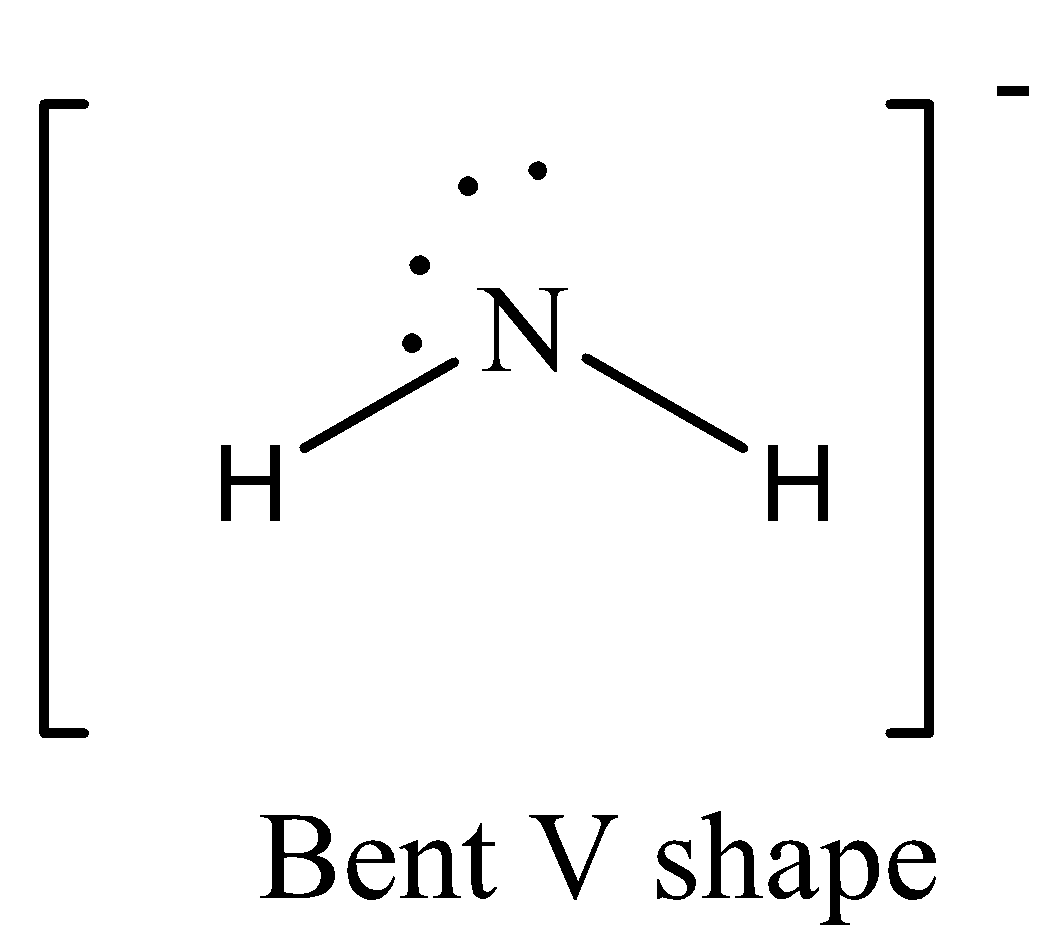
In case of \[NH_2^ - \],
The valence electron of central atom$ = 5$
No. of monovalent atom linked to central atom$ = 2$
Charge of anion$ = 1$
Substitute the values in formula we get,
$H = \dfrac{1}{2}\left( {5 + 2 + 1} \right)$
$ \Rightarrow H = \dfrac{1}{2} \times 8$
On simplifying we get,
$H = 4$
$\therefore $The hybridization of $NH_2^ - $ is $s{p^3}$ and its bent V shape with 10 electrons. We can draw the structure as below,
In case of \[B{H_3}\],
The valence electron of central atom$ = 3$
No. of monovalent atom linked to central atom$ = 3$
There is no charge on this molecule. Substitute the values in formula we get,
$H = \dfrac{1}{2}\left( {3 + 3} \right)$
$ \Rightarrow H = \dfrac{1}{2} \times 6$
On simplifying we get,
$ \Rightarrow H = 3$
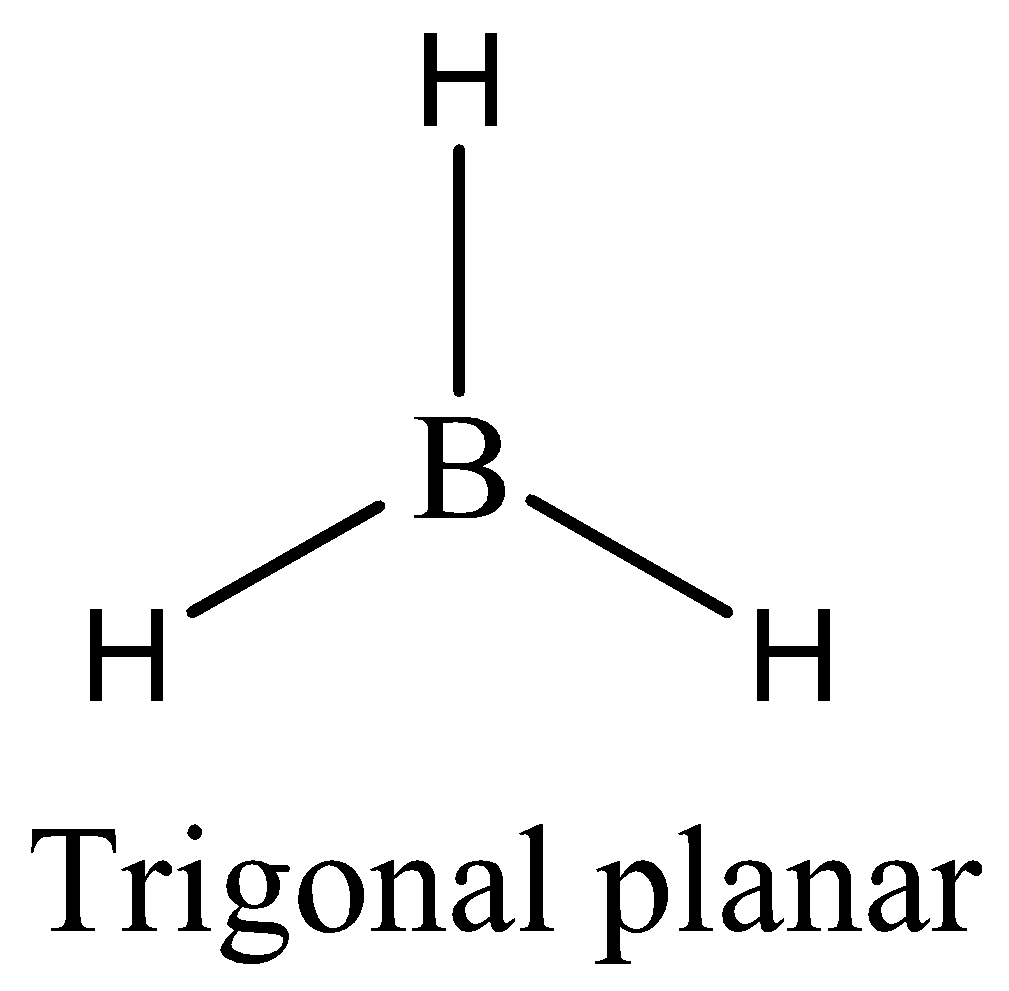
$\therefore $The hybridisation of $B{H_3}$is $s{p^2}$and it has a trigonal planar shape with eight electrons. We can draw the structure as below,
In case of \[C{H_4}\],
The valence electron of central atom$ = 4$
No. of monovalent atom linked to central atom$ = 4$
There is no charge on this molecule. Substitute the values in formula we get,
$H = \dfrac{1}{2}\left( {4 + 4} \right)$
$ \Rightarrow H = \dfrac{1}{2} \times 8$
On simplifying we get,
$ \Rightarrow H = 4$
$\therefore $ The hybridization of $C{H_4}$ is $s{p^3}$ and its tetrahedral shape with 10 electrons. We can draw the structure as below,

In case of \[{H_2}O\],
The valence electron of central atom$ = 6$
No. of monovalent atom linked to central atom$ = 2$
There is no charge on this molecule. Substitute the values in formula we get,
\[H = \dfrac{1}{2}\left( {6 + 2} \right)\]
$ \Rightarrow H = \dfrac{1}{2} \times 8$
On simplifying we get,
$ \Rightarrow H = 4$
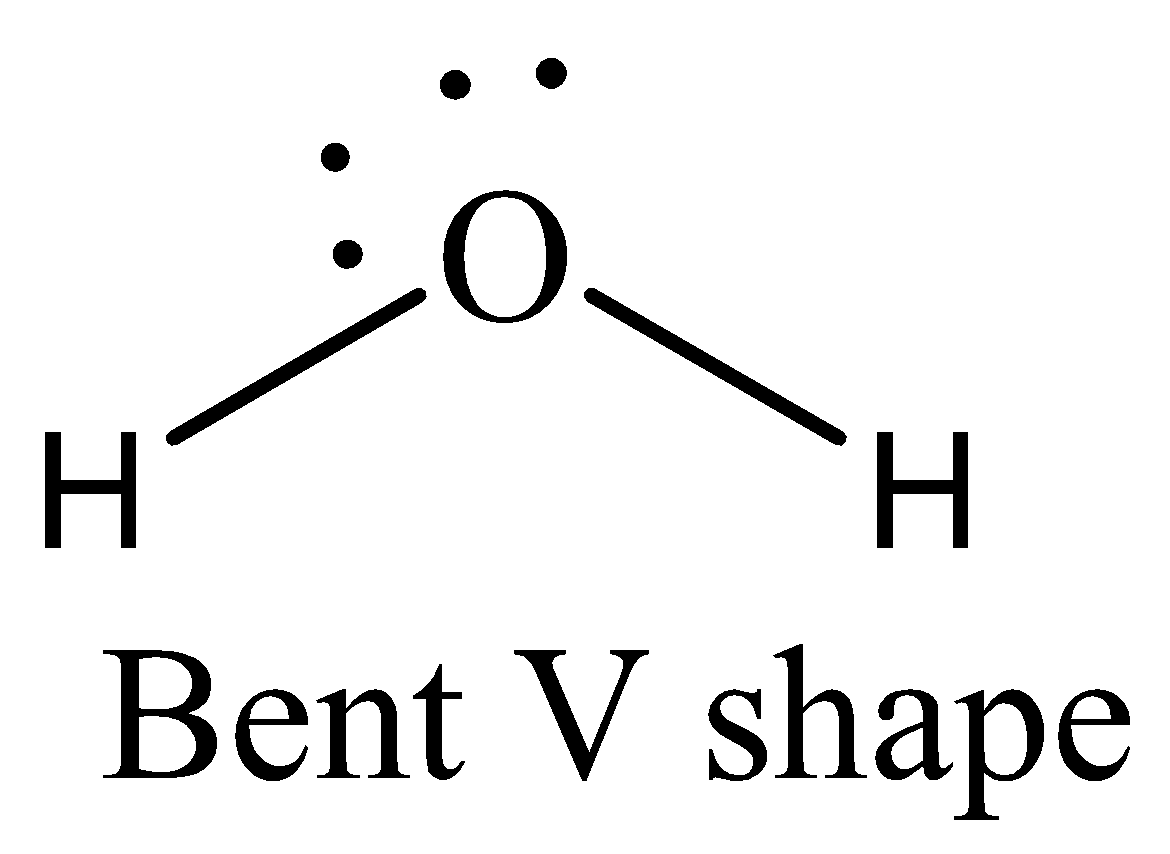
The hybridization of ${H_2}O$ is $s{p^3}$ and its bent V shape with 10 electrons. We can draw the structure as below,
In case of \[{H_3}{O^ + }\],
the valence electron of central atom$ = 6$
No. of monovalent atom linked to central atom$ = 3$
Charge of cation$ = 1$
Substitute the values in formula we get,
$H = \dfrac{1}{2}\left( {6 + 3 - 1} \right)$
$ \Rightarrow H = \dfrac{1}{2} \times 8$
On simplifying we get,
$ \Rightarrow H = 4$
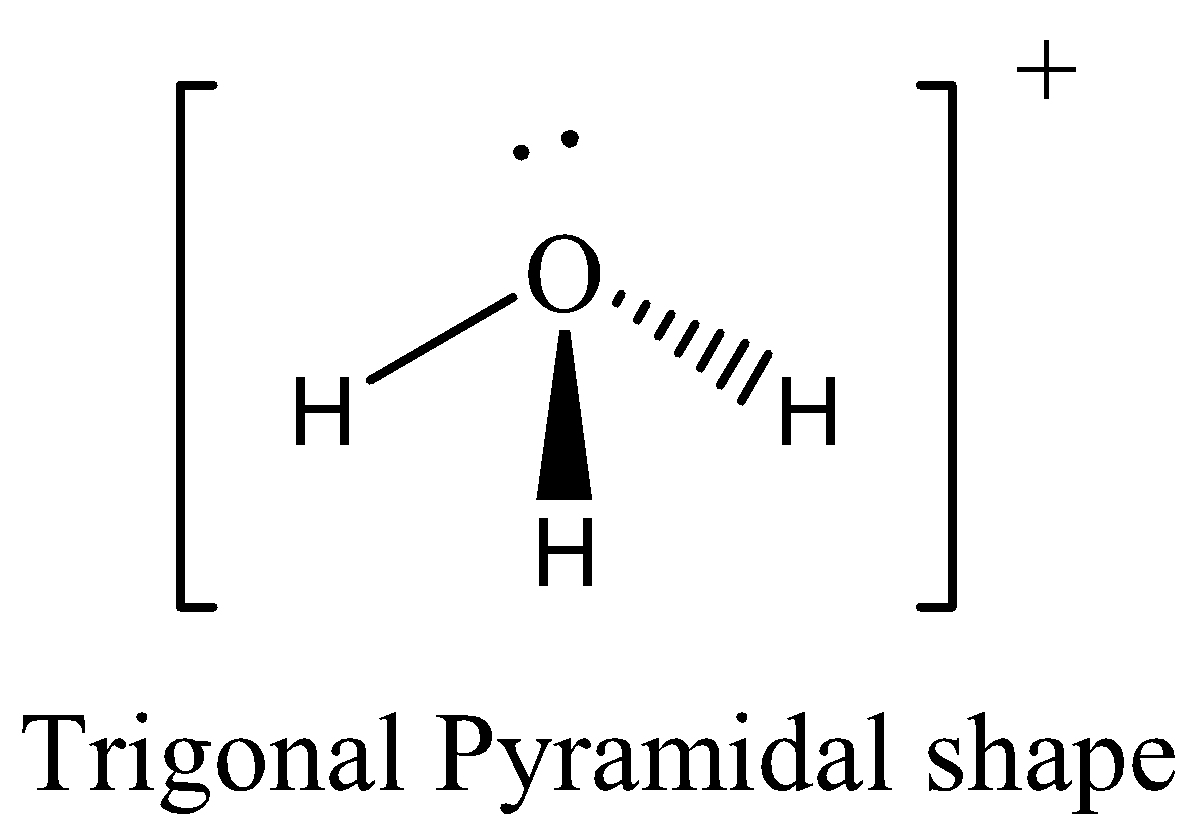
The hybridization of ${H_3}{O^ + }$ is $s{p^3}$ and its trigonal pyramidal shape with 10 electrons. We can draw the structure as below,
We can see that $NH_2^ - $ is isoelectronic with $C{H_4}$,${H_2}O$,${H_3}{O^ + }$. Among them we can see $NH_2^ - $ is isostructural with ${H_2}O$.
Therefore, the option (C) is correct.
Note: We can calculate the hybridization of a molecule using the bond pair and lone pair present in it. Also we must know Isostructural species contains equal numbers of valence electrons.
Formula used:
We can predict the number of orbitals involved in hybridisation by using formula which is given below as,
$H = \dfrac{1}{2}\left[ {V + M - C + A} \right]$
Where,
H-Number of orbitals involved in hybridisation
V-Valence electron of central atom
M-Number of monovalent atoms linked to central atom
C-Charge of cation
A-Charge of anion
Complete answer:
Let us remember that if two species have the identical number of electrons, they are known to be isoelectronic with each other.
Now let us calculate the number of electrons for those species given in question.
We shall also discuss the isostructural species. These species have identical shape and hybridization.
In case of \[NH_2^ - \],
The valence electron of central atom$ = 5$
No. of monovalent atom linked to central atom$ = 2$
Charge of anion$ = 1$
Substitute the values in formula we get,
$H = \dfrac{1}{2}\left( {5 + 2 + 1} \right)$
$ \Rightarrow H = \dfrac{1}{2} \times 8$
On simplifying we get,
$H = 4$
$\therefore $The hybridization of $NH_2^ - $ is $s{p^3}$ and its bent V shape with 10 electrons. We can draw the structure as below,
In case of \[B{H_3}\],
The valence electron of central atom$ = 3$
No. of monovalent atom linked to central atom$ = 3$
There is no charge on this molecule. Substitute the values in formula we get,
$H = \dfrac{1}{2}\left( {3 + 3} \right)$
$ \Rightarrow H = \dfrac{1}{2} \times 6$
On simplifying we get,
$ \Rightarrow H = 3$
$\therefore $The hybridisation of $B{H_3}$is $s{p^2}$and it has a trigonal planar shape with eight electrons. We can draw the structure as below,
In case of \[C{H_4}\],
The valence electron of central atom$ = 4$
No. of monovalent atom linked to central atom$ = 4$
There is no charge on this molecule. Substitute the values in formula we get,
$H = \dfrac{1}{2}\left( {4 + 4} \right)$
$ \Rightarrow H = \dfrac{1}{2} \times 8$
On simplifying we get,
$ \Rightarrow H = 4$
$\therefore $ The hybridization of $C{H_4}$ is $s{p^3}$ and its tetrahedral shape with 10 electrons. We can draw the structure as below,
In case of \[{H_2}O\],
The valence electron of central atom$ = 6$
No. of monovalent atom linked to central atom$ = 2$
There is no charge on this molecule. Substitute the values in formula we get,
\[H = \dfrac{1}{2}\left( {6 + 2} \right)\]
$ \Rightarrow H = \dfrac{1}{2} \times 8$
On simplifying we get,
$ \Rightarrow H = 4$
The hybridization of ${H_2}O$ is $s{p^3}$ and its bent V shape with 10 electrons. We can draw the structure as below,
In case of \[{H_3}{O^ + }\],
the valence electron of central atom$ = 6$
No. of monovalent atom linked to central atom$ = 3$
Charge of cation$ = 1$
Substitute the values in formula we get,
$H = \dfrac{1}{2}\left( {6 + 3 - 1} \right)$
$ \Rightarrow H = \dfrac{1}{2} \times 8$
On simplifying we get,
$ \Rightarrow H = 4$
The hybridization of ${H_3}{O^ + }$ is $s{p^3}$ and its trigonal pyramidal shape with 10 electrons. We can draw the structure as below,
We can see that $NH_2^ - $ is isoelectronic with $C{H_4}$,${H_2}O$,${H_3}{O^ + }$. Among them we can see $NH_2^ - $ is isostructural with ${H_2}O$.
Therefore, the option (C) is correct.
Note: We can calculate the hybridization of a molecule using the bond pair and lone pair present in it. Also we must know Isostructural species contains equal numbers of valence electrons.
Recently Updated Pages
Master Class 11 Computer Science: Engaging Questions & Answers for Success

Master Class 11 Business Studies: Engaging Questions & Answers for Success
Master Class 11 Economics: Engaging Questions & Answers for Success
Master Class 11 English: Engaging Questions & Answers for Success
Master Class 11 Maths: Engaging Questions & Answers for Success
Master Class 11 Biology: Engaging Questions & Answers for Success
Trending doubts
One Metric ton is equal to kg A 10000 B 1000 C 100 class 11 physics CBSE
There are 720 permutations of the digits 1 2 3 4 5 class 11 maths CBSE
Discuss the various forms of bacteria class 11 biology CBSE
Draw a diagram of a plant cell and label at least eight class 11 biology CBSE
State the laws of reflection of light
Explain zero factorial class 11 maths CBSE