




New banana plants develop from
(a) Rhizome
(b) Sucker
(c) Stolons
(d) Both (a) and (b)
Answer
 Verified
637.5k+ views
Hint: This is the sub-aerial modification of the stem which originates from the basal and underground portion of the main stem.
Complete answer: A banana is an elongated, edible fruit. New banana plants develop from sucker and rhizome both.
The underground stem of a banana plant is called a rhizome from where also a new plant develops. The apical meristem is the terminal growing point of the rhizome. Sucker is a lateral shoot that develops from the rhizome and develops into a new banana plant.
Additional information:
1. A rhizome is a flattened dome-like structure.
2. The leaves and the inflorescence are formed from this apical meristem.
3. The banana has a reduced underground stem found in a banana area, called the rhizome, which bears several buds. Each of these buds sprouts and forms its pseudostem and a new bulbous rhizome develops. These daughter plants are called suckers. Banana is mostly propagated by rhizomes and suckers.
4. The life cycle of the banana plant bears two phases:
The vegetative phase- the phase in which the plant prepares itself for reproduction.
The reproductive phase-the phase in which the plant begins to produce fruit.
So the correct answer is both’ sucker and rhizome’
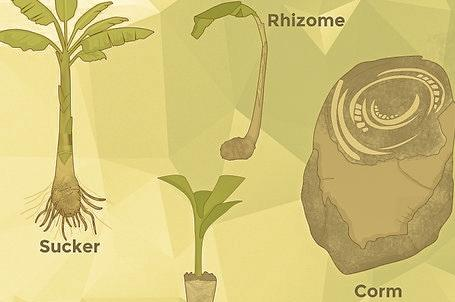
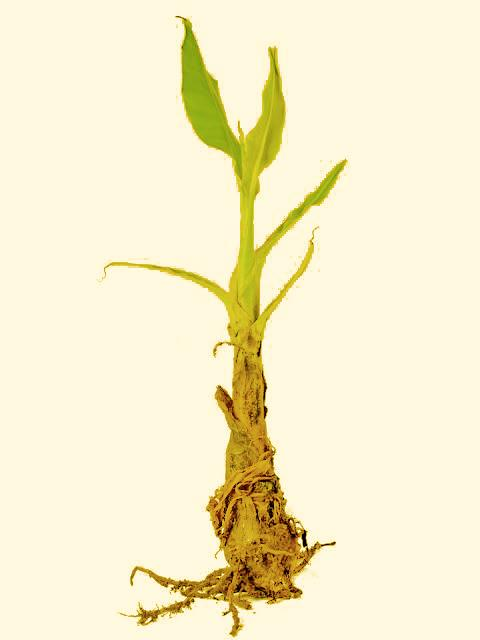
(rhizome of the banana plant)
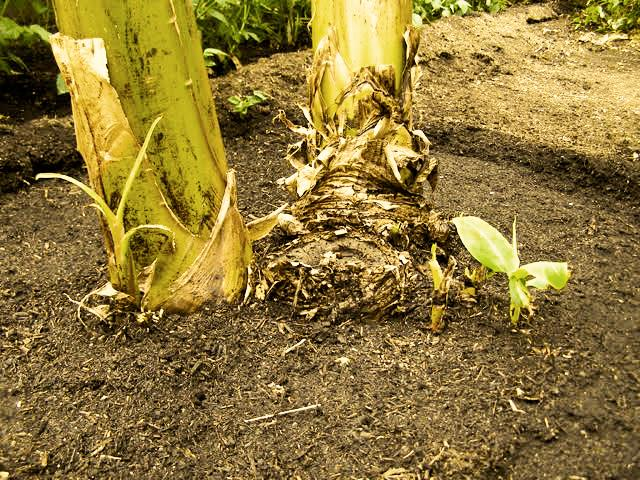
(sucker of the banana plant )
Notes:
1. Sucker is the sub-aerial modification of the stem which originates from the basal and underground portion of the main stem.
2. It grows obliquely upwards giving rise to leafy shoot or a new plant.
3. It is a lateral shoot that develops from the rhizome and emerges from the soil usually near the parent plant It also occurs in mint, Chrysanthemum, etc
Complete answer: A banana is an elongated, edible fruit. New banana plants develop from sucker and rhizome both.
The underground stem of a banana plant is called a rhizome from where also a new plant develops. The apical meristem is the terminal growing point of the rhizome. Sucker is a lateral shoot that develops from the rhizome and develops into a new banana plant.
Additional information:
1. A rhizome is a flattened dome-like structure.
2. The leaves and the inflorescence are formed from this apical meristem.
3. The banana has a reduced underground stem found in a banana area, called the rhizome, which bears several buds. Each of these buds sprouts and forms its pseudostem and a new bulbous rhizome develops. These daughter plants are called suckers. Banana is mostly propagated by rhizomes and suckers.
4. The life cycle of the banana plant bears two phases:
The vegetative phase- the phase in which the plant prepares itself for reproduction.
The reproductive phase-the phase in which the plant begins to produce fruit.
So the correct answer is both’ sucker and rhizome’
(rhizome of the banana plant)
(sucker of the banana plant )
Notes:
1. Sucker is the sub-aerial modification of the stem which originates from the basal and underground portion of the main stem.
2. It grows obliquely upwards giving rise to leafy shoot or a new plant.
3. It is a lateral shoot that develops from the rhizome and emerges from the soil usually near the parent plant It also occurs in mint, Chrysanthemum, etc
Recently Updated Pages
Master Class 11 English: Engaging Questions & Answers for Success

Master Class 11 Social Science: Engaging Questions & Answers for Success
Master Class 11 Maths: Engaging Questions & Answers for Success
Master Class 11 Biology: Engaging Questions & Answers for Success
Master Class 11 Physics: Engaging Questions & Answers for Success
Master Class 11 Chemistry: Engaging Questions & Answers for Success
Trending doubts
One Metric ton is equal to kg A 10000 B 1000 C 100 class 11 physics CBSE
Difference Between Prokaryotic Cells and Eukaryotic Cells
Find the value of the expression given below sin 30circ class 11 maths CBSE
Difference between physical and chemical change class 11 chemistry CBSE
Two of the body parts which do not appear in MRI are class 11 biology CBSE
Draw a diagram of a plant cell and label at least eight class 11 biology CBSE