




What is necessary for photosynthesis?
(a) Chlorophyll
(b) Sunlight
(c) Carbon dioxide and water
(d) All of the above
Answer
 Verified
603.6k+ views
Hint: They are required for providing the source of minerals, carbon, UV radiation so as to produce starch (food in plants). They are essential for the process and are the processor for the production of food.
Complete answer:
Photosynthesis is the mechanism of food processing in the presence of sunlight. It has two steps: In the first stage, the chlorophyll traps light energy and transforms it into chemical energy and calls it the light reaction. Such chemical energy is used in the second stage to prepare food from water and carbon dioxide and is known as a dark reaction.
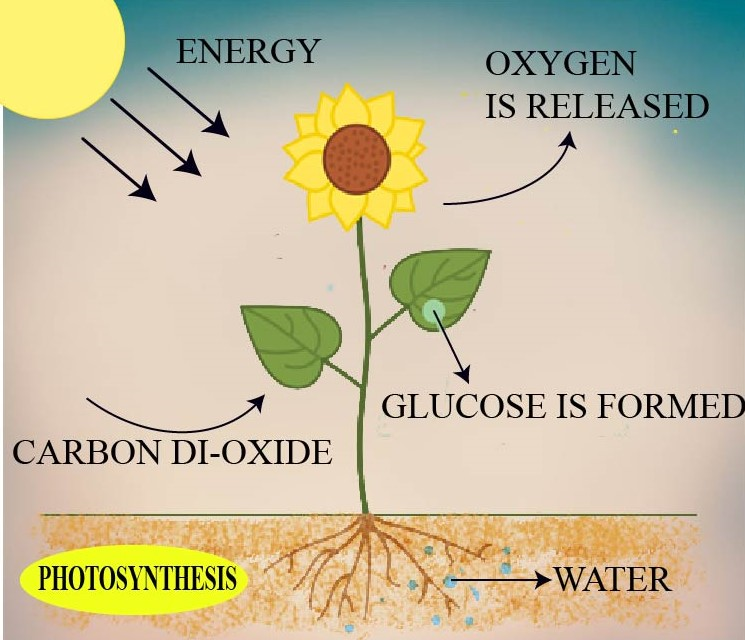
Photosynthesis is a mechanism used to transform light energy into chemical energy by plants and other species that can later be released to fuel the activities of the species. In carbohydrate molecules, such as sugars, which are synthesized from carbon dioxide and water, this chemical energy is stored. Oxygen is often published as a waste product in most circumstances. Photosynthesis is done by most plants, most algae, and cyanobacteria; photoautotrophs are called such species. Photosynthesis is primarily responsible for the creation and maintenance of the Earth's atmospheric oxygen content and provides much of the energy required for life on Earth.
Additional information:
Water, the primary component of the Earth's hydrosphere and the fluids of all known living organisms, is an inorganic, clear, tasteless, odorless, and virtually colorless chemical material.
Sunlight, especially infrared, visible, and ultraviolet light, is a portion of the electromagnetic radiation produced by the Sun. Sunlight on Earth is scattered and filtered through the atmosphere of Earth and is apparent as daylight when the Sun is above the horizon.
Carbon dioxide is a chemical compound made up of one carbon and two atoms of oxygen. By its formula ${ CO }_{ 2 }$, it is sometimes referred to. At a low concentration, it is found in the Earth's atmosphere and functions as a greenhouse gas. It is called dry ice in its solid-state. It is a significant component of the cycle of carbon.
The green photosynthetic pigment present in plants, algae, and cyanobacteria is chlorophyll. Chlorophyll absorbs much of the electromagnetic spectrum in the blue and to a lesser degree in the red portions, hence its vivid green hue.
So, the correct answer is ‘All of the above’.
Note: Photosynthesis is the mechanism through which substances such as carbohydrates are made through plants and certain microorganisms. It is an endothermic (heat taking) chemical process that transforms carbon dioxide into sugars using sunlight. Sugars are used as energy by the cell and to make other kinds of molecules.
Complete answer:
Photosynthesis is the mechanism of food processing in the presence of sunlight. It has two steps: In the first stage, the chlorophyll traps light energy and transforms it into chemical energy and calls it the light reaction. Such chemical energy is used in the second stage to prepare food from water and carbon dioxide and is known as a dark reaction.
Photosynthesis is a mechanism used to transform light energy into chemical energy by plants and other species that can later be released to fuel the activities of the species. In carbohydrate molecules, such as sugars, which are synthesized from carbon dioxide and water, this chemical energy is stored. Oxygen is often published as a waste product in most circumstances. Photosynthesis is done by most plants, most algae, and cyanobacteria; photoautotrophs are called such species. Photosynthesis is primarily responsible for the creation and maintenance of the Earth's atmospheric oxygen content and provides much of the energy required for life on Earth.
Additional information:
Water, the primary component of the Earth's hydrosphere and the fluids of all known living organisms, is an inorganic, clear, tasteless, odorless, and virtually colorless chemical material.
Sunlight, especially infrared, visible, and ultraviolet light, is a portion of the electromagnetic radiation produced by the Sun. Sunlight on Earth is scattered and filtered through the atmosphere of Earth and is apparent as daylight when the Sun is above the horizon.
Carbon dioxide is a chemical compound made up of one carbon and two atoms of oxygen. By its formula ${ CO }_{ 2 }$, it is sometimes referred to. At a low concentration, it is found in the Earth's atmosphere and functions as a greenhouse gas. It is called dry ice in its solid-state. It is a significant component of the cycle of carbon.
The green photosynthetic pigment present in plants, algae, and cyanobacteria is chlorophyll. Chlorophyll absorbs much of the electromagnetic spectrum in the blue and to a lesser degree in the red portions, hence its vivid green hue.
So, the correct answer is ‘All of the above’.
Note: Photosynthesis is the mechanism through which substances such as carbohydrates are made through plants and certain microorganisms. It is an endothermic (heat taking) chemical process that transforms carbon dioxide into sugars using sunlight. Sugars are used as energy by the cell and to make other kinds of molecules.
Recently Updated Pages
Master Class 11 English: Engaging Questions & Answers for Success

Master Class 11 Social Science: Engaging Questions & Answers for Success
Master Class 11 Maths: Engaging Questions & Answers for Success
Master Class 11 Chemistry: Engaging Questions & Answers for Success
Master Class 11 Biology: Engaging Questions & Answers for Success
Master Class 11 Physics: Engaging Questions & Answers for Success
Trending doubts
Find the value of the expression given below sin 30circ class 11 maths CBSE
1 ton equals to A 100 kg B 1000 kg C 10 kg D 10000 class 11 physics CBSE
1 Quintal is equal to a 110 kg b 10 kg c 100kg d 1000 class 11 physics CBSE
Difference between physical and chemical change class 11 chemistry CBSE
What organs are located on the left side of your body class 11 biology CBSE
Which of the following is the hottest month AMay BJune class 11 social science CBSE