




What is the nature of the graph $y=2{{x}^{2}}$ .
A. Parabola passing through the origin
B. Hyperbola passing through the origin
C. Ellipse passing through the origin
D. Hyperbola but not passing through the origin
Answer
 Verified
621k+ views
Hint: To find the nature of the graph $y=2{{x}^{2}}$ , let us first draw the graph for different values of x. From the graph we can clearly observe the nature of $y=2{{x}^{2}}$ . The given function will be a parabola if it is mirror-symmetrical with a single open curve that extends till infinity and is U-shaped. The function will be a hyperbola if it is an open curve with two unconnected branches and has two axes of symmetry. $y=2{{x}^{2}}$ will be an ellipse if it is a planar curve that has two focal points and appears to be somewhat like a circle.
Complete step by step answer:
We need to find the nature of the graph $y=2{{x}^{2}}$ .
Let us first draw this graph. For this, first let us find the coordinates to plot the graph.
The table below shows the values of $y=2{{x}^{2}}$ for different values of x.
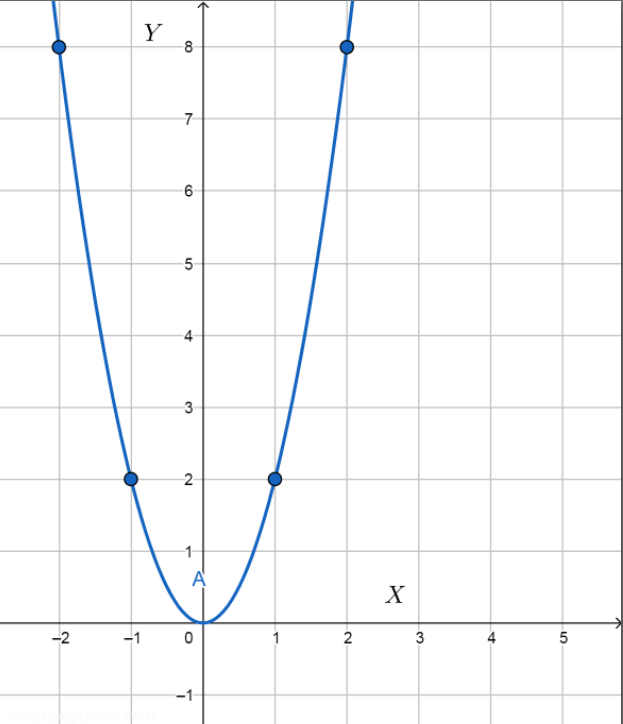
The given options include parabola and hyperbola. Let us see what parabola, hyperbola and ellipse are.
A parabola is a plane curve which is mirror-symmetrical with a single open curve that extends till infinity and is U-shaped. A hyperbola is an open curve with two unconnected branches and has two axes of symmetry. An ellipse is a planar curve that has two focal points and appears to be somewhat like a circle.
From the graph, we can infer that the shape is a U-shape and it extends to infinity. It does not have two axes of symmetry or like a circle. Hence, the given function is a parabola.
Now, let us see whether it passes through the origin. We know that at the origin x and y coordinates are 0. That is, the point $\left( 0,0 \right)$ . From the table, we can see that there exists a point in $y=2{{x}^{2}}$ .
Hence, $y=2{{x}^{2}}$ is a parabola passing through the origin.
So, the correct answer is “Option A”.
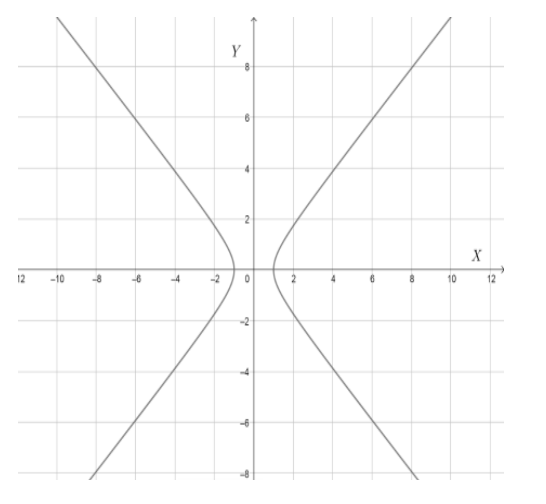
Note: Do not get confused with parabola and hyperbola. A hyperbola will have the equation of the form $\dfrac{{{x}^{2}}}{{{a}^{2}}}-\dfrac{{{y}^{2}}}{{{b}^{2}}}=1$ . The graph of this will be like:
We can also solve this problem in an alternate way. If any equation is of the form shown below, then that function will be a parabola.
$y=a{{x}^{2}}+bx+c,\text{ }a\ne 0...(i)$
The given equation is $y=2{{x}^{2}}$
When we compare it with equation (i),
$a=2,b=0,c=0$
Hence, the given equation is of the form (i) and is a parabola.
Now to check whether it passes through origin, we can check the value of y for $x=0$ . That is
\[y=2\times 0=0\]
Hence, there exists a point $\left( 0,0 \right)$ for $y=2{{x}^{2}}$ . This means that $y=2{{x}^{2}}$ passes through the origin.
In other words, we can say that when either x or y is squared but not both, the given equation will be an equation of parabola.
When x and y are both squared and the coefficients are positive but different, then the given equation is the equation of ellipse.
When x and y are both squared, and exactly one of the coefficients is negative and exactly one of the coefficients is positive, then it resembles a hyperbola.
Complete step by step answer:
We need to find the nature of the graph $y=2{{x}^{2}}$ .
Let us first draw this graph. For this, first let us find the coordinates to plot the graph.
The table below shows the values of $y=2{{x}^{2}}$ for different values of x.
| x | $y=2{{x}^{2}}$ |
| -2 | 8 |
| -1 | 2 |
| 0 | 0 |
| 1 | 2 |
| 2 | 8 |
The given options include parabola and hyperbola. Let us see what parabola, hyperbola and ellipse are.
A parabola is a plane curve which is mirror-symmetrical with a single open curve that extends till infinity and is U-shaped. A hyperbola is an open curve with two unconnected branches and has two axes of symmetry. An ellipse is a planar curve that has two focal points and appears to be somewhat like a circle.
From the graph, we can infer that the shape is a U-shape and it extends to infinity. It does not have two axes of symmetry or like a circle. Hence, the given function is a parabola.
Now, let us see whether it passes through the origin. We know that at the origin x and y coordinates are 0. That is, the point $\left( 0,0 \right)$ . From the table, we can see that there exists a point in $y=2{{x}^{2}}$ .
Hence, $y=2{{x}^{2}}$ is a parabola passing through the origin.
So, the correct answer is “Option A”.
Note: Do not get confused with parabola and hyperbola. A hyperbola will have the equation of the form $\dfrac{{{x}^{2}}}{{{a}^{2}}}-\dfrac{{{y}^{2}}}{{{b}^{2}}}=1$ . The graph of this will be like:
We can also solve this problem in an alternate way. If any equation is of the form shown below, then that function will be a parabola.
$y=a{{x}^{2}}+bx+c,\text{ }a\ne 0...(i)$
The given equation is $y=2{{x}^{2}}$
When we compare it with equation (i),
$a=2,b=0,c=0$
Hence, the given equation is of the form (i) and is a parabola.
Now to check whether it passes through origin, we can check the value of y for $x=0$ . That is
\[y=2\times 0=0\]
Hence, there exists a point $\left( 0,0 \right)$ for $y=2{{x}^{2}}$ . This means that $y=2{{x}^{2}}$ passes through the origin.
In other words, we can say that when either x or y is squared but not both, the given equation will be an equation of parabola.
When x and y are both squared and the coefficients are positive but different, then the given equation is the equation of ellipse.
When x and y are both squared, and exactly one of the coefficients is negative and exactly one of the coefficients is positive, then it resembles a hyperbola.
Recently Updated Pages
Master Class 11 English: Engaging Questions & Answers for Success

Master Class 11 Social Science: Engaging Questions & Answers for Success
Master Class 11 Maths: Engaging Questions & Answers for Success
Master Class 11 Biology: Engaging Questions & Answers for Success
Master Class 11 Physics: Engaging Questions & Answers for Success
Master Class 11 Chemistry: Engaging Questions & Answers for Success
Trending doubts
One Metric ton is equal to kg A 10000 B 1000 C 100 class 11 physics CBSE
Difference Between Prokaryotic Cells and Eukaryotic Cells
Difference between physical and chemical change class 11 chemistry CBSE
Find the value of the expression given below sin 30circ class 11 maths CBSE
Two of the body parts which do not appear in MRI are class 11 biology CBSE
Draw a diagram of a plant cell and label at least eight class 11 biology CBSE