




What is the nature of the graph: $y = - 4{x^2} + 6$
A. Parabola not passing through origin
B. Hyperbola not passing through origin
C. Ellipse not passing through origin
D. It is not a conic.
Answer
 Verified
511.5k+ views
Hint: To find the nature of the graph $y = - 4{x^2} + 6$, let us first draw the graph for different values of $x$. From the graph we can clearly observe the nature of $y = - 4{x^2} + 6$. The given function will be a parabola if it is mirror-symmetrical with a single open curve that extends till infinity and is U-shaped. The function will be a hyperbola if it is an open curve with two unconnected branches and has two axes of symmetry. $y = - 4{x^2} + 6$ will be an ellipse if it is a planar curve that has two focal points and appears to be somewhat like a circle.
Complete step by step answer:
We need to find the nature of the graph $y = - 4{x^2} + 6$. Let us first draw this graph. For this, first let us find the coordinates to plot the graph. The table below shows the values of $y = - 4{x^2} + 6$ for different values of $x$.
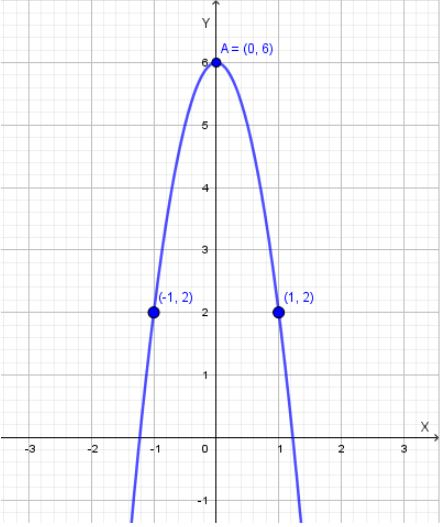
From the graph, we can infer that the shape is a U-shape and it extends to infinity. It does not have two axes of symmetry or like a circle. Hence, the given function is a parabola. Now, let us see whether it passes through the origin or not. We know that at the origin $x$ and $y$ coordinates are $0$. That is, the point $\left( {0,0} \right)$. From the graph, we can see that the parabola passes through the point $\left( {0,6} \right)$ not through the origin.Hence, $y = - 4{x^2} + 6$ is a parabola not passing through the origin.
Therefore, the correct option is A.
Note: Do not get confused with parabola and hyperbola. A hyperbola will have the equation of the form $\dfrac{{{x^2}}}{{{a^2}}} - \dfrac{{{y^2}}}{{{b^2}}} = 1$. The graph of this will be like:
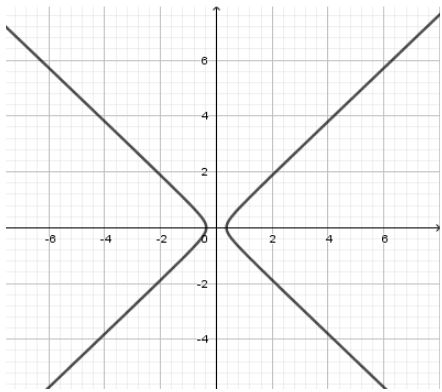
Also, remember that when either $x$ or $y$ is squared but not both, the given equation will be an equation of parabola. When $x$ and $y$ are both squared and the coefficients are positive but different, then the given equation is the equation of ellipse. When $x$ and $y$ are both squared, and exactly one of the coefficients is negative and exactly one of the coefficients is positive, then it resembles a hyperbola.
Complete step by step answer:
We need to find the nature of the graph $y = - 4{x^2} + 6$. Let us first draw this graph. For this, first let us find the coordinates to plot the graph. The table below shows the values of $y = - 4{x^2} + 6$ for different values of $x$.
| $x$ | $y = - 4{x^2} + 6$ |
| $ - 1$ | $2$ |
| $0$ | $6$ |
| $1$ | $2$ |
From the graph, we can infer that the shape is a U-shape and it extends to infinity. It does not have two axes of symmetry or like a circle. Hence, the given function is a parabola. Now, let us see whether it passes through the origin or not. We know that at the origin $x$ and $y$ coordinates are $0$. That is, the point $\left( {0,0} \right)$. From the graph, we can see that the parabola passes through the point $\left( {0,6} \right)$ not through the origin.Hence, $y = - 4{x^2} + 6$ is a parabola not passing through the origin.
Therefore, the correct option is A.
Note: Do not get confused with parabola and hyperbola. A hyperbola will have the equation of the form $\dfrac{{{x^2}}}{{{a^2}}} - \dfrac{{{y^2}}}{{{b^2}}} = 1$. The graph of this will be like:
Also, remember that when either $x$ or $y$ is squared but not both, the given equation will be an equation of parabola. When $x$ and $y$ are both squared and the coefficients are positive but different, then the given equation is the equation of ellipse. When $x$ and $y$ are both squared, and exactly one of the coefficients is negative and exactly one of the coefficients is positive, then it resembles a hyperbola.
Recently Updated Pages
Master Class 12 Economics: Engaging Questions & Answers for Success

Master Class 12 English: Engaging Questions & Answers for Success
Master Class 12 Social Science: Engaging Questions & Answers for Success
Master Class 12 Maths: Engaging Questions & Answers for Success
Master Class 12 Physics: Engaging Questions & Answers for Success
Master Class 9 General Knowledge: Engaging Questions & Answers for Success
Trending doubts
One Metric ton is equal to kg A 10000 B 1000 C 100 class 11 physics CBSE
Difference Between Prokaryotic Cells and Eukaryotic Cells
Two of the body parts which do not appear in MRI are class 11 biology CBSE
1 ton equals to A 100 kg B 1000 kg C 10 kg D 10000 class 11 physics CBSE
10 examples of friction in our daily life
DNA is not present in A Nucleus B Mitochondria C Chloroplast class 11 biology CBSE