




What is the nature of the graph: $y = 4\left( {1 - {e^{ - 2x}}} \right)$
A. Exponentially increasing graph
B. Exponentially decreasing graph
C. Decreasing graph
D. None of these
Answer
 Verified
543.3k+ views
Hint: Here we have to find whether the given graph is exponentially increasing or decreasing or is it a decreasing graph. So we will use the help of derivatives. Firstly we will find the derivative of the function given with respect to $x$ and then we will check whether the value of derivative is increasing or decreasing for all value of $x \in R$
Complete step-by-step solution:
The exponential function is given as below:
$y = 4\left( {1 - {e^{ - 2x}}} \right)$
The graph of the function can be drawn as follows:
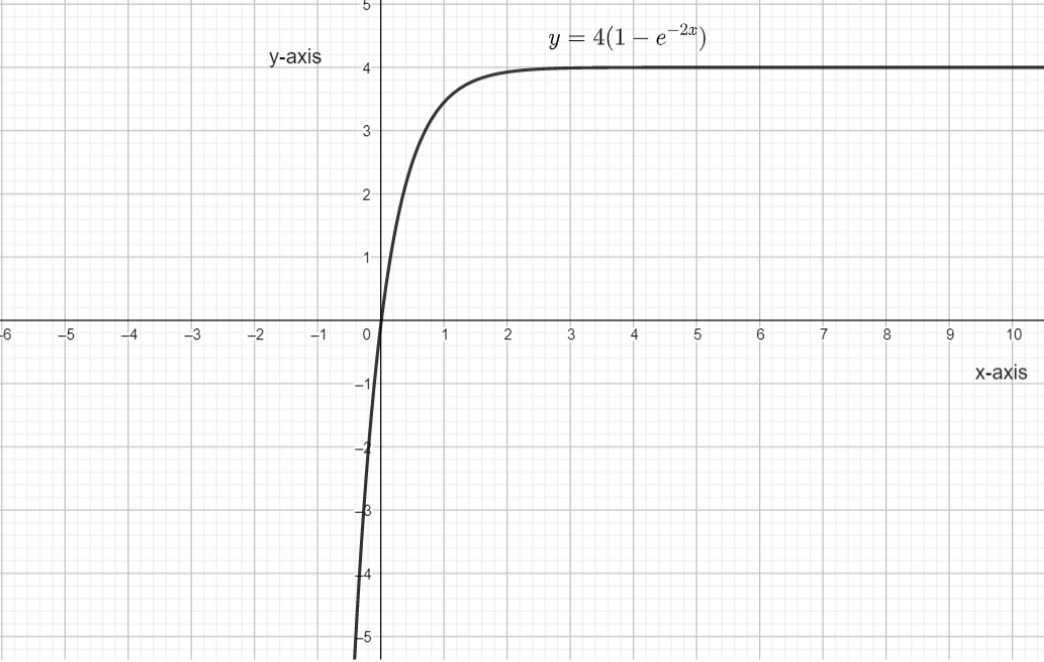
So for finding whether the graph is increasing or decreasing we will firstly find the derivative of the function with respect to $x$ as follows:
\[\dfrac{{dy}}{{dx}} = 4\left( {\dfrac{{d\left( 1 \right)}}{{dx}} - \dfrac{{d\left( {{e^{ - 2x}}} \right)}}{{dx}}} \right)\]
We know that differentiation of a constant term is $0$ and differentiation of an exponential term is calculated as follows:
$\dfrac{{d\left( {{e^{ax}}} \right)}}{{dx}} = a{e^{ax}}$
Where $a \in R$
So we get,
$\dfrac{{dy}}{{dx}} = 4\left( {0 - \left( { - 2} \right){e^{ - 2x}}} \right)$
$ \Rightarrow \dfrac{{dy}}{{dx}} = 8{e^{ - 2x}}$
So as we can see that for any $x \in R$
$\dfrac{{dy}}{{dx}} = 8{e^{ - 2x}} > 0$
So the function is exponentially increasing.
Hence option (A) is correct.
Note: The general form exponential function is $f\left( x \right) = {b^x}$ where $x$ is the exponent and $b$ is any positive number greater than $1$ or we can say that exponential functions are those functions which are in the form of $f\left( x \right) = {e^x}$ where $e$ is a Euler’s number and its value lies between $2\& 3$ and $x$ is the independent variable. The exponential function $f\left( x \right) = {e^x}$ is also known as a natural exponential function. The exponential function can either describe a growth or decay depending upon the independent variable and the graph of the function. In exponential growth the graph increases very slowly at first and then rapidly. In exponential decay the graph decreases rapidly at first and then slowly.
Complete step-by-step solution:
The exponential function is given as below:
$y = 4\left( {1 - {e^{ - 2x}}} \right)$
The graph of the function can be drawn as follows:
So for finding whether the graph is increasing or decreasing we will firstly find the derivative of the function with respect to $x$ as follows:
\[\dfrac{{dy}}{{dx}} = 4\left( {\dfrac{{d\left( 1 \right)}}{{dx}} - \dfrac{{d\left( {{e^{ - 2x}}} \right)}}{{dx}}} \right)\]
We know that differentiation of a constant term is $0$ and differentiation of an exponential term is calculated as follows:
$\dfrac{{d\left( {{e^{ax}}} \right)}}{{dx}} = a{e^{ax}}$
Where $a \in R$
So we get,
$\dfrac{{dy}}{{dx}} = 4\left( {0 - \left( { - 2} \right){e^{ - 2x}}} \right)$
$ \Rightarrow \dfrac{{dy}}{{dx}} = 8{e^{ - 2x}}$
So as we can see that for any $x \in R$
$\dfrac{{dy}}{{dx}} = 8{e^{ - 2x}} > 0$
So the function is exponentially increasing.
Hence option (A) is correct.
Note: The general form exponential function is $f\left( x \right) = {b^x}$ where $x$ is the exponent and $b$ is any positive number greater than $1$ or we can say that exponential functions are those functions which are in the form of $f\left( x \right) = {e^x}$ where $e$ is a Euler’s number and its value lies between $2\& 3$ and $x$ is the independent variable. The exponential function $f\left( x \right) = {e^x}$ is also known as a natural exponential function. The exponential function can either describe a growth or decay depending upon the independent variable and the graph of the function. In exponential growth the graph increases very slowly at first and then rapidly. In exponential decay the graph decreases rapidly at first and then slowly.
Recently Updated Pages
Master Class 12 Business Studies: Engaging Questions & Answers for Success

Master Class 12 Chemistry: Engaging Questions & Answers for Success
Master Class 12 Biology: Engaging Questions & Answers for Success
Class 12 Question and Answer - Your Ultimate Solutions Guide
Master Class 11 English: Engaging Questions & Answers for Success
Master Class 11 Social Science: Engaging Questions & Answers for Success
Trending doubts
Which are the Top 10 Largest Countries of the World?
Draw a labelled sketch of the human eye class 12 physics CBSE
Differentiate between homogeneous and heterogeneous class 12 chemistry CBSE
Differentiate between Pyramid of energy and pyramid class 12 biology CBSE
Why is the cell called the structural and functional class 12 biology CBSE
Draw the diagram of the pyramid of energy Explain In class 12 biology CBSE