




Name the three important steps involved in the PCR process.
Answer
 Verified
600.6k+ views
Hint: PCR is a process utilized in the lab to make a huge number of duplicates of a specific segment of DNA. It was first evolved during the 1980s. PCR includes a process of warming and cooling called warm cycling which is completed by machine.
Complete step by step answer: PCR is shorthand for a straightforward yet extremely valuable method in sub-atomic science called the polymerase chain reaction. It is a process used to enhance a section of DNA of intrigue or produce parts and loads of duplicates. All in all, PCR empowers you to create a large number of duplicates of a particular DNA arrangement from an at first little example – in some cases even a solitary duplicate. It is a significant process for a scope of hereditary innovations and, actually, has empowered the advancement of a set-up of new advances.
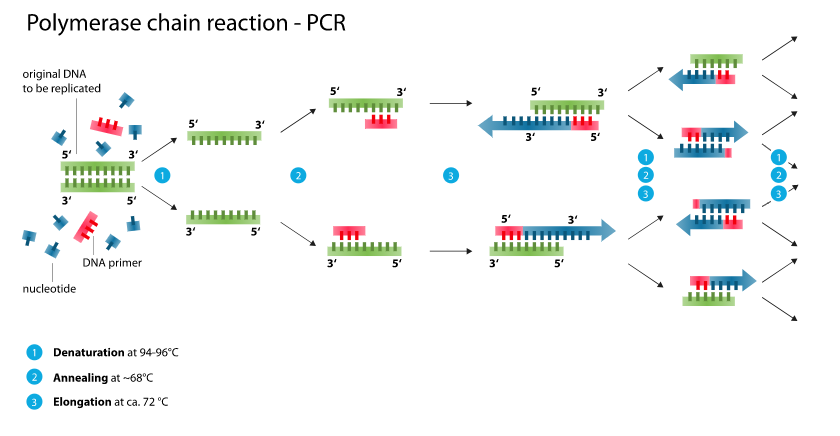
PCR process
Stage 1: Denaturation - As in DNA replication, the two strands in the DNA double helix should be isolated. The division occurs by raising the temperature of the blend, causing the hydrogen connections between the reciprocal DNA strands to break. This process is called denaturation.
Stage 2: Annealing - Preliminaries tie to the objective DNA groupings and start polymerisation. This can just happen once the temperature of the arrangement has been brought down. One preliminary ties to each strand.
Stage 3: Extension - New strands of DNA are made utilizing the first strands as layouts. A DNA polymerase catalyst consolidates free DNA nucleotides. This protein is regularly Taq polymerase, a compound initially disengaged from a thermophilic microbes called Thermus aquaticus. The request in which the free nucleotides are included is controlled by the grouping of nucleotides in the first (layout) DNA strand.
The consequence of one pattern of PCR is two double abandoned successions of target DNA, each containing one recently made strand and one unique strand. The process is rehashed ordinarily (typically 20–30) as most processes utilizing PCR need enormous amounts of DNA. It just takes 2–3 hours to get a billion or so duplicates.
Note: Polymerase chain reaction (PCR) is the process where the enhancement of the quality of intrigue is done with two arrangements of groundworks and a thermostable DNA polymerase protein Taq polymerase. The process includes the accompanying advances:
Denaturation: The double abandoned DNA is warmed up to 98 C which causes the hydrogen securities to break and the two strands get isolated.
Strengthening: The two arrangements of groundworks are added which tie to the proper correlative portion of DNA strand.
Augmentation: The Taq polymerase chemical polymerizes the nucleotide chain utilizing the nucleotides given in the medium and by utilizing the format strand.
Complete step by step answer: PCR is shorthand for a straightforward yet extremely valuable method in sub-atomic science called the polymerase chain reaction. It is a process used to enhance a section of DNA of intrigue or produce parts and loads of duplicates. All in all, PCR empowers you to create a large number of duplicates of a particular DNA arrangement from an at first little example – in some cases even a solitary duplicate. It is a significant process for a scope of hereditary innovations and, actually, has empowered the advancement of a set-up of new advances.
PCR process
Stage 1: Denaturation - As in DNA replication, the two strands in the DNA double helix should be isolated. The division occurs by raising the temperature of the blend, causing the hydrogen connections between the reciprocal DNA strands to break. This process is called denaturation.
Stage 2: Annealing - Preliminaries tie to the objective DNA groupings and start polymerisation. This can just happen once the temperature of the arrangement has been brought down. One preliminary ties to each strand.
Stage 3: Extension - New strands of DNA are made utilizing the first strands as layouts. A DNA polymerase catalyst consolidates free DNA nucleotides. This protein is regularly Taq polymerase, a compound initially disengaged from a thermophilic microbes called Thermus aquaticus. The request in which the free nucleotides are included is controlled by the grouping of nucleotides in the first (layout) DNA strand.
The consequence of one pattern of PCR is two double abandoned successions of target DNA, each containing one recently made strand and one unique strand. The process is rehashed ordinarily (typically 20–30) as most processes utilizing PCR need enormous amounts of DNA. It just takes 2–3 hours to get a billion or so duplicates.
Note: Polymerase chain reaction (PCR) is the process where the enhancement of the quality of intrigue is done with two arrangements of groundworks and a thermostable DNA polymerase protein Taq polymerase. The process includes the accompanying advances:
Denaturation: The double abandoned DNA is warmed up to 98 C which causes the hydrogen securities to break and the two strands get isolated.
Strengthening: The two arrangements of groundworks are added which tie to the proper correlative portion of DNA strand.
Augmentation: The Taq polymerase chemical polymerizes the nucleotide chain utilizing the nucleotides given in the medium and by utilizing the format strand.
Recently Updated Pages
Three beakers labelled as A B and C each containing 25 mL of water were taken A small amount of NaOH anhydrous CuSO4 and NaCl were added to the beakers A B and C respectively It was observed that there was an increase in the temperature of the solutions contained in beakers A and B whereas in case of beaker C the temperature of the solution falls Which one of the following statements isarecorrect i In beakers A and B exothermic process has occurred ii In beakers A and B endothermic process has occurred iii In beaker C exothermic process has occurred iv In beaker C endothermic process has occurred

Master Class 11 Social Science: Engaging Questions & Answers for Success
Master Class 11 Physics: Engaging Questions & Answers for Success
Master Class 11 Maths: Engaging Questions & Answers for Success
Master Class 11 Economics: Engaging Questions & Answers for Success
Master Class 11 Computer Science: Engaging Questions & Answers for Success
Three beakers labelled as A B and C each containing 25 mL of water were taken A small amount of NaOH anhydrous CuSO4 and NaCl were added to the beakers A B and C respectively It was observed that there was an increase in the temperature of the solutions contained in beakers A and B whereas in case of beaker C the temperature of the solution falls Which one of the following statements isarecorrect i In beakers A and B exothermic process has occurred ii In beakers A and B endothermic process has occurred iii In beaker C exothermic process has occurred iv In beaker C endothermic process has occurred
Master Class 11 Social Science: Engaging Questions & Answers for Success
Master Class 11 Physics: Engaging Questions & Answers for Success
Trending doubts
One Metric ton is equal to kg A 10000 B 1000 C 100 class 11 physics CBSE
There are 720 permutations of the digits 1 2 3 4 5 class 11 maths CBSE
State and prove Bernoullis theorem class 11 physics CBSE
Draw a diagram of a plant cell and label at least eight class 11 biology CBSE
Difference Between Prokaryotic Cells and Eukaryotic Cells
Discuss the various forms of bacteria class 11 biology CBSE