




Name the principal mineralocorticoid secreted by the adrenal cortex. What stimulates its secretion? Give it any two functions. What is the disorder caused due to excessive secretion of this hormone?
Answer
 Verified
517.5k+ views
Hint: The name mineralocorticoid comes from early observations that these hormones play a role in the mineral sodium retention. Aldosterone is the principal endogenous mineralocorticoid, however other endogenous hormones (such as progesterone and deoxycorticosterone) also have mineralocorticoid action.
Complete answer:
Aldosterone is the most important mineralocorticoid, acting to conserve sodium ions and water in the body. The middle portion of the adrenal cortex produces glucocorticoids. Mineralocorticoids belong to the corticosteroids family of steroid hormones released by the Adrenal Medulla. Mineralocorticoids are corticosteroids that operate on renal tubules to affect salt and water balances (electrolyte balance and fluid balance.
A decrease in glomerular blood flow, glomerular blood pressure, or GFR can activate JG cells, causing them to produce renin, which transforms angiotensinogen in the blood to angiotensin I, and then to angiotensin II. Angiotensin II stimulates the secretion of aldosterone from the adrenal cortex.
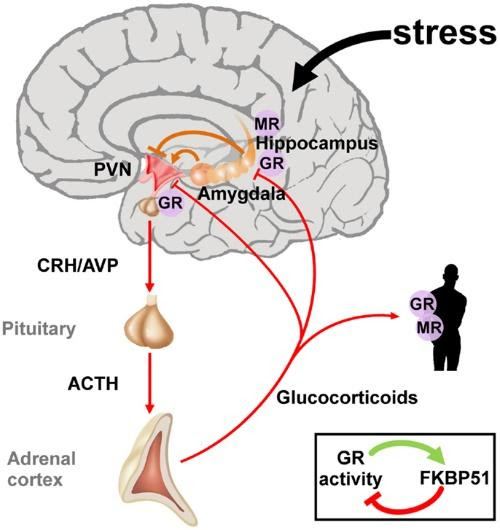
Aldosterone has the following functions:
- Acts primarily on the renal tubules, promoting $Na^+$ and water reabsorption.
$K^+$ and phosphate ions are excreted.
Hyperaldosteronism is a condition marked by excessive aldosterone secretion, which results in increased sodium reabsorption and potassium and hydrogen ion loss. Hypertension (high blood pressure), hypernatremia (high blood salt content), and hypokalemia are all symptoms of apparent mineralocorticoid excess, which is an autosomal recessive condition (decreased blood potassium concentration).
Note:
Although aldosterone and cortisol have a similar affinity for the mineralocorticoid receptor, glucocorticoids circulate at a 100-fold higher concentration than mineralocorticoids. To prevent glucocorticoid overstimulation, an enzyme exists in mineralocorticoid target tissues.
Complete answer:
Aldosterone is the most important mineralocorticoid, acting to conserve sodium ions and water in the body. The middle portion of the adrenal cortex produces glucocorticoids. Mineralocorticoids belong to the corticosteroids family of steroid hormones released by the Adrenal Medulla. Mineralocorticoids are corticosteroids that operate on renal tubules to affect salt and water balances (electrolyte balance and fluid balance.
A decrease in glomerular blood flow, glomerular blood pressure, or GFR can activate JG cells, causing them to produce renin, which transforms angiotensinogen in the blood to angiotensin I, and then to angiotensin II. Angiotensin II stimulates the secretion of aldosterone from the adrenal cortex.
Aldosterone has the following functions:
- Acts primarily on the renal tubules, promoting $Na^+$ and water reabsorption.
$K^+$ and phosphate ions are excreted.
Hyperaldosteronism is a condition marked by excessive aldosterone secretion, which results in increased sodium reabsorption and potassium and hydrogen ion loss. Hypertension (high blood pressure), hypernatremia (high blood salt content), and hypokalemia are all symptoms of apparent mineralocorticoid excess, which is an autosomal recessive condition (decreased blood potassium concentration).
Note:
Although aldosterone and cortisol have a similar affinity for the mineralocorticoid receptor, glucocorticoids circulate at a 100-fold higher concentration than mineralocorticoids. To prevent glucocorticoid overstimulation, an enzyme exists in mineralocorticoid target tissues.
Recently Updated Pages
Master Class 11 English: Engaging Questions & Answers for Success

Master Class 11 Social Science: Engaging Questions & Answers for Success
Master Class 11 Maths: Engaging Questions & Answers for Success
Master Class 11 Biology: Engaging Questions & Answers for Success
Master Class 11 Physics: Engaging Questions & Answers for Success
Master Class 11 Chemistry: Engaging Questions & Answers for Success
Trending doubts
One Metric ton is equal to kg A 10000 B 1000 C 100 class 11 physics CBSE
Difference Between Prokaryotic Cells and Eukaryotic Cells
Two of the body parts which do not appear in MRI are class 11 biology CBSE
Find the value of the expression given below sin 30circ class 11 maths CBSE
Draw a diagram of a plant cell and label at least eight class 11 biology CBSE
10 examples of friction in our daily life