




Name the life cycle of a silk moth in cyclic form.
Answer
 Verified
603k+ views
Hint: Sericulture is the process of breeding silkworms for the production of raw silk. The duration of the life-cycle of a Silkworm ranges from 6-8 weeks. Silk moth shows complete metamorphosis which comprises five stages.
Complete answer:
Silk moth
- Its scientific name is Bombyx mori.
- It is an insect and belongs to the moth family Bombycidae.
- The duration of the life-cycle of a Silkworm ranges from 6-8 weeks.
- The warmer the weather, the faster the Silkworm will complete its life-cycle. The other factors are also important like humidity and exposure to sunlight.
- Life cycle of silk moth is divided into following stages:
> Egg
Copulation between male and female silkworm moths lasts for several hours and during this period moths do not eat or drink. After mating, the female silkworm moth lays tiny eggs on mulberry leaves. After laying eggs, the adult moths die.
> Larva or caterpillar stage
During this stage the silk moth will go through four molts before developing into pupa. The periods between molts are termed as silkworm instars.
> Pupa
After they have molted four times, their bodies become slightly yellow, and the skin becomes tighter to enter the pupa phase of their lifecycle. They enclose themselves in a cocoon made up of raw silk produced by the salivary glands. The final molt from larva to pupa takes place within the cocoon, which provides protection during the vulnerable, motionless pupal state of the silk moth.
> Adult Silkworm
In this final stage when, the pupa changes into an adult moth. The male moth is smaller than the female. The female moth releases pheromones to attract male moths. The male moth has longer antennae to detect pheromones from a distance. When the two find each other, they copulate and the life cycle begins again.
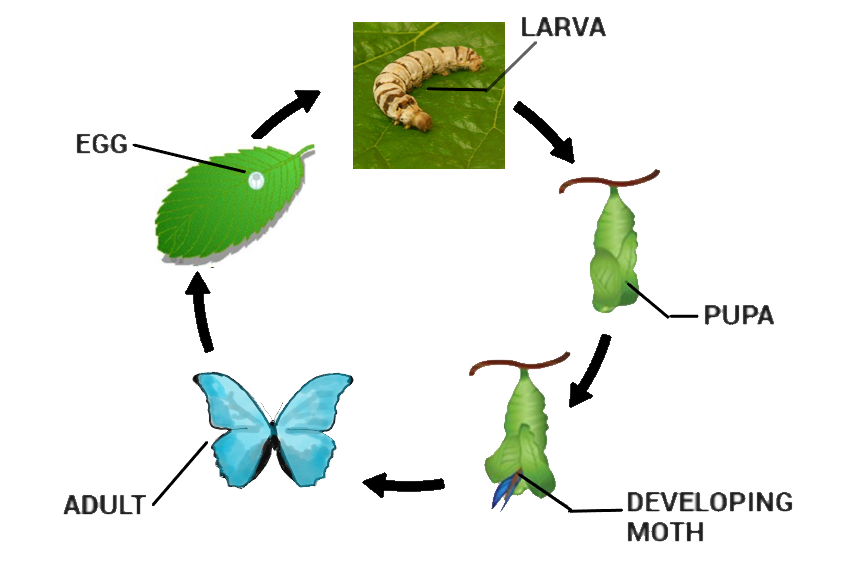
Note: Copulation between male and female silkworm moths lasts for several hours and during this period moths do not eat or drink. The male moth has longer antennae to detect pheromones from a distance.
Complete answer:
Silk moth
- Its scientific name is Bombyx mori.
- It is an insect and belongs to the moth family Bombycidae.
- The duration of the life-cycle of a Silkworm ranges from 6-8 weeks.
- The warmer the weather, the faster the Silkworm will complete its life-cycle. The other factors are also important like humidity and exposure to sunlight.
- Life cycle of silk moth is divided into following stages:
> Egg
Copulation between male and female silkworm moths lasts for several hours and during this period moths do not eat or drink. After mating, the female silkworm moth lays tiny eggs on mulberry leaves. After laying eggs, the adult moths die.
> Larva or caterpillar stage
During this stage the silk moth will go through four molts before developing into pupa. The periods between molts are termed as silkworm instars.
> Pupa
After they have molted four times, their bodies become slightly yellow, and the skin becomes tighter to enter the pupa phase of their lifecycle. They enclose themselves in a cocoon made up of raw silk produced by the salivary glands. The final molt from larva to pupa takes place within the cocoon, which provides protection during the vulnerable, motionless pupal state of the silk moth.
> Adult Silkworm
In this final stage when, the pupa changes into an adult moth. The male moth is smaller than the female. The female moth releases pheromones to attract male moths. The male moth has longer antennae to detect pheromones from a distance. When the two find each other, they copulate and the life cycle begins again.
Note: Copulation between male and female silkworm moths lasts for several hours and during this period moths do not eat or drink. The male moth has longer antennae to detect pheromones from a distance.
Recently Updated Pages
Master Class 11 Social Science: Engaging Questions & Answers for Success

Master Class 11 English: Engaging Questions & Answers for Success
Master Class 11 Maths: Engaging Questions & Answers for Success
Master Class 11 Chemistry: Engaging Questions & Answers for Success
Master Class 11 Biology: Engaging Questions & Answers for Success
Master Class 11 Physics: Engaging Questions & Answers for Success
Trending doubts
One Metric ton is equal to kg A 10000 B 1000 C 100 class 11 physics CBSE
Difference Between Prokaryotic Cells and Eukaryotic Cells
There are 720 permutations of the digits 1 2 3 4 5 class 11 maths CBSE
Draw a diagram of a plant cell and label at least eight class 11 biology CBSE
Two of the body parts which do not appear in MRI are class 11 biology CBSE
Which gas is abundant in air class 11 chemistry CBSE