



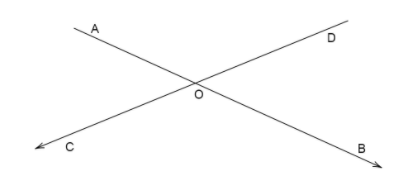
Name the four pairs of supplementary angles shown in the figure.
Answer
 Verified
595.8k+ views
Hint:From the knowledge of supplementary angles that they are the angles which lie on a straight line and sum up to \[{180^ \circ }\], we name the pairs( set of two angles ) which are supplementary in nature.
Complete step-by-step answer:
We know the two lines \[AB,CD\] intersect at point \[O\].
A pair of supplementary angles will be formed if on straight line is cut by another straight line at a point.
So the supplementary angles will be formed at the point of intersection of two lines \[AB,CD\].
We take the line \[AB\] which is cut by the line \[CD\].
This divides the area into four parts and the angles formed around the point of intersection are four angles in total.
Since we know angles on a straight line sum up to be \[{180^ \circ }\]
\[\angle AOB + \angle BOD = {180^ \circ }\] and \[\angle AOC + \angle BOC = {180^ \circ }\]
Therefore set of angles seen from above on a straight line \[AB\] are \[\angle AOB,\angle BOD\]
And the set of angles seen from below on a straight line \[AB\] are \[\angle AOC,\angle BOC\]
Similarly if we take the line \[CD\] which is cut by the line \[AB\].
This divides the area into four parts and the angles formed around the point of intersection are four angles in total.
Since we know angles on a straight line sum up to be \[{180^ \circ }\]
\[\angle COA + \angle DOA = {180^ \circ }\] and \[\angle COB + \angle DOB = {180^ \circ }\]
Therefore set of angles seen from above on a straight line \[CD\] are \[\angle COA,\angle DOA\]
And the set of angles seen from below on a straight line \[CD\] are \[\angle COB,\angle DOB\]
Therefore, four pair of supplementary angles in the given figure are
* \[\angle AOB,\angle BOD\]
*\[\angle AOC,\angle BOC\]
* \[\angle COA,\angle DOA\]
*\[\angle COB,\angle DOB\]
Note:Students are likely to make the mistake of collecting all the possible pairs formed in this diagram which is wrong because there are also vertically opposite angles in the diagram which are not supplementary to each other.
Complete step-by-step answer:
We know the two lines \[AB,CD\] intersect at point \[O\].
A pair of supplementary angles will be formed if on straight line is cut by another straight line at a point.
So the supplementary angles will be formed at the point of intersection of two lines \[AB,CD\].
We take the line \[AB\] which is cut by the line \[CD\].
This divides the area into four parts and the angles formed around the point of intersection are four angles in total.
Since we know angles on a straight line sum up to be \[{180^ \circ }\]
\[\angle AOB + \angle BOD = {180^ \circ }\] and \[\angle AOC + \angle BOC = {180^ \circ }\]
Therefore set of angles seen from above on a straight line \[AB\] are \[\angle AOB,\angle BOD\]
And the set of angles seen from below on a straight line \[AB\] are \[\angle AOC,\angle BOC\]
Similarly if we take the line \[CD\] which is cut by the line \[AB\].
This divides the area into four parts and the angles formed around the point of intersection are four angles in total.
Since we know angles on a straight line sum up to be \[{180^ \circ }\]
\[\angle COA + \angle DOA = {180^ \circ }\] and \[\angle COB + \angle DOB = {180^ \circ }\]
Therefore set of angles seen from above on a straight line \[CD\] are \[\angle COA,\angle DOA\]
And the set of angles seen from below on a straight line \[CD\] are \[\angle COB,\angle DOB\]
Therefore, four pair of supplementary angles in the given figure are
* \[\angle AOB,\angle BOD\]
*\[\angle AOC,\angle BOC\]
* \[\angle COA,\angle DOA\]
*\[\angle COB,\angle DOB\]
Note:Students are likely to make the mistake of collecting all the possible pairs formed in this diagram which is wrong because there are also vertically opposite angles in the diagram which are not supplementary to each other.

Recently Updated Pages
Master Class 8 Social Science: Engaging Questions & Answers for Success

Master Class 8 English: Engaging Questions & Answers for Success
Class 8 Question and Answer - Your Ultimate Solutions Guide
Master Class 8 Maths: Engaging Questions & Answers for Success
Master Class 8 Science: Engaging Questions & Answers for Success
Master Class 7 English: Engaging Questions & Answers for Success
Trending doubts
What is BLO What is the full form of BLO class 8 social science CBSE
Citizens of India can vote at the age of A 18 years class 8 social science CBSE
Full form of STD, ISD and PCO
Advantages and disadvantages of science
Right to vote is a AFundamental Right BFundamental class 8 social science CBSE
What are the 12 elements of nature class 8 chemistry CBSE