




Name the force required for Uniform Circular motion. State its direction.
Answer
 Verified
557.4k+ views
Hint: Let us first review the basics of circular motion before moving on to the question.The motion of an object in a circle at a consistent speed is known as uniform circular motion.
When an object moves in a circle, its direction is continually changing. The thing is moving at all times.tangent to the axis of the circle.Circular motion occurs when anything moves in a circle at a constant speed.
Complete answer:
The motion of an object in a circle at a consistent speed is known as uniform circular motion. When an object moves in a circle, its direction is continually changing. Because of this shift in direction, you can be sure that an item in circular motion is speeding up (even if it is moving at constant speed).
An accelerating object must be operated upon by an imbalanced force, according to Newton's principles of motion. The imbalanced force is moving in the same direction as the acceleration.
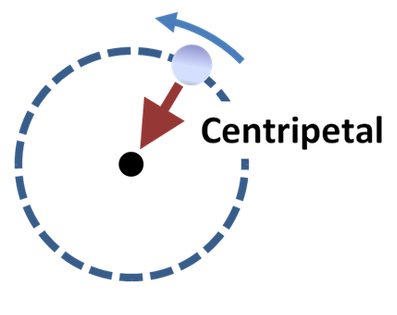
The net force and resultant acceleration are directed inwards for objects moving in a homogeneous circular motion.
A net inward or "centripetal" force is required for circular motion. An object cannot travel in a circular motion without a net centripetal force. In fact, if the forces are equal, a moving object will travel in a straight line at a constant speed.
Note:
The direction of motion in a circular motion is constantly changing. When the direction changes, the velocity changes as well. As a result, circular motion is an accelerated motion.
When an object moves in a circle, its direction is continually changing. The thing is moving at all times.tangent to the axis of the circle.Circular motion occurs when anything moves in a circle at a constant speed.
Complete answer:
The motion of an object in a circle at a consistent speed is known as uniform circular motion. When an object moves in a circle, its direction is continually changing. Because of this shift in direction, you can be sure that an item in circular motion is speeding up (even if it is moving at constant speed).
An accelerating object must be operated upon by an imbalanced force, according to Newton's principles of motion. The imbalanced force is moving in the same direction as the acceleration.
The net force and resultant acceleration are directed inwards for objects moving in a homogeneous circular motion.
A net inward or "centripetal" force is required for circular motion. An object cannot travel in a circular motion without a net centripetal force. In fact, if the forces are equal, a moving object will travel in a straight line at a constant speed.
Note:
The direction of motion in a circular motion is constantly changing. When the direction changes, the velocity changes as well. As a result, circular motion is an accelerated motion.
Recently Updated Pages
Which will be the least stable resonating structure class 11 chemistry CBSE

How many 5 digit telephone numbers can be construc-class-11-maths-CBSE
How do you find the angle of the resultant vector class 11 physics CBSE
Draw labelled diagram of the following i Gram seed class 11 biology CBSE
1 Quintal is equal to a 110 kg b 10 kg c 100kg d 1000 class 11 physics CBSE
What is the need and importance of classification class 11 biology CBSE
Trending doubts
One Metric ton is equal to kg A 10000 B 1000 C 100 class 11 physics CBSE
Find the value of the expression given below sin 30circ class 11 maths CBSE
Draw a diagram of nephron and explain its structur class 11 biology CBSE
10 examples of friction in our daily life
Proton was discovered by A Thomson B Rutherford C Chadwick class 11 chemistry CBSE
The teeth used for biting and cutting food are called class 11 biology CBSE