




Name the following: -
Which is the process of uptake of mineral ions against the concentration gradient, using energy from the cell?
Answer
 Verified
612.9k+ views
Hint: - Plants use various mechanisms to transport molecules and substances in and out of the cells. Some of them use energy while some take place passively without energy expenditure.
Complete answer:
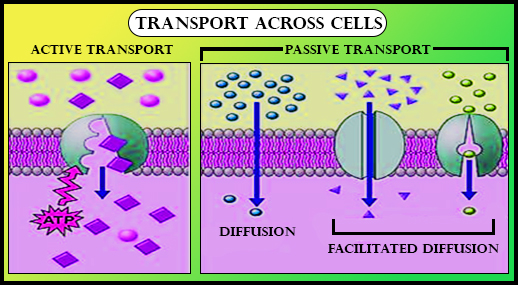
The process of uptake of mineral ions against the concentration gradient using energy from the cell is known as Active transport.
Additional Information:
-There are 3 main means of transport: Passive diffusion, facilitated diffusion, and Active transport.
- Passive diffusion is also known as simple diffusion.
- Diffusion rates are affected by the gradient of the concentration, the permeability of the membrane separating them, temperature, and pressure.
- Substances that have hydrophilic moiety find it difficult to pass through the membrane; their movement has to be facilitated.
- Facilitated diffusion is a type of spontaneous passive diffusion.
- Special membrane proteins provide sites at which hydrophilic molecules across the membrane.
- There’s no energy expenditure in facilitated diffusion.
- Facilitated diffusion is very specific. It allows cells to select substances for uptake.
- It is very sensitive to inhibitors that react with the protein site and blocks the transport.
- Symport: - Here two molecules move together and cross the membrane in the same direction.
- Antiport: - Here two molecules move together but in opposite directions.
- Uniport: - When only one molecule crosses the membrane independent of other molecules.
- Active transport uses energy to pump molecules against the concentration gradient i.e. uphill transport.
- Active transport is carried out by membrane- protein.
Note: Both active and facilitated diffusion use transport channels but in facilitated diffusion, there is no expenditure of ATP energy.
As the passive transport does not allow a long range transportation plants use transpiration for the movement of water.
Complete answer:
The process of uptake of mineral ions against the concentration gradient using energy from the cell is known as Active transport.
Additional Information:
-There are 3 main means of transport: Passive diffusion, facilitated diffusion, and Active transport.
- Passive diffusion is also known as simple diffusion.
- Diffusion rates are affected by the gradient of the concentration, the permeability of the membrane separating them, temperature, and pressure.
- Substances that have hydrophilic moiety find it difficult to pass through the membrane; their movement has to be facilitated.
- Facilitated diffusion is a type of spontaneous passive diffusion.
- Special membrane proteins provide sites at which hydrophilic molecules across the membrane.
- There’s no energy expenditure in facilitated diffusion.
- Facilitated diffusion is very specific. It allows cells to select substances for uptake.
- It is very sensitive to inhibitors that react with the protein site and blocks the transport.
- Symport: - Here two molecules move together and cross the membrane in the same direction.
- Antiport: - Here two molecules move together but in opposite directions.
- Uniport: - When only one molecule crosses the membrane independent of other molecules.
- Active transport uses energy to pump molecules against the concentration gradient i.e. uphill transport.
- Active transport is carried out by membrane- protein.
Note: Both active and facilitated diffusion use transport channels but in facilitated diffusion, there is no expenditure of ATP energy.
As the passive transport does not allow a long range transportation plants use transpiration for the movement of water.
Recently Updated Pages
Master Class 11 Social Science: Engaging Questions & Answers for Success

Master Class 11 English: Engaging Questions & Answers for Success
Master Class 11 Maths: Engaging Questions & Answers for Success
Master Class 11 Chemistry: Engaging Questions & Answers for Success
Master Class 11 Biology: Engaging Questions & Answers for Success
Master Class 11 Physics: Engaging Questions & Answers for Success
Trending doubts
Differentiate between an exothermic and an endothermic class 11 chemistry CBSE
One Metric ton is equal to kg A 10000 B 1000 C 100 class 11 physics CBSE
Difference Between Prokaryotic Cells and Eukaryotic Cells
There are 720 permutations of the digits 1 2 3 4 5 class 11 maths CBSE
Two of the body parts which do not appear in MRI are class 11 biology CBSE
Which gas is abundant in air class 11 chemistry CBSE