




Name the following:
Name the acids present in the following orange, tamarind, apples, sour milk.
Answer
 Verified
584.4k+ views
Hint: Acid is a species that can either donate a proton, or accept an electron pair from suitable base. Acidic aqueous solutions have more number of hydronium ions than hydroxide ions.
Complete answer:
For a neutral solution, the pH of the solution is equal to 7. For an acidic aqueous solution, the pH is less than 7. For a basic solution, the pH is more than 7. pH is a negative logarithm of hydronium ion concentration. Hydronium ion is obtained when a water molecule is protonated. Acid donates a proton. Base accepts a proton. The reaction between acid and base is neutralization reaction. The products are salt and water.
Some examples of acids include nitric acid, oxalic acid, sulphuric acid, hydrochloric acid and acetic acid respectively.
Acids can be classified into strong acids and weak acids. Strong acids completely dissociate in aqueous solutions whereas weak acids dissociate to a small extent.
Orange contains ascorbic acid. Ascorbic acid is also called vitamin C. Tamarind contains tartaric acid. Apples contain malic acid. Sour milk contains lactic acid.

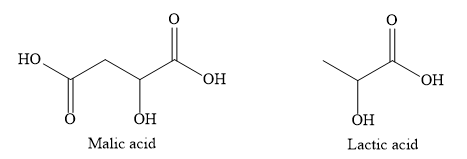
Note: Acids can be classified as monobasic, dibasic, tribasic etc, depending on the number of hydrogen ions that can be obtained from one molecule of the acid. Monobasic, dibasic, tribasic acids give one, two and three protons respectively per molecule of the acid.
Complete answer:
For a neutral solution, the pH of the solution is equal to 7. For an acidic aqueous solution, the pH is less than 7. For a basic solution, the pH is more than 7. pH is a negative logarithm of hydronium ion concentration. Hydronium ion is obtained when a water molecule is protonated. Acid donates a proton. Base accepts a proton. The reaction between acid and base is neutralization reaction. The products are salt and water.
Some examples of acids include nitric acid, oxalic acid, sulphuric acid, hydrochloric acid and acetic acid respectively.
Acids can be classified into strong acids and weak acids. Strong acids completely dissociate in aqueous solutions whereas weak acids dissociate to a small extent.
Orange contains ascorbic acid. Ascorbic acid is also called vitamin C. Tamarind contains tartaric acid. Apples contain malic acid. Sour milk contains lactic acid.
Note: Acids can be classified as monobasic, dibasic, tribasic etc, depending on the number of hydrogen ions that can be obtained from one molecule of the acid. Monobasic, dibasic, tribasic acids give one, two and three protons respectively per molecule of the acid.
Recently Updated Pages
Master Class 11 Computer Science: Engaging Questions & Answers for Success

Master Class 11 Business Studies: Engaging Questions & Answers for Success
Master Class 11 Economics: Engaging Questions & Answers for Success
Master Class 11 English: Engaging Questions & Answers for Success
Master Class 11 Maths: Engaging Questions & Answers for Success
Master Class 11 Biology: Engaging Questions & Answers for Success
Trending doubts
One Metric ton is equal to kg A 10000 B 1000 C 100 class 11 physics CBSE
There are 720 permutations of the digits 1 2 3 4 5 class 11 maths CBSE
Discuss the various forms of bacteria class 11 biology CBSE
Draw a diagram of a plant cell and label at least eight class 11 biology CBSE
State the laws of reflection of light
Explain zero factorial class 11 maths CBSE