




Name the enzyme which is responsible for DNA fragmentation.
Answer
 Verified
579k+ views
Hint: There are certain enzymes present that are capable of breaking the phosphodiester bonds of DNA resulting in the fragmentation of DNA. Such enzymes are known as nucleases which are further divided into endonucleases and endonucleases.
Complete answer:
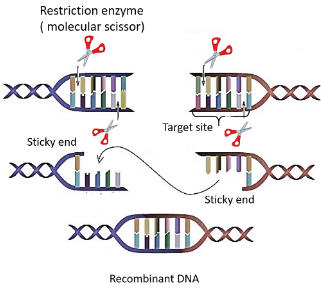
The DNA is a type of nucleic acid that is made up of the repeating unit nucleotides. These nucleotides are joined together by phosphodiester bonds. If these bonds are broken then DNA will be broken into many tiny fragments. This process is known as DNA fragmentation and it is done through restriction digestion. Restriction digestion takes place by the action of restriction endonucleases which cut the DNA at specific sites. Such cuts can leave the two DNA pieces with blunt or sticky ends. In blunt ends, the edges do not have any unpaired nucleotides whereas in sticky ends unpaired nucleotides are found which have a tendency to stick.
-Restriction enzymes were first isolated from the bacteriophage living inside Escherichia coli.
- The first restriction endonuclease enzyme is known as Hind-II which cuts a DNA sequence at a specific palindromic site.
-Palindrome are words that read the same even after we change the direction of reading. For example - MALAYALAM.
-Such palindromic sequences are known as. Recognition sites of that enzyme.
-Today there are more than 900 restriction enzymes that have been isolated from 230 different strains of bacteria.
Note:
-The cut pieces of DNA after restriction digestion are separated by the process of gel electrophoresis.
-In this electrophoresis process, the DNA pieces are made to move across an electric field. The DNA pieces move towards the positive anode as they are negatively charged.
-The smaller DNA pieces move the farthest distance as compared to bigger sized pieces.
Complete answer:
The DNA is a type of nucleic acid that is made up of the repeating unit nucleotides. These nucleotides are joined together by phosphodiester bonds. If these bonds are broken then DNA will be broken into many tiny fragments. This process is known as DNA fragmentation and it is done through restriction digestion. Restriction digestion takes place by the action of restriction endonucleases which cut the DNA at specific sites. Such cuts can leave the two DNA pieces with blunt or sticky ends. In blunt ends, the edges do not have any unpaired nucleotides whereas in sticky ends unpaired nucleotides are found which have a tendency to stick.
-Restriction enzymes were first isolated from the bacteriophage living inside Escherichia coli.
- The first restriction endonuclease enzyme is known as Hind-II which cuts a DNA sequence at a specific palindromic site.
-Palindrome are words that read the same even after we change the direction of reading. For example - MALAYALAM.
-Such palindromic sequences are known as. Recognition sites of that enzyme.
-Today there are more than 900 restriction enzymes that have been isolated from 230 different strains of bacteria.
Note:
-The cut pieces of DNA after restriction digestion are separated by the process of gel electrophoresis.
-In this electrophoresis process, the DNA pieces are made to move across an electric field. The DNA pieces move towards the positive anode as they are negatively charged.
-The smaller DNA pieces move the farthest distance as compared to bigger sized pieces.
Recently Updated Pages
Master Class 12 Business Studies: Engaging Questions & Answers for Success

Master Class 12 Chemistry: Engaging Questions & Answers for Success
Master Class 12 Biology: Engaging Questions & Answers for Success
Class 12 Question and Answer - Your Ultimate Solutions Guide
Master Class 11 English: Engaging Questions & Answers for Success
Master Class 11 Social Science: Engaging Questions & Answers for Success
Trending doubts
Which are the Top 10 Largest Countries of the World?
Draw a labelled sketch of the human eye class 12 physics CBSE
Differentiate between homogeneous and heterogeneous class 12 chemistry CBSE
Differentiate between Pyramid of energy and pyramid class 12 biology CBSE
Why is the cell called the structural and functional class 12 biology CBSE
Draw the diagram of the pyramid of energy Explain In class 12 biology CBSE