




Name the compound.

Answer
 Verified
586.2k+ views
Hint: The IUPAC system is the most rational and widely used system of nomenclature in organic chemistry. The most important feature of this system is that for any given molecular structure there is only one IUPAC name.
Complete step by step answer:
The IUPAC name of any organic compound essentially consists of three parts:
1.Word root
2.Suffix
3.Prefix.
In the case of the above compound, we can find the IUPAC name as per below steps:
1.Find the parent chain containing multiple bonds regardless of the fact that it also denotes the longest continuous chain of carbon atoms or not. In the above structure, the parent chain consists of four carbon atoms. So, word root for the above compound will be but.
2.Number the parent chain from that end which is nearer to double bond as given below:
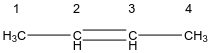
3.To indicate whether the carbon chain is saturated or unsaturated we add a primary suffix. Since the given organic compound contains a double bond then “ene” is used as a primary suffix.
4.According to a 1993 recommendation of IUPAC nomenclature of an organic compound, locanto either numeric or letter are placed immediately before the part of the name to which they relate. Here we can see in the above compound the double bond is at 2nd position.
Hence the name of the compound will be But-2-ene.
Note:
According to the IUPAC system, the suffix is of two types:
The primary suffix indicates that the hydrocarbon is saturated or unsaturated which means the hydrocarbon chain contains a single bond or multiple bond i.e. double bond or triple bond.
The secondary suffix tells the nature of the functional group present in the organic compounds.
Similarly, the prefix is also two types:
A primary prefix is used to distinguish the cyclic from the acyclic compound.
A secondary prefix is used for a certain group that is not considered to be a functional group but treated as a substituent.
Hence the complete IUPAC name is written as:
Secondary prefix + primary prefix + word root + primary suffix + secondary suffix.
Complete step by step answer:
The IUPAC name of any organic compound essentially consists of three parts:
1.Word root
2.Suffix
3.Prefix.
In the case of the above compound, we can find the IUPAC name as per below steps:
1.Find the parent chain containing multiple bonds regardless of the fact that it also denotes the longest continuous chain of carbon atoms or not. In the above structure, the parent chain consists of four carbon atoms. So, word root for the above compound will be but.
2.Number the parent chain from that end which is nearer to double bond as given below:
3.To indicate whether the carbon chain is saturated or unsaturated we add a primary suffix. Since the given organic compound contains a double bond then “ene” is used as a primary suffix.
4.According to a 1993 recommendation of IUPAC nomenclature of an organic compound, locanto either numeric or letter are placed immediately before the part of the name to which they relate. Here we can see in the above compound the double bond is at 2nd position.
Hence the name of the compound will be But-2-ene.
Note:
According to the IUPAC system, the suffix is of two types:
The primary suffix indicates that the hydrocarbon is saturated or unsaturated which means the hydrocarbon chain contains a single bond or multiple bond i.e. double bond or triple bond.
The secondary suffix tells the nature of the functional group present in the organic compounds.
Similarly, the prefix is also two types:
A primary prefix is used to distinguish the cyclic from the acyclic compound.
A secondary prefix is used for a certain group that is not considered to be a functional group but treated as a substituent.
Hence the complete IUPAC name is written as:
Secondary prefix + primary prefix + word root + primary suffix + secondary suffix.
Recently Updated Pages
Master Class 11 Computer Science: Engaging Questions & Answers for Success

Master Class 11 Business Studies: Engaging Questions & Answers for Success
Master Class 11 Economics: Engaging Questions & Answers for Success
Master Class 11 English: Engaging Questions & Answers for Success
Master Class 11 Maths: Engaging Questions & Answers for Success
Master Class 11 Biology: Engaging Questions & Answers for Success
Trending doubts
One Metric ton is equal to kg A 10000 B 1000 C 100 class 11 physics CBSE
There are 720 permutations of the digits 1 2 3 4 5 class 11 maths CBSE
Discuss the various forms of bacteria class 11 biology CBSE
Draw a diagram of a plant cell and label at least eight class 11 biology CBSE
State the laws of reflection of light
Explain zero factorial class 11 maths CBSE