




Name the component of blood which transports oxygen.
Answer
 Verified
580.8k+ views
Hint: The blood component that transports oxygen lacks a nucleus and has a lifespan of around 120 days. Sometimes, due to genetic variation it changes its shape and looks like a sickle, a disease known as Sickle Cell Anaemia.
Complete answer:
Red Blood Cells or erythrocytes help in the transportation of oxygen in blood. In the blood, hemoglobin is present which binds with oxygen and transport it to the cells.
-An unstable reversible bond with oxygen is created by hemoglobin. It is called oxyhemoglobin in the oxygenated state and is bright red; it is purplish blue in the reduced state.
-In cells in the bone marrow, which become red blood cells, hemoglobin is produced.
-Hemoglobin is broken down when red cells die: iron is rescued, proteins called transferrins are transferred to the bone marrow and used again in the development of fresh red blood cells; the remainder of the hemoglobin forms the basis of bilirubin, a chemical that is excreted into the bile and gives its distinctive yellow-brown color to the feces. ⠀
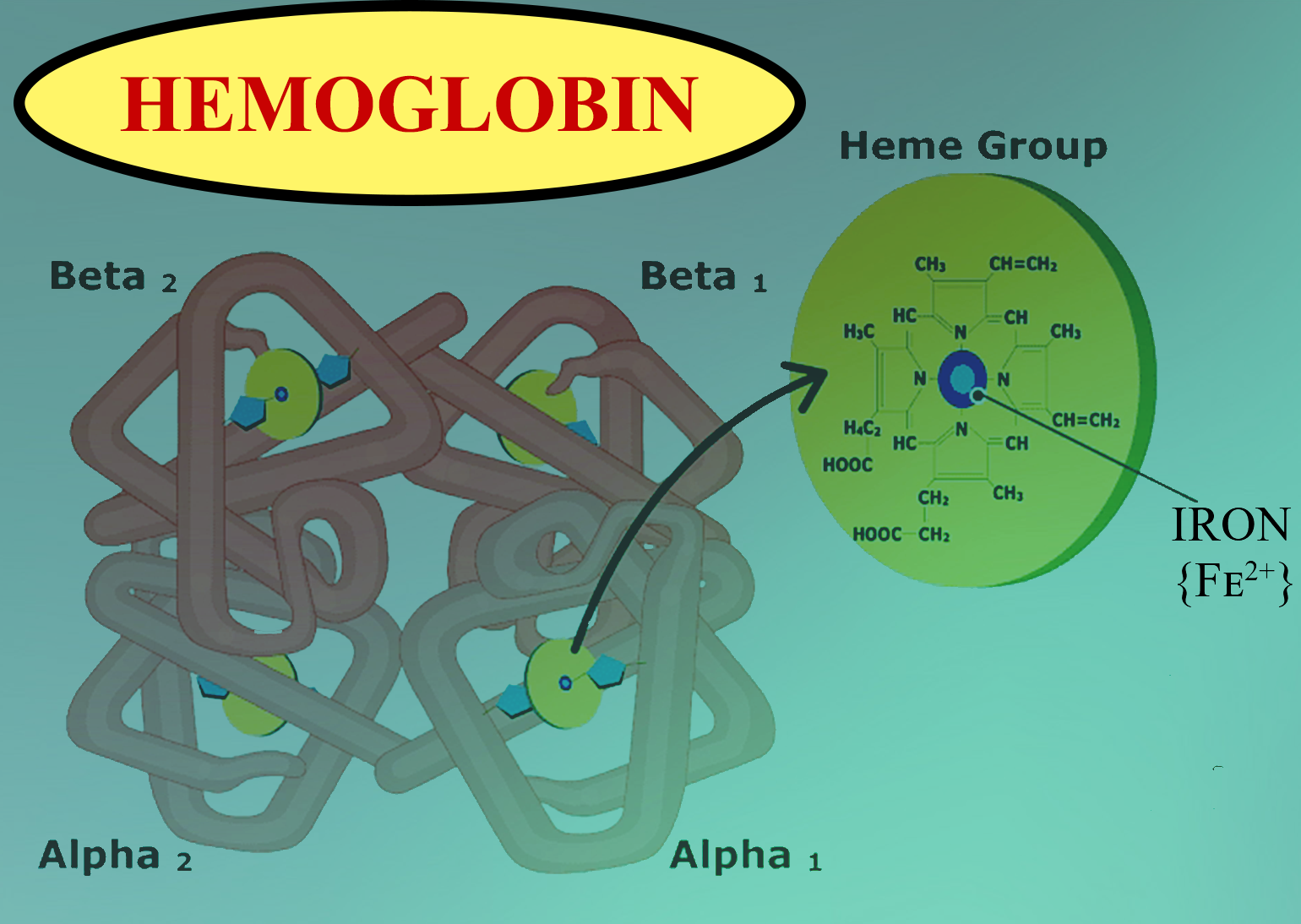
-Hemoglobin is a protein that is made up of four chains of polypeptides -alpha1, alpha2, β1, and β2. Each chain is attached to a group of hemes made up of porphyrin (a ring-like organic compound) attached to an iron atom.
-These iron-porphyrin complexes reversibly coordinate oxygen molecules, an ability directly related to hemoglobin’s role in the transport of oxygen in the blood.
-Each hemoglobin molecule, forming a tetrahedral structure, is made up of four heme groups surrounding a globin group.
Note:
-Heme, which accounts for just $4\%$ of the molecule's weight, is composed of a porphyrin-like organic compound to which an iron atom is attached.
-As the blood flows between the lungs and the tissues, it is the iron atom that connects oxygen.
-In each molecule of hemoglobin, there are four iron atoms, which can therefore bind four oxygen atoms.
Complete answer:
Red Blood Cells or erythrocytes help in the transportation of oxygen in blood. In the blood, hemoglobin is present which binds with oxygen and transport it to the cells.
-An unstable reversible bond with oxygen is created by hemoglobin. It is called oxyhemoglobin in the oxygenated state and is bright red; it is purplish blue in the reduced state.
-In cells in the bone marrow, which become red blood cells, hemoglobin is produced.
-Hemoglobin is broken down when red cells die: iron is rescued, proteins called transferrins are transferred to the bone marrow and used again in the development of fresh red blood cells; the remainder of the hemoglobin forms the basis of bilirubin, a chemical that is excreted into the bile and gives its distinctive yellow-brown color to the feces. ⠀
-Hemoglobin is a protein that is made up of four chains of polypeptides -alpha1, alpha2, β1, and β2. Each chain is attached to a group of hemes made up of porphyrin (a ring-like organic compound) attached to an iron atom.
-These iron-porphyrin complexes reversibly coordinate oxygen molecules, an ability directly related to hemoglobin’s role in the transport of oxygen in the blood.
-Each hemoglobin molecule, forming a tetrahedral structure, is made up of four heme groups surrounding a globin group.
Note:
-Heme, which accounts for just $4\%$ of the molecule's weight, is composed of a porphyrin-like organic compound to which an iron atom is attached.
-As the blood flows between the lungs and the tissues, it is the iron atom that connects oxygen.
-In each molecule of hemoglobin, there are four iron atoms, which can therefore bind four oxygen atoms.
Recently Updated Pages
Master Class 11 English: Engaging Questions & Answers for Success

Master Class 11 Social Science: Engaging Questions & Answers for Success
Master Class 11 Maths: Engaging Questions & Answers for Success
Master Class 11 Biology: Engaging Questions & Answers for Success
Master Class 11 Physics: Engaging Questions & Answers for Success
Master Class 11 Chemistry: Engaging Questions & Answers for Success
Trending doubts
One Metric ton is equal to kg A 10000 B 1000 C 100 class 11 physics CBSE
Difference Between Prokaryotic Cells and Eukaryotic Cells
Find the value of the expression given below sin 30circ class 11 maths CBSE
Two of the body parts which do not appear in MRI are class 11 biology CBSE
Draw a diagram of a plant cell and label at least eight class 11 biology CBSE
10 examples of friction in our daily life