




Name the chemical used to test starch.
Answer
 Verified
654.9k+ views
Hint: The chemical belongs to the group of halogens and is a non-metallic solid with a purple-black luster in the standard conditions but it melts to form a deep violet liquid when the temperature is around 144 degrees celsius.
Complete answer:
Iodine is used to test the presence of starch and this test is known as Starch-Iodine test. In this test, the presence of starch is detected by observing a change in color that is due to the formation of a complex. The reagents in this test are – a solution of $I_{2}$ (iodine) and KI (potassium iodide). The solution of these two chemicals in water is generally light orange-brown but when it is added to another solution or sample that contains starch, the light orange-brown color changes to deep blue. This change in color is due to the charge-transfer complexes. In the presence of potassium iodide, the iodine forms polyiodide ions like $I_{3}^{-}$ that act as charge donors and get embedded in the amylose helix forming a complex that is deep blue.
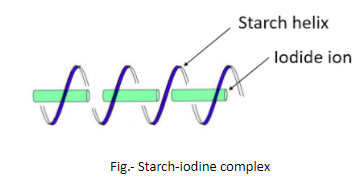
So, it is clear now that it is the amylose in the starch which is responsible for the formation of deep blue color by forming a complex with iodine. Iodine is a lustrous purple-black non-metallic solid belonging to the group of halogens.
Note: There is a limitation of this test that it cannot be performed in a very low pH environment because in such conditions, the hydrolysis of starch occurs and it prevents the formation of a starch-iodine complex that gives the blue color as an indication of the presence of starch.
Complete answer:
Iodine is used to test the presence of starch and this test is known as Starch-Iodine test. In this test, the presence of starch is detected by observing a change in color that is due to the formation of a complex. The reagents in this test are – a solution of $I_{2}$ (iodine) and KI (potassium iodide). The solution of these two chemicals in water is generally light orange-brown but when it is added to another solution or sample that contains starch, the light orange-brown color changes to deep blue. This change in color is due to the charge-transfer complexes. In the presence of potassium iodide, the iodine forms polyiodide ions like $I_{3}^{-}$ that act as charge donors and get embedded in the amylose helix forming a complex that is deep blue.
So, it is clear now that it is the amylose in the starch which is responsible for the formation of deep blue color by forming a complex with iodine. Iodine is a lustrous purple-black non-metallic solid belonging to the group of halogens.
Note: There is a limitation of this test that it cannot be performed in a very low pH environment because in such conditions, the hydrolysis of starch occurs and it prevents the formation of a starch-iodine complex that gives the blue color as an indication of the presence of starch.
Recently Updated Pages
Which will be the least stable resonating structure class 11 chemistry CBSE

How many 5 digit telephone numbers can be construc-class-11-maths-CBSE
How do you find the angle of the resultant vector class 11 physics CBSE
Draw labelled diagram of the following i Gram seed class 11 biology CBSE
What is the need and importance of classification class 11 biology CBSE
The way in which the sparrows expressed their sorrow class 11 english CBSE
Trending doubts
One Metric ton is equal to kg A 10000 B 1000 C 100 class 11 physics CBSE
Find the value of the expression given below sin 30circ class 11 maths CBSE
1 Quintal is equal to a 110 kg b 10 kg c 100kg d 1000 class 11 physics CBSE
Draw a diagram of nephron and explain its structur class 11 biology CBSE
10 examples of friction in our daily life
Proton was discovered by A Thomson B Rutherford C Chadwick class 11 chemistry CBSE