




Name the bacteria which causes peptic ulcer.
Answer
 Verified
572.1k+ views
Hint: A peptic ulcer is an open raw or sore area in the lining of the stomach or intestine. Normally, the lining of the stomach and small intestines can protect itself against strong stomach acids. But if the lining breaks down, the result may be a swollen and inflamed tissue (gastritis) or an ulcer. There are certain bacteria present in the stomach acids that contribute to these conditions.
Complete answer:
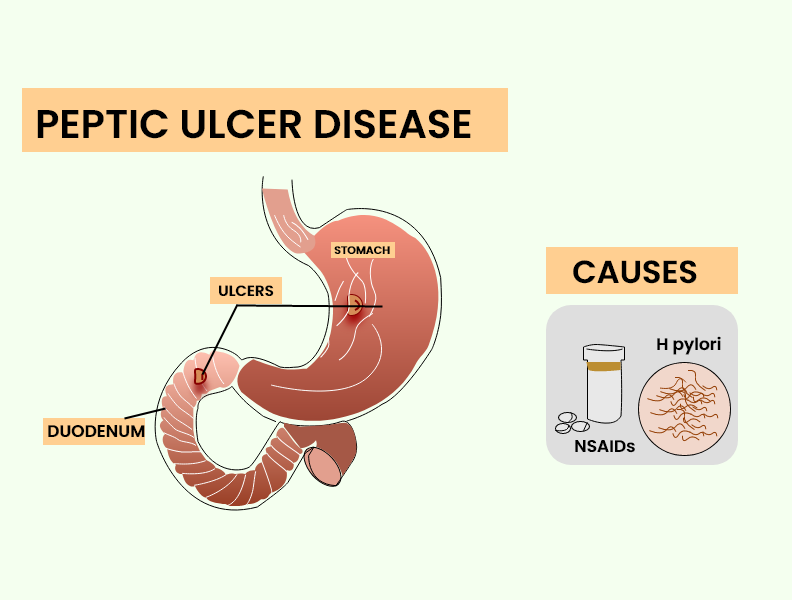
The most common cause of ulcers is due to the infection of the stomach by the bacteria called Helicobacter pylori (H pylori). Most people with peptic ulcers have these bacteria living in their digestive tract. Helicobacter pylori, previously known as Campylobacter pylori, is the gram-negative, microaerophilic, spiral (helical) bacterium usually found in the stomach. Its helical shape (from which the genus name, helicobacter, derives) is said to have evolved to penetrate the mucous lining of the stomach and thereby establish an infection, commonly called ulcer. The biochemicals produced by H. pylori such as proteases, vacuolating cytotoxin A (VacA) is toxic to the stomach and duodenal linings. VacA damages epithelial cells, disrupts tight junctions and causes apoptosis.
Ulcers in the stomach and duodenum occur when the inflammation allows stomach acid and the digestive enzyme pepsin to overthrow the mechanisms that protect the stomach and duodenal mucous membranes. The location where H. pylori has colonised, affects the location of the ulcer and depends on the acidity of the stomach. People who produce large amounts of acid, exhibit H. pylori near the pyloric antrum (the exit to the duodenum) so as to avoid the acid-secretion parietal cells at the fundus (near the entrance to the stomach). People who produce normal or less amounts of acid are susceptible to the colonisation of the rest of the stomach by H. pylori.
Note:
Several factors raise the risk for peptic ulcers, such as, drinking too much alcohol, regular use of aspirin, ibuprofen, naproxen, or other nonsteroidal anti-inflammatory drugs (NSAIDs), smoking cigarettes or chewing tobacco, being on a breathing machine, radiation treatments, stress etc. Peptic ulcers may lead to the perforation of the stomach lining or bleeding.
Complete answer:
The most common cause of ulcers is due to the infection of the stomach by the bacteria called Helicobacter pylori (H pylori). Most people with peptic ulcers have these bacteria living in their digestive tract. Helicobacter pylori, previously known as Campylobacter pylori, is the gram-negative, microaerophilic, spiral (helical) bacterium usually found in the stomach. Its helical shape (from which the genus name, helicobacter, derives) is said to have evolved to penetrate the mucous lining of the stomach and thereby establish an infection, commonly called ulcer. The biochemicals produced by H. pylori such as proteases, vacuolating cytotoxin A (VacA) is toxic to the stomach and duodenal linings. VacA damages epithelial cells, disrupts tight junctions and causes apoptosis.
Ulcers in the stomach and duodenum occur when the inflammation allows stomach acid and the digestive enzyme pepsin to overthrow the mechanisms that protect the stomach and duodenal mucous membranes. The location where H. pylori has colonised, affects the location of the ulcer and depends on the acidity of the stomach. People who produce large amounts of acid, exhibit H. pylori near the pyloric antrum (the exit to the duodenum) so as to avoid the acid-secretion parietal cells at the fundus (near the entrance to the stomach). People who produce normal or less amounts of acid are susceptible to the colonisation of the rest of the stomach by H. pylori.
Note:
Several factors raise the risk for peptic ulcers, such as, drinking too much alcohol, regular use of aspirin, ibuprofen, naproxen, or other nonsteroidal anti-inflammatory drugs (NSAIDs), smoking cigarettes or chewing tobacco, being on a breathing machine, radiation treatments, stress etc. Peptic ulcers may lead to the perforation of the stomach lining or bleeding.
Recently Updated Pages
Basicity of sulphurous acid and sulphuric acid are

Master Class 11 English: Engaging Questions & Answers for Success
Master Class 11 Physics: Engaging Questions & Answers for Success
Master Class 11 Computer Science: Engaging Questions & Answers for Success
Master Class 11 Chemistry: Engaging Questions & Answers for Success
Master Class 11 Social Science: Engaging Questions & Answers for Success
Trending doubts
Difference Between Prokaryotic Cells and Eukaryotic Cells
Two of the body parts which do not appear in MRI are class 11 biology CBSE
One Metric ton is equal to kg A 10000 B 1000 C 100 class 11 physics CBSE
10 examples of friction in our daily life
Draw a diagram of nephron and explain its structur class 11 biology CBSE
What will happen if the mucus is not secreted by the class 11 biology CBSE