




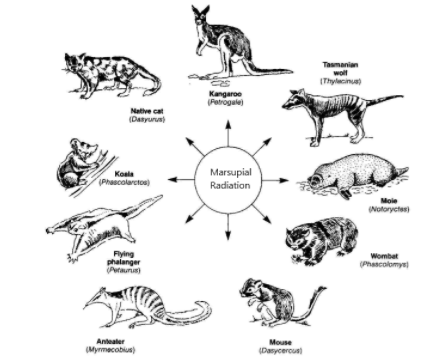
Name and explain the evolutionary concept represented in the illustration given below:
Answer
 Verified
604.8k+ views
Hint:Adaptive radiation is a process of evolutionary biology where organisms rapidly diversify from ancient species to a host of new types, especially as changes in the environment provide new resources, create new challenges and open new niches.
Complete answer:
Marsupials are all members of Marsupialia's mammalian subclass. All the marsupials which exist are endemic to Australia and America. A distinguishing feature common to all of these species is that young ones are carried in a pouch. Kangaroos, koalas, wallabies, opossums, Tasmanians, wombats, and extinct thylacines are well-known marsupials. The dunnarts, the potoroos and the cuscus are lesser-known marsupials. Clades from the last shared ancestor of current metatherians are represented by Marsupials. Like other Metatheria mammals, they bring to life relatively underdeveloped young ones, who mostly remain in a pouch in the abdomen. On the Australian continent, approximately 70% of the 334 existing species occur. The remaining 30% are found in America, mainly South America, 13 in Central America, and one in North America, north Mexico.
The given diagram demonstrates adaptive radiation of marsupials in Australia. Australia was isolated from other continents by continental drift. Monotremes and marsupials continued to flourish and diversify in Australia. The Australian geographic isolation was an obstacle against placental mammals from competing with its monotremes and marsupials, which emerged elsewhere at a later period. In other areas of the world where the majority of monotremes and marsupials were extinct, placental mammals were created.
Note: Convergent evolution in evolutionary biology is the mechanism by which species are not closely related to themselves, and by adapting to similar conditions or ecological niches, they acquire similar traits independently.
Complete answer:
Marsupials are all members of Marsupialia's mammalian subclass. All the marsupials which exist are endemic to Australia and America. A distinguishing feature common to all of these species is that young ones are carried in a pouch. Kangaroos, koalas, wallabies, opossums, Tasmanians, wombats, and extinct thylacines are well-known marsupials. The dunnarts, the potoroos and the cuscus are lesser-known marsupials. Clades from the last shared ancestor of current metatherians are represented by Marsupials. Like other Metatheria mammals, they bring to life relatively underdeveloped young ones, who mostly remain in a pouch in the abdomen. On the Australian continent, approximately 70% of the 334 existing species occur. The remaining 30% are found in America, mainly South America, 13 in Central America, and one in North America, north Mexico.
The given diagram demonstrates adaptive radiation of marsupials in Australia. Australia was isolated from other continents by continental drift. Monotremes and marsupials continued to flourish and diversify in Australia. The Australian geographic isolation was an obstacle against placental mammals from competing with its monotremes and marsupials, which emerged elsewhere at a later period. In other areas of the world where the majority of monotremes and marsupials were extinct, placental mammals were created.
Note: Convergent evolution in evolutionary biology is the mechanism by which species are not closely related to themselves, and by adapting to similar conditions or ecological niches, they acquire similar traits independently.
Recently Updated Pages
Master Class 11 Social Science: Engaging Questions & Answers for Success

Master Class 11 English: Engaging Questions & Answers for Success
Master Class 11 Maths: Engaging Questions & Answers for Success
Master Class 11 Chemistry: Engaging Questions & Answers for Success
Master Class 11 Biology: Engaging Questions & Answers for Success
Master Class 11 Physics: Engaging Questions & Answers for Success
Trending doubts
One Metric ton is equal to kg A 10000 B 1000 C 100 class 11 physics CBSE
Difference Between Prokaryotic Cells and Eukaryotic Cells
Draw a diagram of a plant cell and label at least eight class 11 biology CBSE
Two of the body parts which do not appear in MRI are class 11 biology CBSE
Which gas is abundant in air class 11 chemistry CBSE
10 examples of friction in our daily life