




Name a machine which is used to be a multiply force.
A) a movable pulley
B) a fixed pulley
C) a fixed pendulum
D) a moveable pendulum
Answer
 Verified
531k+ views
Hint: In physics, a force is any influence that, when unopposed, causes an object to change its velocity. A force can cause a mass item to change its velocity (which includes starting to move from a standstill), i.e. accelerate. Intuitively, force may be characterised as a push or a pull. A force is a vector quantity since it has both magnitude and direction. Force multiplication is will amplify our effort to produce more output.
Complete answer:
> Force multiplication, often known as a force multiplier, is a factor or a set of factors that allows individuals or weapons (or other gear) to achieve larger feats than they might otherwise. The multiplication factor is the projected size increase necessary to achieve the same efficacy without the benefit.
> For example, if a technology such as GPS allows a force to achieve the same results as a force five times its size, the multiplier is five. These figures are used to justify the expenditure on force multipliers.
> A pulley is a mechanical device that makes it easier to lift large things. Pulleys are made up of a wheel that spins on an axle (a rod that runs through the centre of the wheel) and a rope, cable, or chain.
> Fixed, moveable, and compound pulleys are the three basic types of pulleys.
> The wheel and axle of a fixed pulley remain stationary. We can see a fixed pulley in the below image:
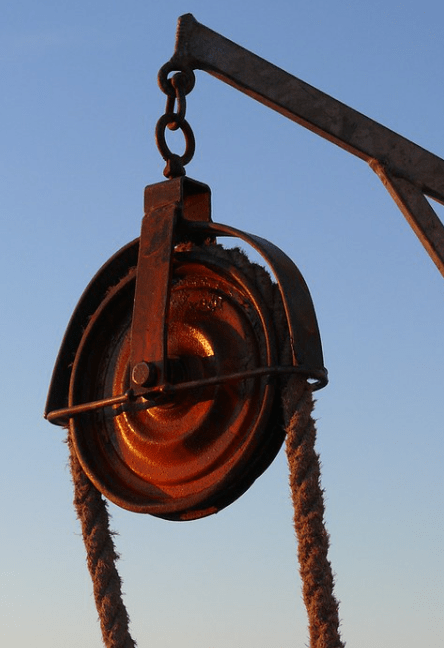
> A flagpole is a good example of a fixed pulley: as you pull down on the rope, the force is diverted by the pulley, and the flag is raised. Force may be multiplied by using a wheel and axle.
> Instead of force, the wheel and axle are frequently employed to multiply speed. Bicycle and automobile wheels, for example.
Hence option (A) is correct.
Note:
A pulley is a wheel on an axle or shaft that supports movement and direction changing of a taut cable or belt, as well as power transfer between the shaft and the cable or belt. The supporting shell is termed a block, and the pulley is called a sheave in the case of a pulley supported by a frame or shell that does not deliver power to a shaft but is used to direct the cable or apply a force.
Complete answer:
> Force multiplication, often known as a force multiplier, is a factor or a set of factors that allows individuals or weapons (or other gear) to achieve larger feats than they might otherwise. The multiplication factor is the projected size increase necessary to achieve the same efficacy without the benefit.
> For example, if a technology such as GPS allows a force to achieve the same results as a force five times its size, the multiplier is five. These figures are used to justify the expenditure on force multipliers.
> A pulley is a mechanical device that makes it easier to lift large things. Pulleys are made up of a wheel that spins on an axle (a rod that runs through the centre of the wheel) and a rope, cable, or chain.
> Fixed, moveable, and compound pulleys are the three basic types of pulleys.
> The wheel and axle of a fixed pulley remain stationary. We can see a fixed pulley in the below image:
> A flagpole is a good example of a fixed pulley: as you pull down on the rope, the force is diverted by the pulley, and the flag is raised. Force may be multiplied by using a wheel and axle.
> Instead of force, the wheel and axle are frequently employed to multiply speed. Bicycle and automobile wheels, for example.
Hence option (A) is correct.
Note:
A pulley is a wheel on an axle or shaft that supports movement and direction changing of a taut cable or belt, as well as power transfer between the shaft and the cable or belt. The supporting shell is termed a block, and the pulley is called a sheave in the case of a pulley supported by a frame or shell that does not deliver power to a shaft but is used to direct the cable or apply a force.
Recently Updated Pages
Master Class 11 English: Engaging Questions & Answers for Success

Master Class 11 Physics: Engaging Questions & Answers for Success
Master Class 11 Computer Science: Engaging Questions & Answers for Success
Master Class 11 Chemistry: Engaging Questions & Answers for Success
Master Class 11 Social Science: Engaging Questions & Answers for Success
Master Class 11 Accountancy: Engaging Questions & Answers for Success
Trending doubts
Difference Between Prokaryotic Cells and Eukaryotic Cells
Two of the body parts which do not appear in MRI are class 11 biology CBSE
One Metric ton is equal to kg A 10000 B 1000 C 100 class 11 physics CBSE
10 examples of friction in our daily life
Draw a diagram of nephron and explain its structur class 11 biology CBSE
Draw a diagram of a plant cell and label at least eight class 11 biology CBSE