




Why is \[{{\text{N}}_{\text{2}}}\] less reactive at room temperature?
Answer
 Verified
675.9k+ views
Hint: Before answering the question, we need to have an idea about the structure of \[{{\text{N}}_{\text{2}}}\]. And at the same time the existing chemical bonding between the atoms. Once we get a clear idea, we will be able to answer this question.
Complete step by step solution:
We first will take a look into the chemical bonding of the \[{{\text{N}}_{\text{2}}}\] molecule.
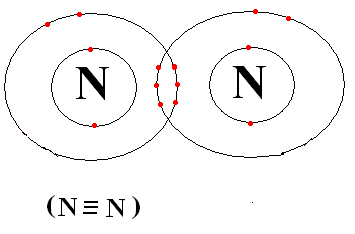 As we can see that there exists a triple bond between the \[{{\text{N}}_{\text{2}}}\] atoms. The triple bond is pretty strong.
Therefore, it needs a lot of energy to break those bonds and participate in a reaction. So nitrogen is commonly referred to as an inert gas (more abundance and low-cost).
Dissociation energy of this molecule is fairly high therefore it is less reactive at room temperature.
By Bond Dissociation energy we mean the energy that is required to break a chemical bond. It is one means by quantifying the strength of a chemical bond dissociation energy which is equal to the bond energy, only for diatomic molecules.
The other reason behind the high dissociation energy of nitrogen can also be defined from the fact that nitrogen has six more electrons in a bonding atomic orbital. So its bond order is 3. However, \[{{\text{N}}_{\text{2}}}^{+}\] has only 5 in bonding with bond order is 2.5. Bond dissociation energy is directly proportional to bond order of a molecule so it has more bond dissociation energy.
So, it is due to the high dissociation energy of \[{{\text{N}}_{\text{2}}}\] that it is less reactive at room temperature.
Note: The only way to break the \[{{\text{N}}_{\text{2}}}\] bond is the solution which involves clamshell like organic molecules that holds an atom of the metal hafnium in their opening. Two of these molecules can lock a nitrogen molecule between their metal atoms and break the first two of its bonds.
Although nitrogen makes up 78% of the atmosphere it is not used in many industrial processes as the triple bond is difficult to break.
Complete step by step solution:
We first will take a look into the chemical bonding of the \[{{\text{N}}_{\text{2}}}\] molecule.
Therefore, it needs a lot of energy to break those bonds and participate in a reaction. So nitrogen is commonly referred to as an inert gas (more abundance and low-cost).
Dissociation energy of this molecule is fairly high therefore it is less reactive at room temperature.
By Bond Dissociation energy we mean the energy that is required to break a chemical bond. It is one means by quantifying the strength of a chemical bond dissociation energy which is equal to the bond energy, only for diatomic molecules.
The other reason behind the high dissociation energy of nitrogen can also be defined from the fact that nitrogen has six more electrons in a bonding atomic orbital. So its bond order is 3. However, \[{{\text{N}}_{\text{2}}}^{+}\] has only 5 in bonding with bond order is 2.5. Bond dissociation energy is directly proportional to bond order of a molecule so it has more bond dissociation energy.
So, it is due to the high dissociation energy of \[{{\text{N}}_{\text{2}}}\] that it is less reactive at room temperature.
Note: The only way to break the \[{{\text{N}}_{\text{2}}}\] bond is the solution which involves clamshell like organic molecules that holds an atom of the metal hafnium in their opening. Two of these molecules can lock a nitrogen molecule between their metal atoms and break the first two of its bonds.
Although nitrogen makes up 78% of the atmosphere it is not used in many industrial processes as the triple bond is difficult to break.
Recently Updated Pages
Master Class 10 Computer Science: Engaging Questions & Answers for Success

Differentiate between voluntary action and reflex class 10 biology CBSE
The uses of bleaching powder are A It is used bleaching class 10 chemistry CBSE
Fill in the blanks with abstract nouns of the words class 10 english CBSE
How many threedigit numbers are there class 10 maths CBSE
What is a reflex arc class 10 biology CBSE
Trending doubts
Explain the Treaty of Vienna of 1815 class 10 social science CBSE
10 examples of evaporation in daily life with explanations
Which country is known as "The land of Fire and Ice"?
What is the full form of POSCO class 10 social science CBSE
Make a sketch of the human nerve cell What function class 10 biology CBSE
In which year voting age was reduced from 21 to 18?