



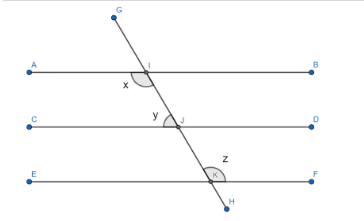
n the adjacent figure we have \[\text{AB}\parallel \text{CD}\,\text{;}\,\text{CD}\parallel \text{EF}\] and y: z=3:7, find x.
Answer
 Verified
602.1k+ views
Hint: We know the property that when two lines intersect then the vertically opposite angles are equal to each other. So, \[\angle IJC=\angle DJZ\] . We know the property that the sum of interior angles between the parallel lines having a transversal is equal to \[180{}^\circ \] . So, \[y+z=180{}^\circ \] . Now, let the ratio of y and z be in a. Replace y by 3a and z by 7a in the equation \[y+z=180{}^\circ \] . Now, find the value of a and get the value of y. Use the property that the sum of the interior angles between the parallel lines having a transversal is equal to \[{{180}^{0}}\] . Now, we have \[x\text{ }+\text{ }y=~180{}^\circ \] . Solve it further and get the value of x.
Complete step-by-step answer:
The line segment GH and CD are intersecting at point J.
We know the property that when two lines intersect then the vertically opposite angles are equal to each other. In the figure given, \[\angle IJC\] and \[\angle DJZ\] are vertically opposite angles.
Using this property, we can say that \[\angle IJC\] and \[\angle DJZ\] are equal to each other.
So, \[\angle IJC=\angle DJZ\] …………………(1)
In the figure, it is given that \[\angle IJC\] is equal to y.
\[\angle IJC=y\] ………………………(2)
From equation (1) and equation (2), we have
\[\angle DJZ=y\] ………………….(3)
In the figure we can see that CD and EF are parallel and here, \[\angle DJZ\] and \[\angle JZE\] are the alternate interior angles.
We know the property that when two lines are parallel then, the alternate interior angles are equal to each other.
Now, using this property we can say that \[\angle DJZ\] and \[\angle JZE\] are equal to each other.
\[\angle DJZ=\angle JZE\] ……………………..(4)
From equation (3) and y we have,
\[\angle JZE=y\] ………………………….(5)
In the figure, we can see that \[\angle JZE\] and \[\angle JZF\] are linear pairs of angles.
We know the property that the sum of the linear pair of angles is equal to \[180{}^\circ \] .
Now, using this property we can say that the sum of \[\angle JZE\] and \[\angle JZF\] is equal to \[180{}^\circ \] .
\[\angle JZE+\angle JZF=180{}^\circ \] ………………………..(6)
From the figure, we have \[\angle JZF\] equal to z.
\[\angle JZF=z\] ……………………..(7)
From equation (5), equation (6), and equation (7), we have
\[\angle JZE+\angle JZF=180{}^\circ \]
\[\Rightarrow y+z=180{}^\circ \] ……………………(8)
It is given that y: z=3: 7.
Let the ratio of y and z be in a.
y = 3a ……………….(9)
z = 7a …………………….(10)
From equation (8), equation (9), and equation (10), we have
\[\begin{align}
& 3a+7a=180{}^\circ \\
& \Rightarrow 10a=180{}^\circ \\
& \Rightarrow a=18{}^\circ \\
\end{align}\]
So, y = 3a = \[3\times 18{}^\circ =54{}^\circ \] ………………..(11)
We know the property that the sum of the interior angles between the parallel lines having a transversal is equal to \[180{}^\circ \] .
Using this property, we can say that,
\[x\text{ }+\text{ }y=~180{}^\circ \] …………………….(12)
From equation (11), putting the value of y in equation (12), we get
\[\begin{align}
& x\text{ }+\text{ 54}{}^\circ =~180{}^\circ \\
& \Rightarrow x=180{}^\circ -54{}^\circ \\
& \Rightarrow x=126{}^\circ \\
\end{align}\]
Hence, the value of x is \[126{}^\circ \] .
Note: We can also solve this question without the use of the property of alternate interior angles. We know the property that when two lines intersect then the vertically opposite angles are equal to each other. In the figure given, \[\angle IJC\] and \[\angle DJZ\] are vertically opposite angles.
\[\angle IJC=\angle DJZ=y\] ……………………(1)
We know the property that the sum of the interior angles between the parallel lines having a transversal is equal to \[180{}^\circ \] .
Using this property, we can say that,
\[z+\text{ }y=~180{}^\circ \] …………………..(2)
It is given that y: z=3: 7.
Let the ratio of y and z be in a.
y = 3a ……………….(3)
z = 7a …………………….(4)
From equation (2), equation (3), and equation (4), we have
\[\begin{align}
& 3a+7a=180{}^\circ \\
& \Rightarrow 10a=180{}^\circ \\
& \Rightarrow a=18{}^\circ \\
\end{align}\]
So, y = 3a = \[3\times 18{}^\circ =54{}^\circ \] ……………………(5)
We know the property that the sum of the interior angles between the parallel lines having a transversal is equal to \[180{}^\circ \] .
Using this property, we can say that,
\[x\text{ }+\text{ }y=~180{}^\circ \] …………………….(6)
From equation (5), putting the value of y in equation (6), we get
\[\begin{align}
& x\text{ }+\text{ 54}{}^\circ =~180{}^\circ \\
& \Rightarrow x=180{}^\circ -54{}^\circ \\
& \Rightarrow x=126{}^\circ \\
\end{align}\]
Hence, the value of x is \[126{}^\circ \] .
Complete step-by-step answer:
The line segment GH and CD are intersecting at point J.
We know the property that when two lines intersect then the vertically opposite angles are equal to each other. In the figure given, \[\angle IJC\] and \[\angle DJZ\] are vertically opposite angles.
Using this property, we can say that \[\angle IJC\] and \[\angle DJZ\] are equal to each other.
So, \[\angle IJC=\angle DJZ\] …………………(1)
In the figure, it is given that \[\angle IJC\] is equal to y.
\[\angle IJC=y\] ………………………(2)
From equation (1) and equation (2), we have
\[\angle DJZ=y\] ………………….(3)
In the figure we can see that CD and EF are parallel and here, \[\angle DJZ\] and \[\angle JZE\] are the alternate interior angles.
We know the property that when two lines are parallel then, the alternate interior angles are equal to each other.
Now, using this property we can say that \[\angle DJZ\] and \[\angle JZE\] are equal to each other.
\[\angle DJZ=\angle JZE\] ……………………..(4)
From equation (3) and y we have,
\[\angle JZE=y\] ………………………….(5)
In the figure, we can see that \[\angle JZE\] and \[\angle JZF\] are linear pairs of angles.
We know the property that the sum of the linear pair of angles is equal to \[180{}^\circ \] .
Now, using this property we can say that the sum of \[\angle JZE\] and \[\angle JZF\] is equal to \[180{}^\circ \] .
\[\angle JZE+\angle JZF=180{}^\circ \] ………………………..(6)
From the figure, we have \[\angle JZF\] equal to z.
\[\angle JZF=z\] ……………………..(7)
From equation (5), equation (6), and equation (7), we have
\[\angle JZE+\angle JZF=180{}^\circ \]
\[\Rightarrow y+z=180{}^\circ \] ……………………(8)
It is given that y: z=3: 7.
Let the ratio of y and z be in a.
y = 3a ……………….(9)
z = 7a …………………….(10)
From equation (8), equation (9), and equation (10), we have
\[\begin{align}
& 3a+7a=180{}^\circ \\
& \Rightarrow 10a=180{}^\circ \\
& \Rightarrow a=18{}^\circ \\
\end{align}\]
So, y = 3a = \[3\times 18{}^\circ =54{}^\circ \] ………………..(11)
We know the property that the sum of the interior angles between the parallel lines having a transversal is equal to \[180{}^\circ \] .
Using this property, we can say that,
\[x\text{ }+\text{ }y=~180{}^\circ \] …………………….(12)
From equation (11), putting the value of y in equation (12), we get
\[\begin{align}
& x\text{ }+\text{ 54}{}^\circ =~180{}^\circ \\
& \Rightarrow x=180{}^\circ -54{}^\circ \\
& \Rightarrow x=126{}^\circ \\
\end{align}\]
Hence, the value of x is \[126{}^\circ \] .
Note: We can also solve this question without the use of the property of alternate interior angles. We know the property that when two lines intersect then the vertically opposite angles are equal to each other. In the figure given, \[\angle IJC\] and \[\angle DJZ\] are vertically opposite angles.
\[\angle IJC=\angle DJZ=y\] ……………………(1)
We know the property that the sum of the interior angles between the parallel lines having a transversal is equal to \[180{}^\circ \] .
Using this property, we can say that,
\[z+\text{ }y=~180{}^\circ \] …………………..(2)
It is given that y: z=3: 7.
Let the ratio of y and z be in a.
y = 3a ……………….(3)
z = 7a …………………….(4)
From equation (2), equation (3), and equation (4), we have
\[\begin{align}
& 3a+7a=180{}^\circ \\
& \Rightarrow 10a=180{}^\circ \\
& \Rightarrow a=18{}^\circ \\
\end{align}\]
So, y = 3a = \[3\times 18{}^\circ =54{}^\circ \] ……………………(5)
We know the property that the sum of the interior angles between the parallel lines having a transversal is equal to \[180{}^\circ \] .
Using this property, we can say that,
\[x\text{ }+\text{ }y=~180{}^\circ \] …………………….(6)
From equation (5), putting the value of y in equation (6), we get
\[\begin{align}
& x\text{ }+\text{ 54}{}^\circ =~180{}^\circ \\
& \Rightarrow x=180{}^\circ -54{}^\circ \\
& \Rightarrow x=126{}^\circ \\
\end{align}\]
Hence, the value of x is \[126{}^\circ \] .
Recently Updated Pages
Master Class 9 General Knowledge: Engaging Questions & Answers for Success

Master Class 9 Social Science: Engaging Questions & Answers for Success
Master Class 9 English: Engaging Questions & Answers for Success
Master Class 9 Maths: Engaging Questions & Answers for Success
Master Class 9 Science: Engaging Questions & Answers for Success
Class 9 Question and Answer - Your Ultimate Solutions Guide
Trending doubts
Difference Between Plant Cell and Animal Cell
Fill the blanks with the suitable prepositions 1 The class 9 english CBSE
Who is eligible for RTE class 9 social science CBSE
Which places in India experience sunrise first and class 9 social science CBSE
What is pollution? How many types of pollution? Define it
Name 10 Living and Non living things class 9 biology CBSE