




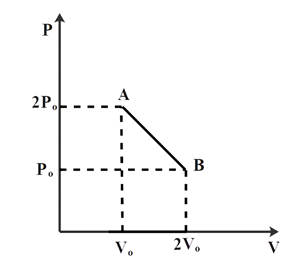
n moles of an ideal gas undergoes a process A and B as shown in the figure. The maximum temperature of the gas during the process will be:
A. \[\dfrac{9}{4}\dfrac{{{p}_{o}}{{V}_{o}}}{nR}\]
B. \[\dfrac{9}{2}\dfrac{{{p}_{o}}{{V}_{o}}}{nR}\]
C. \[\dfrac{9{{p}_{o}}{{V}_{o}}}{nR}\]
D. \[n=\dfrac{{{C}_{p}}}{{{C}_{v}}}\]
Answer
 Verified
626.4k+ views
Hint: In this question we have been asked to calculate the maximum temperature of gas during the given process. We have been given a pressure vs volume diagram and the number of moles is given as n. We know that the ideal gas equation deals with the relation between the pressure, volume, number of moles, gas constant and temperature. Therefore, we shall use the ideal gas equation to calculate the maximum temperature for a given process.
Formula used:
\[pV=nRT\]
\[y-{{y}_{1}}=\dfrac{{{y}_{2}}-{{y}_{1}}}{{{x}_{2}}-{{x}_{1}}}(x-{{x}_{1}})\]
Where,
X and Y are the coordinates
Complete Step by step solution:
It is given that the number of moles is to be taken as n.
Now, from the diagram we can say that equation of line AB is,
\[y-{{y}_{1}}=\dfrac{{{y}_{2}}-{{y}_{1}}}{{{x}_{2}}-{{x}_{1}}}(x-{{x}_{1}})\]
Now, substitute the x and y coordinates from the given diagram
We get,
\[p-{{p}_{o}}=\dfrac{2{{p}_{o}}-{{p}_{o}}}{{{V}_{o}}-2{{V}_{o}}}(V-2{{V}_{o}})\]
On solving,
\[p-{{p}_{o}}=\dfrac{-{{p}_{o}}}{{{V}_{o}}}(V-2{{V}_{o}})\]
Therefore,
\[p=\dfrac{-{{p}_{o}}}{{{V}_{o}}}V+3{{p}_{o}}\]
Now, multiplying both sides by V
We get,
\[pV=\dfrac{-{{p}_{o}}}{{{V}_{o}}}{{V}^{2}}+3{{p}_{o}}V\]
Now, we know from ideal gas equation,
\[pV=nRT\]
Therefore, we can write,
\[nRT=\dfrac{-{{p}_{o}}}{{{V}_{o}}}{{V}^{2}}+3{{p}_{o}}V\]
Now, solving for temperature
We get,
\[T=\dfrac{1}{nR}\left( \dfrac{-{{p}_{o}}}{{{V}_{o}}}{{V}^{2}}+3{{p}_{o}}V \right)\] ………………… (1)
Now, we know that for the temperature to be maximum,
\[\dfrac{\partial T}{\partial V}=0\]
After substituting value of T
We get,
\[\dfrac{-{{p}_{o}}}{{{V}_{o}}}(2V)+3{{p}_{o}}=0\]
On solving,
\[V=\dfrac{3}{2}{{V}_{o}}\] ……………….. (2)
Now, from (1) and (2)
We get,
\[{{T}_{\max }}=\dfrac{1}{nR}\left( \dfrac{-{{p}_{o}}}{{{V}_{o}}}\times \dfrac{9}{4}V_{o}^{2}+3{{p}_{o}}\times \dfrac{3}{2}{{V}_{o}} \right)\]
On solving,
\[{{T}_{\max }}=\dfrac{1}{nR}\left( -\dfrac{9}{4}{{p}_{o}}{{V}_{o}}+\dfrac{9}{2}{{p}_{o}}{{V}_{o}} \right)\]
Therefore,
\[{{T}_{\max }}=\dfrac{9}{4}\dfrac{{{p}_{o}}{{V}_{o}}}{nR}\]
Therefore, the correct answer is option A.
Note:
The ideal gas equation is an equation defining a hypothetical ideal gas. The normal gases can never be as accurate as the ideal gas. The ideal gas has certain limitations and it is based on the assumption that the gas taken into account is ideal or a perfect gas. Ideal gas equation can be derived from kinetic theory of gases. The state of a gas is determined by pressure, volume and temperature. The ideal gas relates these parameters with each other.
Formula used:
\[pV=nRT\]
\[y-{{y}_{1}}=\dfrac{{{y}_{2}}-{{y}_{1}}}{{{x}_{2}}-{{x}_{1}}}(x-{{x}_{1}})\]
Where,
X and Y are the coordinates
Complete Step by step solution:
It is given that the number of moles is to be taken as n.
Now, from the diagram we can say that equation of line AB is,
\[y-{{y}_{1}}=\dfrac{{{y}_{2}}-{{y}_{1}}}{{{x}_{2}}-{{x}_{1}}}(x-{{x}_{1}})\]
Now, substitute the x and y coordinates from the given diagram
We get,
\[p-{{p}_{o}}=\dfrac{2{{p}_{o}}-{{p}_{o}}}{{{V}_{o}}-2{{V}_{o}}}(V-2{{V}_{o}})\]
On solving,
\[p-{{p}_{o}}=\dfrac{-{{p}_{o}}}{{{V}_{o}}}(V-2{{V}_{o}})\]
Therefore,
\[p=\dfrac{-{{p}_{o}}}{{{V}_{o}}}V+3{{p}_{o}}\]
Now, multiplying both sides by V
We get,
\[pV=\dfrac{-{{p}_{o}}}{{{V}_{o}}}{{V}^{2}}+3{{p}_{o}}V\]
Now, we know from ideal gas equation,
\[pV=nRT\]
Therefore, we can write,
\[nRT=\dfrac{-{{p}_{o}}}{{{V}_{o}}}{{V}^{2}}+3{{p}_{o}}V\]
Now, solving for temperature
We get,
\[T=\dfrac{1}{nR}\left( \dfrac{-{{p}_{o}}}{{{V}_{o}}}{{V}^{2}}+3{{p}_{o}}V \right)\] ………………… (1)
Now, we know that for the temperature to be maximum,
\[\dfrac{\partial T}{\partial V}=0\]
After substituting value of T
We get,
\[\dfrac{-{{p}_{o}}}{{{V}_{o}}}(2V)+3{{p}_{o}}=0\]
On solving,
\[V=\dfrac{3}{2}{{V}_{o}}\] ……………….. (2)
Now, from (1) and (2)
We get,
\[{{T}_{\max }}=\dfrac{1}{nR}\left( \dfrac{-{{p}_{o}}}{{{V}_{o}}}\times \dfrac{9}{4}V_{o}^{2}+3{{p}_{o}}\times \dfrac{3}{2}{{V}_{o}} \right)\]
On solving,
\[{{T}_{\max }}=\dfrac{1}{nR}\left( -\dfrac{9}{4}{{p}_{o}}{{V}_{o}}+\dfrac{9}{2}{{p}_{o}}{{V}_{o}} \right)\]
Therefore,
\[{{T}_{\max }}=\dfrac{9}{4}\dfrac{{{p}_{o}}{{V}_{o}}}{nR}\]
Therefore, the correct answer is option A.
Note:
The ideal gas equation is an equation defining a hypothetical ideal gas. The normal gases can never be as accurate as the ideal gas. The ideal gas has certain limitations and it is based on the assumption that the gas taken into account is ideal or a perfect gas. Ideal gas equation can be derived from kinetic theory of gases. The state of a gas is determined by pressure, volume and temperature. The ideal gas relates these parameters with each other.
Recently Updated Pages
Which will be the least stable resonating structure class 11 chemistry CBSE

How many 5 digit telephone numbers can be construc-class-11-maths-CBSE
How do you find the angle of the resultant vector class 11 physics CBSE
Draw labelled diagram of the following i Gram seed class 11 biology CBSE
1 Quintal is equal to a 110 kg b 10 kg c 100kg d 1000 class 11 physics CBSE
What is the need and importance of classification class 11 biology CBSE
Trending doubts
One Metric ton is equal to kg A 10000 B 1000 C 100 class 11 physics CBSE
Find the value of the expression given below sin 30circ class 11 maths CBSE
Draw a diagram of nephron and explain its structur class 11 biology CBSE
10 examples of friction in our daily life
Proton was discovered by A Thomson B Rutherford C Chadwick class 11 chemistry CBSE
The teeth used for biting and cutting food are called class 11 biology CBSE