




Myosin filaments are localized in
(a) Z- band
(b) H- band
(c) A- band
(d) None of the above
Answer
 Verified
629.1k+ views
Hint: Actin molecules are sure to the Z line, which forms the borders of the sarcomere. Other bands appear when the sarcomere is relaxed. The myofibrils of smooth muscle cells aren't arranged into sarcomeres. Myosin filaments, the thick filaments, are bipolar in nature.
Complete answer:
-Each myofibril (muscle filament)has an alternate dark and lightweight band thereon.
- Whereas the dark band called ‘A’ or Anisotropic band contains Myosin and the light bands contain actin and are called I-band or Isotropic band,
-Myosin filaments also are called Thick filaments.
-Hence Myosin filaments are localized in A-Band.
Additional Information: Van Leeuwenhoek was the first which depicted the sarcomeres are what give skeletal and cardiovascular muscles their striated appearance
- A sarcomere is characterized in light of the fact that the fragment between two neighboring Z-lines (or Z-circles, or Z bodies). In electron micrographs of cross-striated muscle, the Z-line (from the German "Zwischenscheibe", the plate in the middle of the I groups) shows up as a progression of dull lines. They go about as a mooring purpose of the actin fibers.
-Surrounding the Z-line is the region of the I-band (for isotropic). I-band is the zone of thin filaments that are not superimposed by thick filaments (myosin).
-Following the I-band is the A-band (for anisotropic). Named for his or her properties under a polarizing microscope. An A-band contains the whole length of one thick filament. In anisotropic band, it can contain both thick and thin filaments.
-Within the A-band may be a paler region called the H-zone (from the German "heller", brighter). Named for his or her lighter appearance under a polarization microscope. H-band is that zone of the thick filaments that haven't any actin.
- Within the H-zone might be a flimsy M-line (from the German "Mittel Scheibe", the circle inside the center of the sarcomere) shaped of cross-interfacing components of the cytoskeleton.
So the correct answer is ‘A-band’.
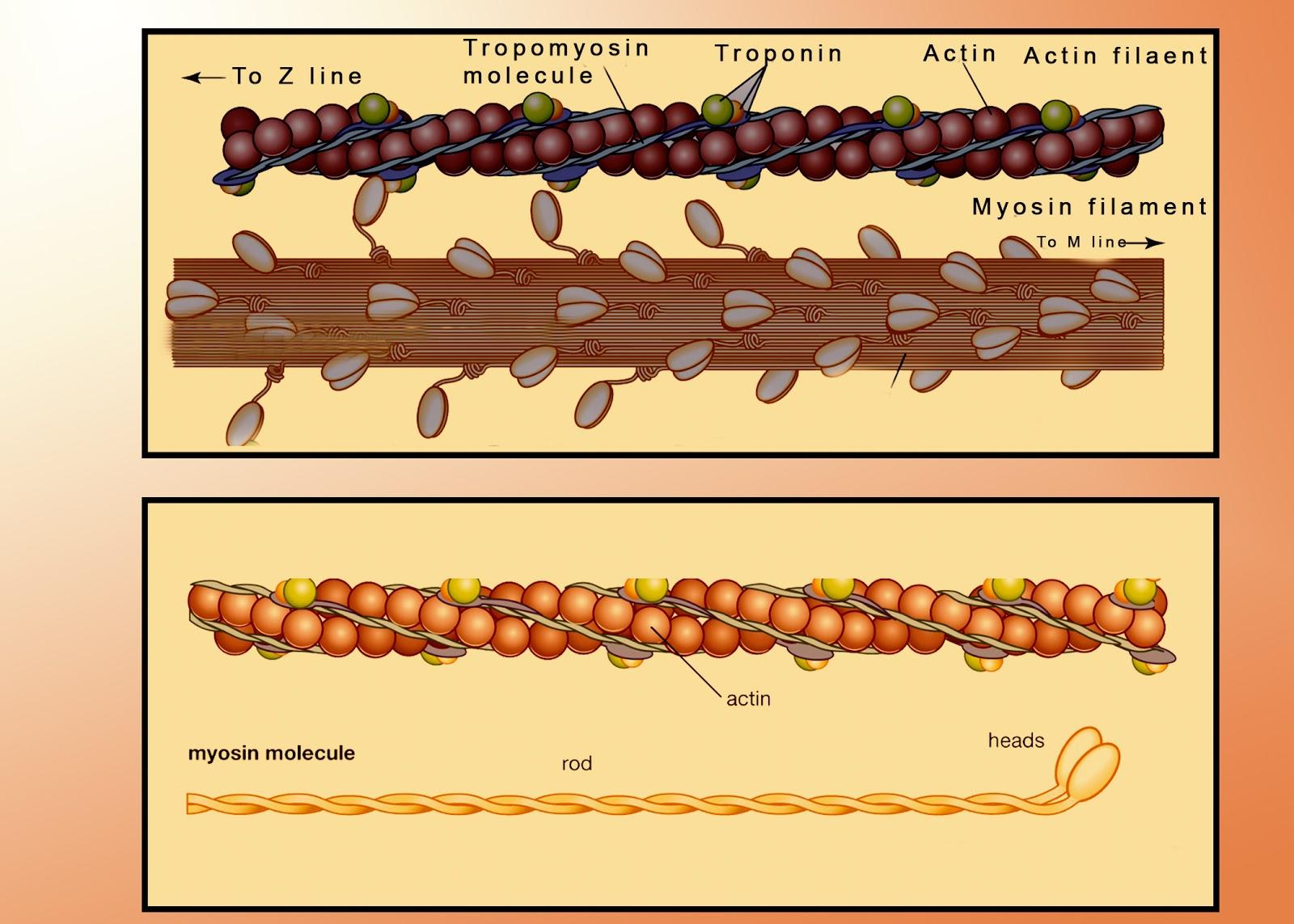
Note: Two of the important proteins are myosin, which forms the thick filament, and actin, which forms the skinny filament. Myosin features a long, fibrous tail and a globular head, which binds to actin. Myosin is the source of energy for muscle movement and the myosin head also binds to ATP. Myosin can possibly tie to actin when the coupling locales on actin are uncovered by calcium particles.
Complete answer:
-Each myofibril (muscle filament)has an alternate dark and lightweight band thereon.
- Whereas the dark band called ‘A’ or Anisotropic band contains Myosin and the light bands contain actin and are called I-band or Isotropic band,
-Myosin filaments also are called Thick filaments.
-Hence Myosin filaments are localized in A-Band.
Additional Information: Van Leeuwenhoek was the first which depicted the sarcomeres are what give skeletal and cardiovascular muscles their striated appearance
- A sarcomere is characterized in light of the fact that the fragment between two neighboring Z-lines (or Z-circles, or Z bodies). In electron micrographs of cross-striated muscle, the Z-line (from the German "Zwischenscheibe", the plate in the middle of the I groups) shows up as a progression of dull lines. They go about as a mooring purpose of the actin fibers.
-Surrounding the Z-line is the region of the I-band (for isotropic). I-band is the zone of thin filaments that are not superimposed by thick filaments (myosin).
-Following the I-band is the A-band (for anisotropic). Named for his or her properties under a polarizing microscope. An A-band contains the whole length of one thick filament. In anisotropic band, it can contain both thick and thin filaments.
-Within the A-band may be a paler region called the H-zone (from the German "heller", brighter). Named for his or her lighter appearance under a polarization microscope. H-band is that zone of the thick filaments that haven't any actin.
- Within the H-zone might be a flimsy M-line (from the German "Mittel Scheibe", the circle inside the center of the sarcomere) shaped of cross-interfacing components of the cytoskeleton.
So the correct answer is ‘A-band’.
Note: Two of the important proteins are myosin, which forms the thick filament, and actin, which forms the skinny filament. Myosin features a long, fibrous tail and a globular head, which binds to actin. Myosin is the source of energy for muscle movement and the myosin head also binds to ATP. Myosin can possibly tie to actin when the coupling locales on actin are uncovered by calcium particles.
Recently Updated Pages
Which will be the least stable resonating structure class 11 chemistry CBSE

How many 5 digit telephone numbers can be construc-class-11-maths-CBSE
How do you find the angle of the resultant vector class 11 physics CBSE
Draw labelled diagram of the following i Gram seed class 11 biology CBSE
What is the need and importance of classification class 11 biology CBSE
The way in which the sparrows expressed their sorrow class 11 english CBSE
Trending doubts
One Metric ton is equal to kg A 10000 B 1000 C 100 class 11 physics CBSE
Find the value of the expression given below sin 30circ class 11 maths CBSE
1 Quintal is equal to a 110 kg b 10 kg c 100kg d 1000 class 11 physics CBSE
Draw a diagram of nephron and explain its structur class 11 biology CBSE
10 examples of friction in our daily life
Proton was discovered by A Thomson B Rutherford C Chadwick class 11 chemistry CBSE