




Myopia can be corrected by _____
A. Converging lens
B. Bifocal lens
C. Diverging lens
D. None of the above
Answer
 Verified
628.5k+ views
Hint: Short-sightedness which is additionally referred to as myopia is caused when the eyeballs get elongated. To find the solution to the required question we need to find where the image is formed in such eyes, and how it can be corrected.
Complete step-by-step solution:
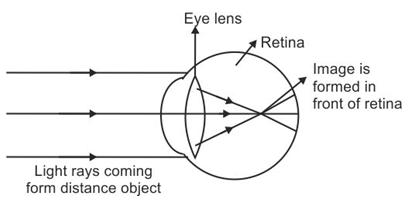
The person who is suffering from myopia can see nearby objects clearly but cannot see distant objects distinctly. The person suffering from this defect has the far point nearer than infinity. Such a person would only be able to see clearly up to a distance of a few meters. In a myopic eye, a distant object’s image is formed in front of the retina and not at the retina itself.
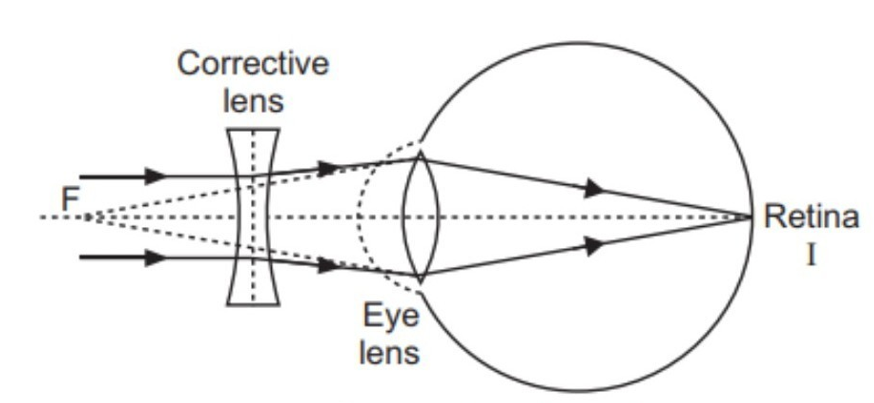
This defect occurs either because of (i) excessive curvature of the eye lens, or (ii) elongation of the eyeball. This defect can be corrected by using a diverging or concave lens of appropriate power.
Hence, option (C) is the correct answer.
For a better understanding of the concept let us see the diagrams of the human eye suffering from myopia,
The defect of a myopic eye can be corrected by using a diverging or concave lens of appropriate power.
Note: The normal vision of an eye is from 25cm to infinity. But in some situations, the eye is unable to focus the image of the object on the retina, so in such cases, the person is said to suffer from eye defects. Defects other than myopia are hypermetropia and presbyopia. Hypermetropia is also known as long-sightedness is caused when the eyeball is too short or when the focal length of the eye lens is too long. Presbyopia is caused when the eye loses its power of accommodation. It occurs because of aging due to the weakening of the ciliary muscles and diminishing flexibility of the eye lens.
Complete step-by-step solution:
The person who is suffering from myopia can see nearby objects clearly but cannot see distant objects distinctly. The person suffering from this defect has the far point nearer than infinity. Such a person would only be able to see clearly up to a distance of a few meters. In a myopic eye, a distant object’s image is formed in front of the retina and not at the retina itself.
This defect occurs either because of (i) excessive curvature of the eye lens, or (ii) elongation of the eyeball. This defect can be corrected by using a diverging or concave lens of appropriate power.
Hence, option (C) is the correct answer.
For a better understanding of the concept let us see the diagrams of the human eye suffering from myopia,
The defect of a myopic eye can be corrected by using a diverging or concave lens of appropriate power.
Note: The normal vision of an eye is from 25cm to infinity. But in some situations, the eye is unable to focus the image of the object on the retina, so in such cases, the person is said to suffer from eye defects. Defects other than myopia are hypermetropia and presbyopia. Hypermetropia is also known as long-sightedness is caused when the eyeball is too short or when the focal length of the eye lens is too long. Presbyopia is caused when the eye loses its power of accommodation. It occurs because of aging due to the weakening of the ciliary muscles and diminishing flexibility of the eye lens.
Recently Updated Pages
Class 10 Question and Answer - Your Ultimate Solutions Guide

Master Class 12 Economics: Engaging Questions & Answers for Success
Master Class 12 Social Science: Engaging Questions & Answers for Success
Master Class 12 English: Engaging Questions & Answers for Success
Master Class 12 Maths: Engaging Questions & Answers for Success
Master Class 12 Physics: Engaging Questions & Answers for Success
Trending doubts
Explain the Treaty of Vienna of 1815 class 10 social science CBSE
The slogan Jai Hind was given by A Lal Bahadur Shastri class 10 social science CBSE
10 examples of evaporation in daily life with explanations
What is the full form of POSCO class 10 social science CBSE
Identify the feminine form of noun nephew a shenephew class 10 english CBSE
CSIR full form?