




Muscle contraction is initiated by a signal by the central nervous system via
(a) Motor nerve
(b) Sensory nerve
(c) Mixed nerve
(d) All of the above
Answer
 Verified
610.2k+ views
Hint: It is a nerve located in the central nervous system (CNS), usually the spinal cord, that sends motor signals from the CNS to the muscles of the body. act as efferent nerves that carry information out from the CNS, as opposed to afferent nerves (also called sensory nerves), which send signals from sensory receptors in the periphery to the CNS.
Complete answer:
Most of the muscle actions of the body are voluntary except for the pumping of the heart and the reflex action. These muscles receive a signal through the motor nerves, sent by the brain or the CNS.
Additional Information: Motor nerves can vary supported by the subtype of efferent neuron they're accompany
Alpha
Alpha motor neurons target extrafusal muscle fibers. The motor nerves related to these neurons innervate extrafusal striated muscle fibers and are liable for contraction. These nerve fibers have the most important diameter of the motor neurons and need the very best conduction velocity of the three types
Beta
Beta engine neurons innervate intrafusal filaments of muscle axles. These nerves are liable for signaling slow-twitch muscle fibers.
Gamma
Gamma motor neurons, unlike alpha motor neurons, aren't directly involved in contraction. The nerves related to these neurons don't send signals that directly adjust the shortening or lengthening of muscle fibers. However, these nerves are important to keep muscle spindles taut.
So the correct answer is ‘Motor nerve’.
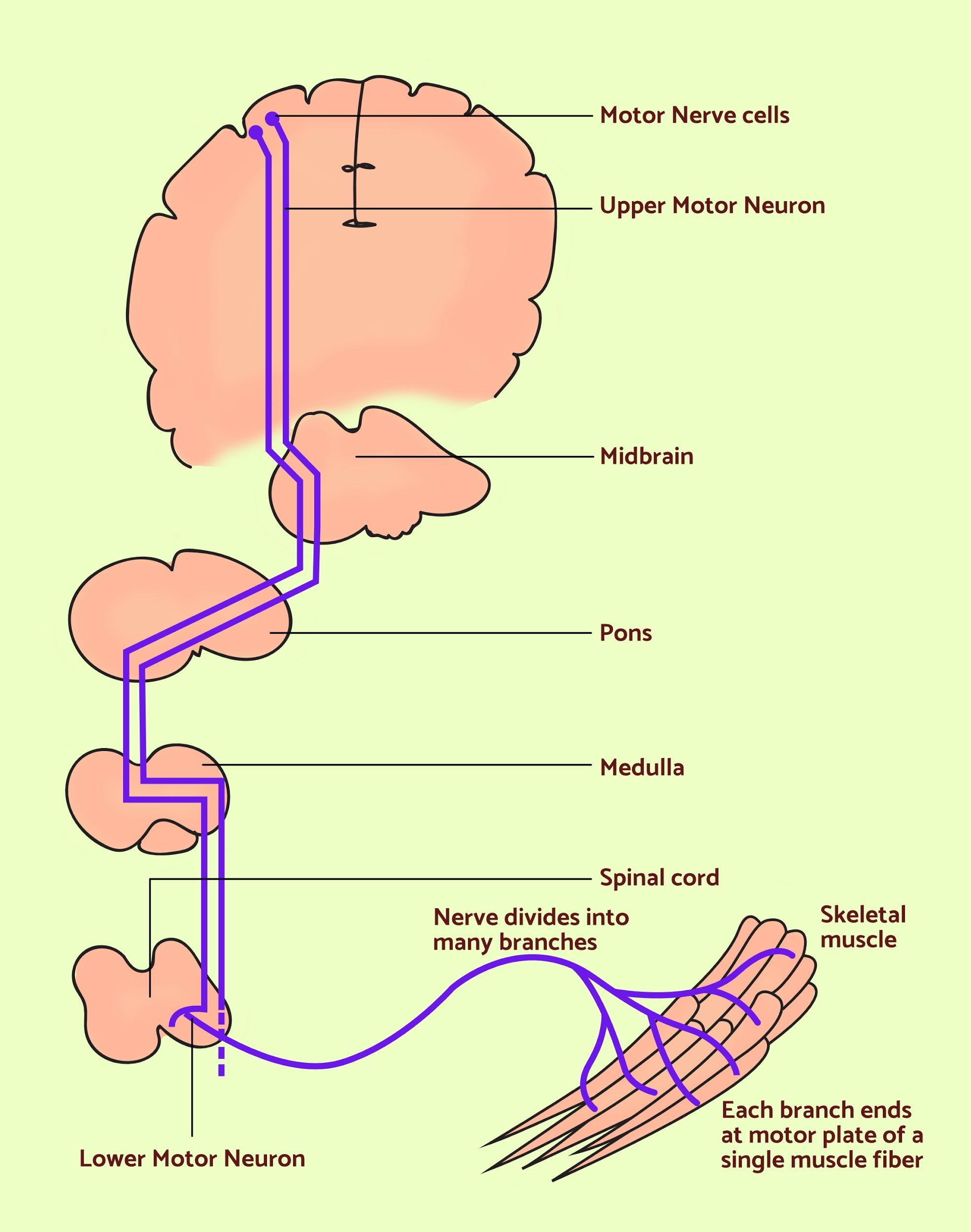
Note: Motor nerve axon terminals innervate skeletal and smooth muscle, as they are heavily involved in muscle control. Motor nerves tend to be rich in Acetylcholine vesicles because of the motor nerve, a bundle of motor nerve axons that deliver motor signals and signal for movement and motor control. Calcium vesicles reside within the axon terminals of the nerve bundles.
Complete answer:
Most of the muscle actions of the body are voluntary except for the pumping of the heart and the reflex action. These muscles receive a signal through the motor nerves, sent by the brain or the CNS.
Additional Information: Motor nerves can vary supported by the subtype of efferent neuron they're accompany
Alpha
Alpha motor neurons target extrafusal muscle fibers. The motor nerves related to these neurons innervate extrafusal striated muscle fibers and are liable for contraction. These nerve fibers have the most important diameter of the motor neurons and need the very best conduction velocity of the three types
Beta
Beta engine neurons innervate intrafusal filaments of muscle axles. These nerves are liable for signaling slow-twitch muscle fibers.
Gamma
Gamma motor neurons, unlike alpha motor neurons, aren't directly involved in contraction. The nerves related to these neurons don't send signals that directly adjust the shortening or lengthening of muscle fibers. However, these nerves are important to keep muscle spindles taut.
So the correct answer is ‘Motor nerve’.
Note: Motor nerve axon terminals innervate skeletal and smooth muscle, as they are heavily involved in muscle control. Motor nerves tend to be rich in Acetylcholine vesicles because of the motor nerve, a bundle of motor nerve axons that deliver motor signals and signal for movement and motor control. Calcium vesicles reside within the axon terminals of the nerve bundles.
Recently Updated Pages
Master Class 11 English: Engaging Questions & Answers for Success

Master Class 11 Social Science: Engaging Questions & Answers for Success
Master Class 11 Maths: Engaging Questions & Answers for Success
Master Class 11 Biology: Engaging Questions & Answers for Success
Master Class 11 Physics: Engaging Questions & Answers for Success
Master Class 11 Chemistry: Engaging Questions & Answers for Success
Trending doubts
One Metric ton is equal to kg A 10000 B 1000 C 100 class 11 physics CBSE
Difference Between Prokaryotic Cells and Eukaryotic Cells
Find the value of the expression given below sin 30circ class 11 maths CBSE
Difference between physical and chemical change class 11 chemistry CBSE
Two of the body parts which do not appear in MRI are class 11 biology CBSE
Draw a diagram of a plant cell and label at least eight class 11 biology CBSE