




Mr. Verma (50Kg) and Mr. Mathur (60Kg) are sitting at the two extremes of a 4m long boat (40Kg) standing still in water. To discuss a mechanics problem, they come to the middle of the boat. Neglecting friction with water, how far does the boat move in the water during the process:
$
{\text{A}}{\text{. }}\dfrac{{40}}{3}cm \\
{\text{B}}{\text{. }}\dfrac{{20}}{3}cm \\
{\text{C}}{\text{. }}\dfrac{{10}}{3}cm \\
{\text{D}}{\text{. }}10cm \\
$
Answer
 Verified
639.9k+ views
Hint: Here we go through the property of the center of mass to solve the question by first letting the persons and boat have different systems and then by letting all in the same system.
Complete Step-by-Step solution:
Here in the question it is given that Mr. Verma (50Kg) and Mr. Mathur (60Kg) are sitting at the two extremes of a 4m long boat (40Kg).
Now let,
${M_1} = $ Mass of Mr. Verma=50 kg ${X_1} = $Position of Mr. Verma
${M_2} = $Mass of Boat =40 kg ${X_2} = $Position Of Boat
${M_2} = $Mass of Mr. Mathur= 60 kg ${X_3} = $Position of Mr. Mathur.
Let the coordinate of the position of Mr. Verma be${X_1} \equiv (0,0)$ from this point we can say that the position of boat is ${X_2} \equiv (2,0)$ (because we know in uniform body the centre of mass is in the centre) and ${X_3} \equiv (4,0)$
As we know the formula of Center of mass of system in x is $\dfrac{{{M_1}{X_1} + {M_2}{X_2} + {M_3}{X_3}}}{{{M_1} + {M_2} + {M_3}}}$
After putting the data in the formula we get,
C.O.M. $ = \dfrac{{(50)(0) + (40)(2) + (60)(4)}}{{60 + 40 + 50}} = \dfrac{{32}}{{15}}$
When both come to the middle of the boat the mass of all the body comes to the center of the boat and now we will find out the centre of mass again taking the whole system.
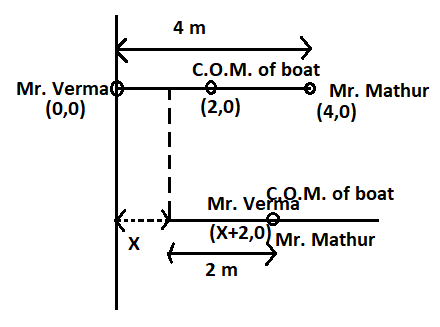
Let the distance moved by the boat be X from the origin.
The final coordinates of the centre of mass of boat, Mr. Verma and Mr. Mathur will be (X+2)
The centre of mass of system will now have equation:
Final C.O.M$ = \dfrac{{(X + 2)(50 + 40 + 60)}}{{50 + 40 + 60}}$
The initial and final C.O.M. will be same:
$\dfrac{{32}}{{15}}$$ = \dfrac{{(X + 2)(50 + 40 + 60)}}{{50 + 40 + 60}}$
From the above equation we get the value of X as
$\dfrac{2}{{15}}meters$
The options are in centimeters so, multiplying by 100 to get the answer:
$\dfrac{2}{{15}} \times 100 = \dfrac{{40}}{3} cm$
This gives (A) as the correct option.
Note- This is a simple centre of mass problem and to solve this type of question, the formula should be correctly remembered plus the diagram should be made to get the correct idea of displacement.
Complete Step-by-Step solution:
Here in the question it is given that Mr. Verma (50Kg) and Mr. Mathur (60Kg) are sitting at the two extremes of a 4m long boat (40Kg).
Now let,
${M_1} = $ Mass of Mr. Verma=50 kg ${X_1} = $Position of Mr. Verma
${M_2} = $Mass of Boat =40 kg ${X_2} = $Position Of Boat
${M_2} = $Mass of Mr. Mathur= 60 kg ${X_3} = $Position of Mr. Mathur.
Let the coordinate of the position of Mr. Verma be${X_1} \equiv (0,0)$ from this point we can say that the position of boat is ${X_2} \equiv (2,0)$ (because we know in uniform body the centre of mass is in the centre) and ${X_3} \equiv (4,0)$
As we know the formula of Center of mass of system in x is $\dfrac{{{M_1}{X_1} + {M_2}{X_2} + {M_3}{X_3}}}{{{M_1} + {M_2} + {M_3}}}$
After putting the data in the formula we get,
C.O.M. $ = \dfrac{{(50)(0) + (40)(2) + (60)(4)}}{{60 + 40 + 50}} = \dfrac{{32}}{{15}}$
When both come to the middle of the boat the mass of all the body comes to the center of the boat and now we will find out the centre of mass again taking the whole system.
Let the distance moved by the boat be X from the origin.
The final coordinates of the centre of mass of boat, Mr. Verma and Mr. Mathur will be (X+2)
The centre of mass of system will now have equation:
Final C.O.M$ = \dfrac{{(X + 2)(50 + 40 + 60)}}{{50 + 40 + 60}}$
The initial and final C.O.M. will be same:
$\dfrac{{32}}{{15}}$$ = \dfrac{{(X + 2)(50 + 40 + 60)}}{{50 + 40 + 60}}$
From the above equation we get the value of X as
$\dfrac{2}{{15}}meters$
The options are in centimeters so, multiplying by 100 to get the answer:
$\dfrac{2}{{15}} \times 100 = \dfrac{{40}}{3} cm$
This gives (A) as the correct option.
Note- This is a simple centre of mass problem and to solve this type of question, the formula should be correctly remembered plus the diagram should be made to get the correct idea of displacement.
Recently Updated Pages
Master Class 12 Economics: Engaging Questions & Answers for Success

Master Class 12 English: Engaging Questions & Answers for Success
Master Class 12 Social Science: Engaging Questions & Answers for Success
Master Class 12 Maths: Engaging Questions & Answers for Success
Master Class 12 Physics: Engaging Questions & Answers for Success
Master Class 10 English: Engaging Questions & Answers for Success
Trending doubts
Explain the Treaty of Vienna of 1815 class 10 social science CBSE
Why is it 530 pm in india when it is 1200 afternoon class 10 social science CBSE
What is the full form of POSCO class 10 social science CBSE
Define Potential, Developed, Stock and Reserved resources
Which Country Has the Largest Border with India?
Complete the sentence with the most appropriate word class 10 english CBSE