




Most water absorption in plants takes place through
A) Root cap
B) Root apex
C) Root hair
D) Meristematic zone
Answer
 Verified
530.7k+ views
Hint: Absorption of water refers to the translocation of water from the soil solution to the xylem of the root. Most often plants absorb water by the root system. The absorption of water is a vital process that is important for plant growth and other metabolic activities. Most water is absorbed by a unicellular tubular hair-like structure which is a water-permeable region of the plant.
Complete answer:
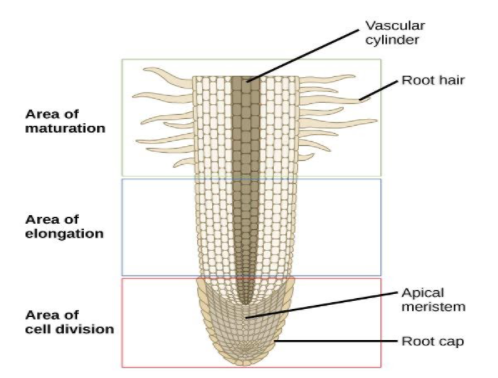
To answer this question you must know about the absorption of water in plants. Plants absorb the water through the entire surface using roots, stem and leaves. Generally, the water is absorbed by roots and the area of young roots where most water absorption takes place through the root hair zone.
The root hair is a very delicate structure that is continuously replaced by new ones. Roots hairs have numerous pores which provide a large surface area for absorption and they have sticky walls by which they adhere tightly to soil particles. So, most water absorption in plants takes place through root hairs.
Considering another example:
- Root apex also called apical meristem which is capable of cell division and is responsible for the growth of plants.
- Root cap is the mass of a cell that is generally present at the end of the root and protects the growing cells.
- Meristematic zones consist of tissues or groups of totipotent cells that have the ability to divide and differentiate.
Since roots hair absorbs most water in plants, therefore, the correct answer is an option (C) i.e, root hairs.
Note: There are two types of absorption : active and passive absorption. Active absorption of water is the absorption of water with the use of energy is known as active absorption. And passive absorption is the intake of water through the transpiration pull is called passive absorption. The most interesting thing about water is, it's said to be the liquid gold of life.
Complete answer:
To answer this question you must know about the absorption of water in plants. Plants absorb the water through the entire surface using roots, stem and leaves. Generally, the water is absorbed by roots and the area of young roots where most water absorption takes place through the root hair zone.
The root hair is a very delicate structure that is continuously replaced by new ones. Roots hairs have numerous pores which provide a large surface area for absorption and they have sticky walls by which they adhere tightly to soil particles. So, most water absorption in plants takes place through root hairs.
Considering another example:
- Root apex also called apical meristem which is capable of cell division and is responsible for the growth of plants.
- Root cap is the mass of a cell that is generally present at the end of the root and protects the growing cells.
- Meristematic zones consist of tissues or groups of totipotent cells that have the ability to divide and differentiate.
Since roots hair absorbs most water in plants, therefore, the correct answer is an option (C) i.e, root hairs.
Note: There are two types of absorption : active and passive absorption. Active absorption of water is the absorption of water with the use of energy is known as active absorption. And passive absorption is the intake of water through the transpiration pull is called passive absorption. The most interesting thing about water is, it's said to be the liquid gold of life.
Recently Updated Pages
Master Class 11 English: Engaging Questions & Answers for Success

Master Class 11 Social Science: Engaging Questions & Answers for Success
Master Class 11 Maths: Engaging Questions & Answers for Success
Master Class 11 Biology: Engaging Questions & Answers for Success
Master Class 11 Physics: Engaging Questions & Answers for Success
Master Class 11 Chemistry: Engaging Questions & Answers for Success
Trending doubts
One Metric ton is equal to kg A 10000 B 1000 C 100 class 11 physics CBSE
Difference Between Prokaryotic Cells and Eukaryotic Cells
Find the value of the expression given below sin 30circ class 11 maths CBSE
Two of the body parts which do not appear in MRI are class 11 biology CBSE
Draw a diagram of a plant cell and label at least eight class 11 biology CBSE
10 examples of friction in our daily life