




Most important character of Brassica campestris is
A) False Septum
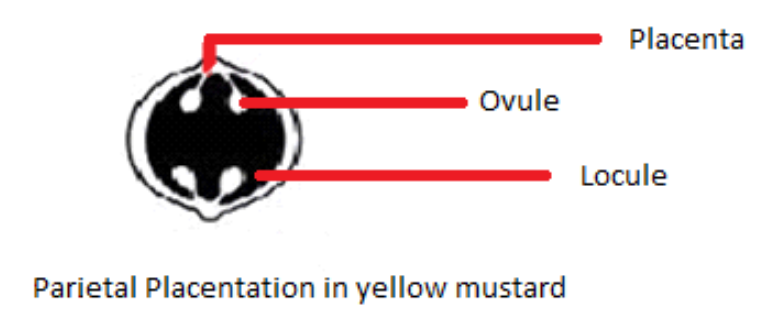
B) Parietal placentation
C) Ebracteate
D) Imbricate aestivation.
Answer
 Verified
594k+ views
Hint: Brassica campestris belong to the kingdom Plantae, family Brassicaceae. It is an angiospermic plant. It is commonly known as yellow mustard which produces oil.
Complete Answer:
To solve this question we have to know about the distinctive features of the Genus Brassica.
Brassica genus plants are mainly agricultural and horticultural plants. They are commonly used for food and are mostly seasonal plants. These plants grow as small shrubs. Brassica campestris is widely cultivated as a leafy vegetable, root vegetable and an oil yielding plant.
Some characteristics of Brassicaceae are- flowers are actinomorphic and hermaphrodite. They do not have false septum rather they possess an oblique septum. The style and stigma are short and bifid. They exhibit parietal placentation due to the presence of a superior ovary. One or more than one ovule is present.
Leaves are simple and alternate. Petals are polypetalous. They are arranged in one whole alternate with sepals. This kind of arrangement is a characteristic feature of this family. It is known as the cruciform arrangement. They show valvate aestivation.
Thus, the correct answer is (B). The parietal placentation is an important character of Brassica campestris or yellow mustard.
Additional Information: The plants belonging to this family are used as vegetables. Cabbage, Cauliflower, broccoli, radish, and turnip belong to the family Brassicaceae. Few plants like Lepidium are used as medicines to cure cough, asthma. Some are used as ornamental plants.
Note: Aestivation means the arrangement of petals and sepals in a flower. In valvate aestivation the sepals and petals do not overlap. Rather, they are present separately.
Complete Answer:
To solve this question we have to know about the distinctive features of the Genus Brassica.
Brassica genus plants are mainly agricultural and horticultural plants. They are commonly used for food and are mostly seasonal plants. These plants grow as small shrubs. Brassica campestris is widely cultivated as a leafy vegetable, root vegetable and an oil yielding plant.
Some characteristics of Brassicaceae are- flowers are actinomorphic and hermaphrodite. They do not have false septum rather they possess an oblique septum. The style and stigma are short and bifid. They exhibit parietal placentation due to the presence of a superior ovary. One or more than one ovule is present.
Leaves are simple and alternate. Petals are polypetalous. They are arranged in one whole alternate with sepals. This kind of arrangement is a characteristic feature of this family. It is known as the cruciform arrangement. They show valvate aestivation.
Thus, the correct answer is (B). The parietal placentation is an important character of Brassica campestris or yellow mustard.
Additional Information: The plants belonging to this family are used as vegetables. Cabbage, Cauliflower, broccoli, radish, and turnip belong to the family Brassicaceae. Few plants like Lepidium are used as medicines to cure cough, asthma. Some are used as ornamental plants.
Note: Aestivation means the arrangement of petals and sepals in a flower. In valvate aestivation the sepals and petals do not overlap. Rather, they are present separately.
Recently Updated Pages
Master Class 11 Computer Science: Engaging Questions & Answers for Success

Master Class 11 Business Studies: Engaging Questions & Answers for Success
Master Class 11 Economics: Engaging Questions & Answers for Success
Master Class 11 English: Engaging Questions & Answers for Success
Master Class 11 Maths: Engaging Questions & Answers for Success
Master Class 11 Biology: Engaging Questions & Answers for Success
Trending doubts
One Metric ton is equal to kg A 10000 B 1000 C 100 class 11 physics CBSE
There are 720 permutations of the digits 1 2 3 4 5 class 11 maths CBSE
Discuss the various forms of bacteria class 11 biology CBSE
Draw a diagram of a plant cell and label at least eight class 11 biology CBSE
State the laws of reflection of light
10 examples of friction in our daily life