




Most common type of embryo sac reported in angiosperm is of
(a) Polygonum
(b) Oenothera
(c) Adoxa
(d) Plumbago
Answer
 Verified
668.1k+ views
Hint: The most common type of embryo sac is an 8 nucleated embryo sac and develops from the chalazal megaspore. Three nuclear divisions occur in order to form this type of embryo sac.
Complete Answer:
The embryo sac that occurs in the majority of flowering plants is monosporic eight‐nucleate and seven‐celled embryo sac and is of polygonum type. This type of embryo sac is found in about 81% of the plant families. It was described for the first time by Strasburger in Polygonum divaricatum and considered to be formed by three nuclear divisions that result in 8 nuclei. It is formed from the chalazal megaspore of the megaspore tetrad and comprises 3-celled egg apparatus, three antipodals, and a central cell that is binucleate.
The monosporic embryo sac develops from a single megaspore and in these embryo sacs all the nuclei, that are present, are found to be genetically similar to each other. This is because all the nuclei have been derived by mitosis in a single nucleus. After the first mitotic division, the two daughter nuclei move apart and reach to the opposite poles. Most part of the cytoplasm gets aggregated around the two nuclei and the rest part of the cytoplasm forms a thin peripheral layer while the central portion is occupied by a large vacuole. On the next division, a 4-celled stage is reached and in the subsequent ones, the 8-celled stage is acquired.
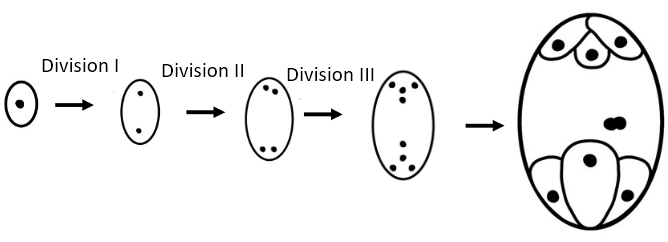
So, the correct answer is,’Polygonum’.
Note: Oenothera is a monosporic 4-nucleated embryo sac and develops from the micropylar megaspore. It lacks antipodals.
- Adoxa and Plumbago are the types of tetrasporic embryo sacs and the nuclei in these embryo sacs are more heterogeneous in comparison to the other types.
Complete Answer:
The embryo sac that occurs in the majority of flowering plants is monosporic eight‐nucleate and seven‐celled embryo sac and is of polygonum type. This type of embryo sac is found in about 81% of the plant families. It was described for the first time by Strasburger in Polygonum divaricatum and considered to be formed by three nuclear divisions that result in 8 nuclei. It is formed from the chalazal megaspore of the megaspore tetrad and comprises 3-celled egg apparatus, three antipodals, and a central cell that is binucleate.
The monosporic embryo sac develops from a single megaspore and in these embryo sacs all the nuclei, that are present, are found to be genetically similar to each other. This is because all the nuclei have been derived by mitosis in a single nucleus. After the first mitotic division, the two daughter nuclei move apart and reach to the opposite poles. Most part of the cytoplasm gets aggregated around the two nuclei and the rest part of the cytoplasm forms a thin peripheral layer while the central portion is occupied by a large vacuole. On the next division, a 4-celled stage is reached and in the subsequent ones, the 8-celled stage is acquired.
So, the correct answer is,’Polygonum’.
Note: Oenothera is a monosporic 4-nucleated embryo sac and develops from the micropylar megaspore. It lacks antipodals.
- Adoxa and Plumbago are the types of tetrasporic embryo sacs and the nuclei in these embryo sacs are more heterogeneous in comparison to the other types.
Recently Updated Pages
Which of the following graphs shows the variation of class 12 physics CBSE

Draw a labelled diagram of the human male reproductive class 12 biology CBSE
Describe the experiment to compare the emf of two cells class 12 physics CBSE
What is standard hydrogen electrode
What is conventional current and electric current class 12 physics CBSE
2Bromopentane is treated with an alcoholic KOH solution class 12 chemistry CBSE
Trending doubts
Draw a labelled sketch of the human eye class 12 physics CBSE
Which are the Top 10 Largest Countries of the World?
Draw ray diagrams each showing i myopic eye and ii class 12 physics CBSE
Materials which do not allow an electric current to class 12 physics CBSE
Which is the correct genotypic ratio of mendel dihybrid class 12 biology CBSE
Which is the strongest oxidising agent out of the following class 12 chemistry CBSE