




Most appropriate term to designate the life cycle of Obelia is
A. Neoteny
B. Metagenesis
C. Metamorphosis
D. None of the above
Answer
 Verified
669.9k+ views
Hint: In a complete life cycle, when an organism goes through alternation of generations between sexual and asexual forms is termed as metagenesis whereas metamorphosis involves in change in forms on habits of an organism during normal development after the completion of embryonic stage..Besides, delayed physiological development of an organism (specially in humans) is called neoteny.
Complete answer:
Obelia sp. (sea fur), a marine, freshwater hydrozoan, belongs to the phylum Chidaria. It is diploblastic having two true tissue layers- an epidermis and a gastrodermis, with a jelly-like substance (mesoglea) which fills the area between two true tissue layers.
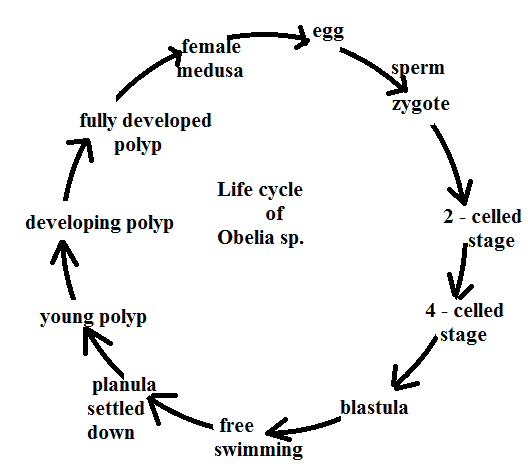
Life cycle of Obelia sp. is completed through two distinct stages: polyp stage and medusa stage. The life cycle begins as immobile polyp colonies that contain gonangium, a reproductive unit. Later, gonangium reproduces asexually while releasing medusa. Medusa or jellyfish can go through sexual reproduction releasing eggs and also sperms into the water. This results in the formation of larvae which attach to the ocean floor as new polyps. Hence in complete life cycle, Obelia begins with polyp stage (asexual generation) and then to medusa stage (sexual generation). Thus alternation of generation takes place which is also known as metagenesis.
Hence, (B) Metagenesis is termed to designate the life cycle of Obelia sp.
Note: As metagenesis and metamorphosis are two quite similar terms, sometimes one makes mistakes in choosing between them. So, keeping this in mind, we should have a clear idea between metamorphosis and alternation of generation (metagenesis) and also neoteny i.e. the retention of physical development of an organism.
Complete answer:
Obelia sp. (sea fur), a marine, freshwater hydrozoan, belongs to the phylum Chidaria. It is diploblastic having two true tissue layers- an epidermis and a gastrodermis, with a jelly-like substance (mesoglea) which fills the area between two true tissue layers.
Life cycle of Obelia sp. is completed through two distinct stages: polyp stage and medusa stage. The life cycle begins as immobile polyp colonies that contain gonangium, a reproductive unit. Later, gonangium reproduces asexually while releasing medusa. Medusa or jellyfish can go through sexual reproduction releasing eggs and also sperms into the water. This results in the formation of larvae which attach to the ocean floor as new polyps. Hence in complete life cycle, Obelia begins with polyp stage (asexual generation) and then to medusa stage (sexual generation). Thus alternation of generation takes place which is also known as metagenesis.
Hence, (B) Metagenesis is termed to designate the life cycle of Obelia sp.
Note: As metagenesis and metamorphosis are two quite similar terms, sometimes one makes mistakes in choosing between them. So, keeping this in mind, we should have a clear idea between metamorphosis and alternation of generation (metagenesis) and also neoteny i.e. the retention of physical development of an organism.
Recently Updated Pages
Master Class 11 Social Science: Engaging Questions & Answers for Success

Master Class 11 English: Engaging Questions & Answers for Success
Master Class 11 Accountancy: Engaging Questions & Answers for Success
Master Class 11 Physics: Engaging Questions & Answers for Success
Master Class 11 Computer Science: Engaging Questions & Answers for Success
Master Class 11 Business Studies: Engaging Questions & Answers for Success
Trending doubts
One Metric ton is equal to kg A 10000 B 1000 C 100 class 11 physics CBSE
Find the value of the expression given below sin 30circ class 11 maths CBSE
Draw a diagram of nephron and explain its structur class 11 biology CBSE
10 examples of friction in our daily life
Proton was discovered by A Thomson B Rutherford C Chadwick class 11 chemistry CBSE
How many kilometers are there in 100 meters class 11 maths CBSE