




Why do molecules like glucose require a carrier protein to get across the cell membrane?
Answer
 Verified
481.5k+ views
Hint: In order to answer this question, first we need to understand the concept of carrier protein. Carrier proteins are basically the proteins which carry various chemicals across the membrane in both the directions, which is down as well as up the concentration gradient. Carrier proteins can also be defined as the proteins which bind to molecules or ions on any one side of the membrane and therefore, release them on the other.
Complete solution:
The structure of a glucose molecule is as follows:
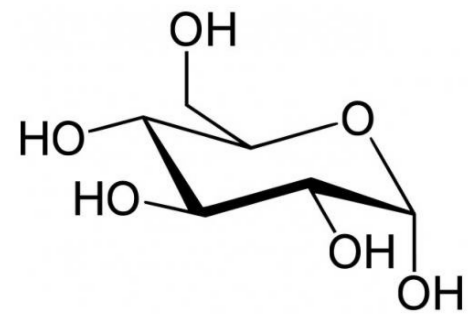
The cell membrane is basically made up of two layers of phospholipids, and each of the two layers is made of two parts, a hydrophobic tail and a hydrophilic head. These two tails meet to make the middle portion of the membrane, and the heads go outward in order to make the outer and the inner surface of this particular cell membrane.
The glucose molecule is made up of carbon atoms which are connected to many OH groups and even the H protons. This makes the glucose molecule a very polar molecule which is a hydrophilic one.
Even outside the cell, when the glucose molecule wants to get an inside down concentration gradient, the polarity of the glucose molecule is accepted by the head of the cell membrane so that it is able to pass through, whereas the middle part of this particular cell membrane repels it. So, there should always be a channel which is embedded in the cell membrane with a hydrophilic layer inside it which allows the glucose molecule to easily pass through it.
Thus, molecules like glucose require a carrier protein to get across the cell membrane in order to overcome the repulsion by the middle part of the cell membrane which is hydrophobic in nature.
Note: Other than carrier protein, there is also a channel protein which can easily generate hydrophilic holes in the cell membranes, which allows the molecules to go down with a concentration gradient. These channel proteins create holes that can easily penetrate through the membrane, enabling the various target molecules to flow through via the diffusion without interfering with one another.
Complete solution:
The structure of a glucose molecule is as follows:
The cell membrane is basically made up of two layers of phospholipids, and each of the two layers is made of two parts, a hydrophobic tail and a hydrophilic head. These two tails meet to make the middle portion of the membrane, and the heads go outward in order to make the outer and the inner surface of this particular cell membrane.
The glucose molecule is made up of carbon atoms which are connected to many OH groups and even the H protons. This makes the glucose molecule a very polar molecule which is a hydrophilic one.
Even outside the cell, when the glucose molecule wants to get an inside down concentration gradient, the polarity of the glucose molecule is accepted by the head of the cell membrane so that it is able to pass through, whereas the middle part of this particular cell membrane repels it. So, there should always be a channel which is embedded in the cell membrane with a hydrophilic layer inside it which allows the glucose molecule to easily pass through it.
Thus, molecules like glucose require a carrier protein to get across the cell membrane in order to overcome the repulsion by the middle part of the cell membrane which is hydrophobic in nature.
Note: Other than carrier protein, there is also a channel protein which can easily generate hydrophilic holes in the cell membranes, which allows the molecules to go down with a concentration gradient. These channel proteins create holes that can easily penetrate through the membrane, enabling the various target molecules to flow through via the diffusion without interfering with one another.
Recently Updated Pages
Master Class 11 Computer Science: Engaging Questions & Answers for Success

Master Class 11 Business Studies: Engaging Questions & Answers for Success
Master Class 11 Economics: Engaging Questions & Answers for Success
Master Class 11 English: Engaging Questions & Answers for Success
Master Class 11 Maths: Engaging Questions & Answers for Success
Master Class 11 Biology: Engaging Questions & Answers for Success
Trending doubts
One Metric ton is equal to kg A 10000 B 1000 C 100 class 11 physics CBSE
There are 720 permutations of the digits 1 2 3 4 5 class 11 maths CBSE
Discuss the various forms of bacteria class 11 biology CBSE
Draw a diagram of a plant cell and label at least eight class 11 biology CBSE
State the laws of reflection of light
Explain zero factorial class 11 maths CBSE