




What minimum is to be pulled Contacts \[15\]. I’ll be force by the rod on one of the blocks \[20\]. A block of mass M is kept on a rough horizontal surface. The coefficient of static friction between the block and the surface is\[\mu \]. The block is to be pulled by applying a force to it. What minimum force is needed to side the block? In which direction should this block force act? The friction coefficient, between the board and the floor block? In what motion should I be bored?
Answer
 Verified
576.6k+ views
Hint: The coefficient of friction is a dimensionless scalar value. The coefficient of friction is a ratio of the force friction between two bodies and force pressing together. Friction does not depend on the amount of surface area in contact between moving bodies. Friction depends on the magnitude of the forces holding the bodies together. The coefficients of friction range from \[0\] to greater than 1.
Complete step-by-step solution:
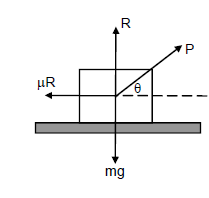
Let ‘\[P\] ’ be the force applied to at an angle \[\theta \] from the free body diagram.
\[R + P\sin \theta - mg = 0\]
\[R = - P\sin \theta + mg \to \left( 1 \right)\]
\[\mu R - P\cos \theta \to \left( 2 \right)\]
Equation \[\left( 1 \right)\mu \left( {mg - P\sin \theta } \right) - P\cos \theta = 0\]
\[ \Rightarrow \mu mg = \mu \rho \sin \theta - P\cos \theta \Rightarrow \rho = \dfrac{{\mu mg}}{{\mu \sin \theta + \cos \theta }}\]
Applied force \[P\] should be minimum, when \[\mu \sin \theta + \cos \theta \] is maximum again, \[\mu \sin \theta + \cos \theta \] is maximum when its derivative is zero.
Therefore, \[d/d\theta \left( {\mu \sin \theta + \cos \theta } \right) = 0\]
\[\mu \cos \theta - \sin \theta = 0\]
\[\theta = {\tan ^{ - 1}}\mu \]
So,\[P = \dfrac{{\mu mg}}{{\mu \sin \theta + \cos \theta }} = \dfrac{{\mu mg/\cos \theta }}{{\dfrac{{\mu \sin \theta }}{{\cos \theta }} + \dfrac{{\cos \theta }}{{\cos \theta }}}} = \dfrac{{\mu mg\sec \theta }}{{1 + \mu \tan \theta }} = \dfrac{{\mu mg\sec \theta }}{{1 + {{\tan }^2}\theta }}\]
\[ = \dfrac{{\mu mg}}{{\sec \theta }} = \dfrac{{\mu mg}}{{\sqrt {\left( {1 + {{\tan }^2}\theta } \right)} }} = \dfrac{{\mu mg}}{{\sqrt {1 + {\mu ^2}} }}\]
The minimum force is \[\dfrac{{\mu mg}}{{\sqrt {1 + {\mu ^2}} }}\] at an angle \[\theta = {\tan ^{ - 1}}\mu \].
The block should move in the direction of the larger force. So, the block moves to the left side.
The friction coefficient between the board and floor is \[\mu \]. Therefore the maximum friction force which the floor can exert is \[\mu N\], when \[N\] is the normal reaction at the contact surface between the board and the floor.
Note:The static coefficient of friction is applied to motionless objects. The low value of the coefficient of friction is that the force required for sliding occurs is less than the force required when the coefficient of friction is high. The coefficients of friction range from \[0\] to greater than 1.
Complete step-by-step solution:
Let ‘\[P\] ’ be the force applied to at an angle \[\theta \] from the free body diagram.
\[R + P\sin \theta - mg = 0\]
\[R = - P\sin \theta + mg \to \left( 1 \right)\]
\[\mu R - P\cos \theta \to \left( 2 \right)\]
Equation \[\left( 1 \right)\mu \left( {mg - P\sin \theta } \right) - P\cos \theta = 0\]
\[ \Rightarrow \mu mg = \mu \rho \sin \theta - P\cos \theta \Rightarrow \rho = \dfrac{{\mu mg}}{{\mu \sin \theta + \cos \theta }}\]
Applied force \[P\] should be minimum, when \[\mu \sin \theta + \cos \theta \] is maximum again, \[\mu \sin \theta + \cos \theta \] is maximum when its derivative is zero.
Therefore, \[d/d\theta \left( {\mu \sin \theta + \cos \theta } \right) = 0\]
\[\mu \cos \theta - \sin \theta = 0\]
\[\theta = {\tan ^{ - 1}}\mu \]
So,\[P = \dfrac{{\mu mg}}{{\mu \sin \theta + \cos \theta }} = \dfrac{{\mu mg/\cos \theta }}{{\dfrac{{\mu \sin \theta }}{{\cos \theta }} + \dfrac{{\cos \theta }}{{\cos \theta }}}} = \dfrac{{\mu mg\sec \theta }}{{1 + \mu \tan \theta }} = \dfrac{{\mu mg\sec \theta }}{{1 + {{\tan }^2}\theta }}\]
\[ = \dfrac{{\mu mg}}{{\sec \theta }} = \dfrac{{\mu mg}}{{\sqrt {\left( {1 + {{\tan }^2}\theta } \right)} }} = \dfrac{{\mu mg}}{{\sqrt {1 + {\mu ^2}} }}\]
The minimum force is \[\dfrac{{\mu mg}}{{\sqrt {1 + {\mu ^2}} }}\] at an angle \[\theta = {\tan ^{ - 1}}\mu \].
The block should move in the direction of the larger force. So, the block moves to the left side.
The friction coefficient between the board and floor is \[\mu \]. Therefore the maximum friction force which the floor can exert is \[\mu N\], when \[N\] is the normal reaction at the contact surface between the board and the floor.
Note:The static coefficient of friction is applied to motionless objects. The low value of the coefficient of friction is that the force required for sliding occurs is less than the force required when the coefficient of friction is high. The coefficients of friction range from \[0\] to greater than 1.
Recently Updated Pages
If x a + bt + ct2 where x is in meters and t is in class 11 physics CBSE

A car covers the first half distance between two places class 11 physics CBSE
The resultant of two vectors overrightarrow P and overrightarrow class 11 physics CBSE
Find the value of cos 135 class 11 maths CBSE
A mass M is held in place by an applied force F and class 11 physics CBSE
A solution of glucose in water is labelled as 10 dfracwv class 11 chemistry CBSE
Trending doubts
One Metric ton is equal to kg A 10000 B 1000 C 100 class 11 physics CBSE
Find the value of the expression given below sin 30circ class 11 maths CBSE
What do you mean by retardation What is its SI uni class 11 physics CBSE
Draw a diagram of nephron and explain its structur class 11 biology CBSE
10 examples of friction in our daily life
Difference between physical and chemical change class 11 chemistry CBSE