




Microsporogenesis is a synonym for
A. Spermatogenesis
B. Development of pollen
C. Development of female gametophyte
D. None of the above
Answer
 Verified
660.6k+ views
Hint: Microspores are land plant spores that develop into male gametophytes, whereas megaspores develop into female gametophytes. The male gametophyte gives rise to sperm cells, which are used for fertilization of an egg cell to form a zygote.
Step by step answer:Micro gametogenesis is the process in plant reproduction where a microgametophyte develops in a pollen grain to the three-celled stage of its development. In flowering plants, it occurs with a microspore mother cell inside the anther of the plant.
When the microgametophyte is first formed inside the pollen grain four sets of fertile cells called sporogenous cells are apparent. These cells are surrounded by a wall of sterile cells called the tapetum, which supplies food to the cell and eventually becomes the cell wall for the pollen grain. These sets of sporogenous cells eventually develop into diploid microspore mother cells. These microspore mother cells, also called microsporocytes, then undergo meiosis and become four microspore haploid cells. These new microspore cells then undergo mitosis and form a tube cell and a generative cell. The generative cell then undergoes mitosis one more time to form two male gametes, also called sperm.
Microsporocytes are produced in the microsporangia of the gymnosperm and the anthers of the angiosperms. They are diploid microspore mother-cells, which then produce four haploid microspores through the process of meiosis. These become pollen grains, within which the microspores divide twice by mitosis to produce a very simple gametophyte.
Hence, the correct option is (B) Development of pollen
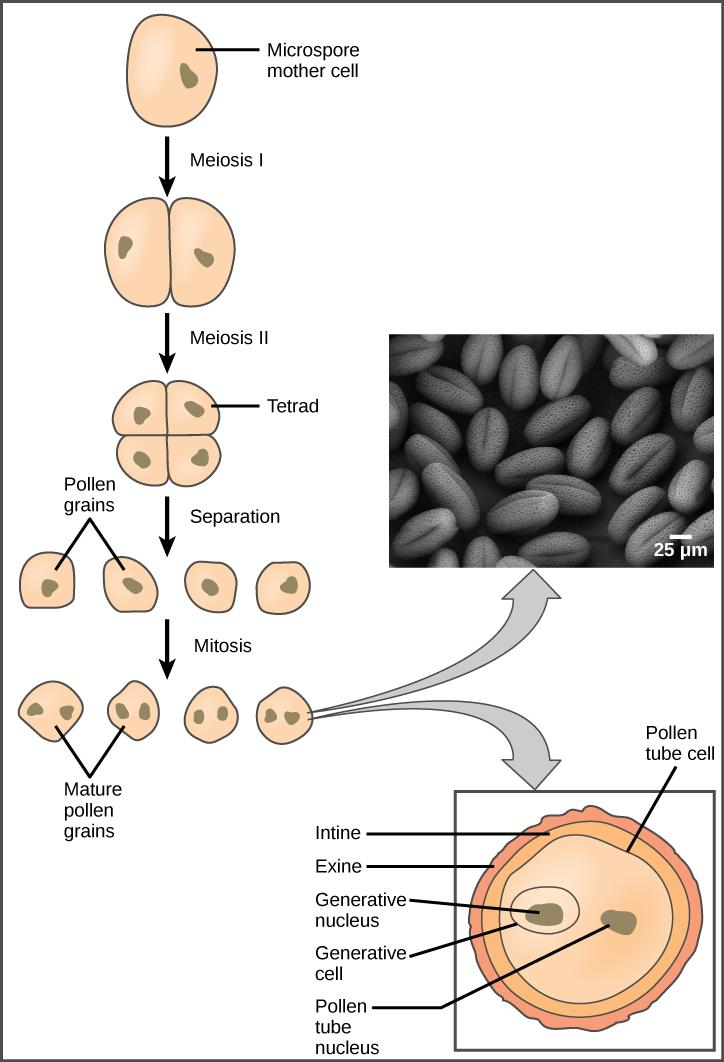
Note: Gametogenesis is a biological process by which diploid or haploid precursor cells undergo cell division and differentiation to form mature haploid gametes. Depending on the biological life cycle of the organism, gametogenesis occurs by meiotic division of diploid gametocytes into various gametes, or by mitosis. For example, plants produce gametes through mitosis in gametophytes. The gametophytes grow from haploid spores after meiosis.
Step by step answer:Micro gametogenesis is the process in plant reproduction where a microgametophyte develops in a pollen grain to the three-celled stage of its development. In flowering plants, it occurs with a microspore mother cell inside the anther of the plant.
When the microgametophyte is first formed inside the pollen grain four sets of fertile cells called sporogenous cells are apparent. These cells are surrounded by a wall of sterile cells called the tapetum, which supplies food to the cell and eventually becomes the cell wall for the pollen grain. These sets of sporogenous cells eventually develop into diploid microspore mother cells. These microspore mother cells, also called microsporocytes, then undergo meiosis and become four microspore haploid cells. These new microspore cells then undergo mitosis and form a tube cell and a generative cell. The generative cell then undergoes mitosis one more time to form two male gametes, also called sperm.
Microsporocytes are produced in the microsporangia of the gymnosperm and the anthers of the angiosperms. They are diploid microspore mother-cells, which then produce four haploid microspores through the process of meiosis. These become pollen grains, within which the microspores divide twice by mitosis to produce a very simple gametophyte.
Hence, the correct option is (B) Development of pollen
Note: Gametogenesis is a biological process by which diploid or haploid precursor cells undergo cell division and differentiation to form mature haploid gametes. Depending on the biological life cycle of the organism, gametogenesis occurs by meiotic division of diploid gametocytes into various gametes, or by mitosis. For example, plants produce gametes through mitosis in gametophytes. The gametophytes grow from haploid spores after meiosis.
Recently Updated Pages
Explain the structure of megasporangium class 12 biology CBSE

Why is chloroform kept in dark coloured bottles class 12 chemistry CBSE
Derive the balancing condition of a Wheatstone bri class 12 physics CBSE
Draw VI characteristics of a pn junction diode Explain class 12 physics CBSE
Is it possible to carry pride in ones language too class 12 english CBSE
In a population at Hardy Weinberg equilibrium the allele class 12 biology CBSE
Trending doubts
Draw a labelled sketch of the human eye class 12 physics CBSE
Which are the Top 10 Largest Countries of the World?
Draw ray diagrams each showing i myopic eye and ii class 12 physics CBSE
One megawatt is equal to how many units of electri class 12 physics CBSE
Which is the correct genotypic ratio of mendel dihybrid class 12 biology CBSE
Give 10 examples of unisexual and bisexual flowers