




Microscopic pores in plants are called as
(a)Stigma
(b) Thalamus
(c)Gills
(d)Stomata
Answer
 Verified
612.9k+ views
Hint: Pores allow carbon dioxide and oxygen in the plants and let the water vapor out. It is surrounded by a pair of cells that control whether the stoma is opened or closed. Ponds are tiny, microscopic, and are important for the process of photosynthesis. Thousands of pores dot on the surface of the plants.
Complete answer:
Microscope pores in plants are known as stomata which are a tiny opening or pore. It is present on the leaves, stems, and another green part of the plant. Stomata are mostly found under the surface of plant leaves and are used for gaseous exchange. Stomata is present in the land plant mostly. Stomata help with the gaseous exchange in which the intake of carbon dioxide and release of oxygen takes place. It helps with the process of transpiration in plants. The air enters into the plant through these stomata and some of the oxygen produced is used in the processor respiration.
Additional Information: Stigma: It is the receptive tip of the carpel. It stays together with the style and ovary. It comprises the pistil which is a part of the gynoecium or the female reproductive organ of a plant. It constitutes stigmatic papillae which are the cells receptive to pollen. They restrict the apex of style and cover a wide surface in wind-pollinated species.
Thalamus: It is the axis which is shortly abbreviated and wears four sets of floral leaves. It has a swollen end of the peduncle which is also known as the pedicel and is compressed within the internodes. The floral leaves are inserted on the nodes in whorls. it becomes evident in some flowers which are considerably longer and internodes are distinct.
Gills: It is a respiratory organ in many aquatic animals which extracts the dissolved oxygen from water and excretes carbon dioxide. Some aquatic animals absorb sufficient oxygen through the entire surface of the body and respire adequately without gills. Gills are thin filaments of tissue, lamellae which are highly folded surfaces to increase the surface area.
So, the correct answer is 'Stomata'.
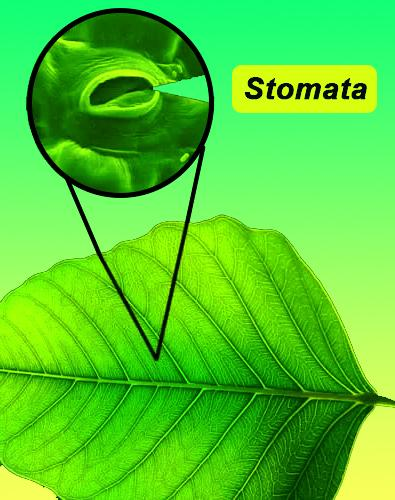
Note: There are 80000 species of edible plants on earth among which 90% of the foods humans eat from just 30 plants. 70000 plant species serve medicinal purposes and one percent of rainforest plants are studied for medicinal potential.
Complete answer:
Microscope pores in plants are known as stomata which are a tiny opening or pore. It is present on the leaves, stems, and another green part of the plant. Stomata are mostly found under the surface of plant leaves and are used for gaseous exchange. Stomata is present in the land plant mostly. Stomata help with the gaseous exchange in which the intake of carbon dioxide and release of oxygen takes place. It helps with the process of transpiration in plants. The air enters into the plant through these stomata and some of the oxygen produced is used in the processor respiration.
Additional Information: Stigma: It is the receptive tip of the carpel. It stays together with the style and ovary. It comprises the pistil which is a part of the gynoecium or the female reproductive organ of a plant. It constitutes stigmatic papillae which are the cells receptive to pollen. They restrict the apex of style and cover a wide surface in wind-pollinated species.
Thalamus: It is the axis which is shortly abbreviated and wears four sets of floral leaves. It has a swollen end of the peduncle which is also known as the pedicel and is compressed within the internodes. The floral leaves are inserted on the nodes in whorls. it becomes evident in some flowers which are considerably longer and internodes are distinct.
Gills: It is a respiratory organ in many aquatic animals which extracts the dissolved oxygen from water and excretes carbon dioxide. Some aquatic animals absorb sufficient oxygen through the entire surface of the body and respire adequately without gills. Gills are thin filaments of tissue, lamellae which are highly folded surfaces to increase the surface area.
So, the correct answer is 'Stomata'.
Note: There are 80000 species of edible plants on earth among which 90% of the foods humans eat from just 30 plants. 70000 plant species serve medicinal purposes and one percent of rainforest plants are studied for medicinal potential.
Recently Updated Pages
Master Class 11 English: Engaging Questions & Answers for Success

Master Class 11 Social Science: Engaging Questions & Answers for Success
Master Class 11 Maths: Engaging Questions & Answers for Success
Master Class 11 Biology: Engaging Questions & Answers for Success
Master Class 11 Physics: Engaging Questions & Answers for Success
Master Class 11 Chemistry: Engaging Questions & Answers for Success
Trending doubts
One Metric ton is equal to kg A 10000 B 1000 C 100 class 11 physics CBSE
Difference Between Prokaryotic Cells and Eukaryotic Cells
Find the value of the expression given below sin 30circ class 11 maths CBSE
Difference between physical and chemical change class 11 chemistry CBSE
Two of the body parts which do not appear in MRI are class 11 biology CBSE
Draw a diagram of a plant cell and label at least eight class 11 biology CBSE