




Mention the various valves and their location in the human heart.
Answer
 Verified
626.7k+ views
Hint: They are a one-way valve that allows the blood to flow only in one direction throughout the heart and prevent the backflow of blood. There are four types of heart valves that are responsible for the blood flow pathway in the heart.
Complete answer:
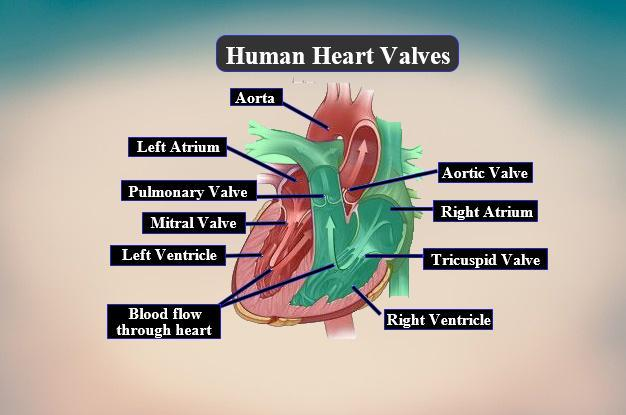
The heart valves are flap-like structures that allow blood to flow in one direction and prevents the backflow of blood. There are four valves of the heart: Atrioventricular valve (pumps blood from the left ventricle to aorta), Mitral valve (pumps blood from left atrium to the left ventricle), Pulmonary valve (pumps blood from right ventricle to pulmonary artery), and Tricuspid valve (pumps blood from atrium to the right ventricle).
The atrioventricular valve, the mitral valve, and the tricuspid valve are present between the upper and the lower chambers of the heart. The upper chamber of the heart is the atria while the lower chamber of the heart is the ventricles. The semilunar valves are present in the arteries and help in the blood flow, it is of two types: the aortic valve, and the pulmonary valve. In the right heart, the tricuspid valve and the pulmonary valve are present while in the left heart mitral valve and the aortic valve are present.
The valves of the heart are covered by the protective layer called endocardium that separates the arteries and the veins through blood vessels. The function of the two atrioventricular valves is to stop the blood backflow into the atria while the two semilunar valves stop the blood backflow into the ventricles.
Note: Arteries carry oxygenated blood away from the heart while veins carry deoxygenated blood towards the heart. Arteries have thicker walls than veins because they must be able to withstand the large pressure from a beating heart. Veins have thinner walls as it requires a large space to hold blood. Veins have less smooth muscles than arteries as arteries accumulate the pulses of blood generated by each contraction of the heart.
Complete answer:
The heart valves are flap-like structures that allow blood to flow in one direction and prevents the backflow of blood. There are four valves of the heart: Atrioventricular valve (pumps blood from the left ventricle to aorta), Mitral valve (pumps blood from left atrium to the left ventricle), Pulmonary valve (pumps blood from right ventricle to pulmonary artery), and Tricuspid valve (pumps blood from atrium to the right ventricle).
The atrioventricular valve, the mitral valve, and the tricuspid valve are present between the upper and the lower chambers of the heart. The upper chamber of the heart is the atria while the lower chamber of the heart is the ventricles. The semilunar valves are present in the arteries and help in the blood flow, it is of two types: the aortic valve, and the pulmonary valve. In the right heart, the tricuspid valve and the pulmonary valve are present while in the left heart mitral valve and the aortic valve are present.
The valves of the heart are covered by the protective layer called endocardium that separates the arteries and the veins through blood vessels. The function of the two atrioventricular valves is to stop the blood backflow into the atria while the two semilunar valves stop the blood backflow into the ventricles.
Note: Arteries carry oxygenated blood away from the heart while veins carry deoxygenated blood towards the heart. Arteries have thicker walls than veins because they must be able to withstand the large pressure from a beating heart. Veins have thinner walls as it requires a large space to hold blood. Veins have less smooth muscles than arteries as arteries accumulate the pulses of blood generated by each contraction of the heart.
Recently Updated Pages
Master Class 11 English: Engaging Questions & Answers for Success

Master Class 11 Social Science: Engaging Questions & Answers for Success
Master Class 11 Maths: Engaging Questions & Answers for Success
Master Class 11 Chemistry: Engaging Questions & Answers for Success
Master Class 11 Biology: Engaging Questions & Answers for Success
Master Class 11 Physics: Engaging Questions & Answers for Success
Trending doubts
One Metric ton is equal to kg A 10000 B 1000 C 100 class 11 physics CBSE
Difference Between Prokaryotic Cells and Eukaryotic Cells
Find the value of the expression given below sin 30circ class 11 maths CBSE
1 ton equals to A 100 kg B 1000 kg C 10 kg D 10000 class 11 physics CBSE
Two of the body parts which do not appear in MRI are class 11 biology CBSE
What are hard magnetic materials class 11 physics CBSE