



How do Mendel's experiments show that the Traits may be dominant or recessive?
Answer
 Verified
600.6k+ views
Hint: The Mendel's experiments show that the Traits may be dominant or recessive by a genetic mix between two individuals who have homozygous genotypes, or genotypes that have completely dominant or completely recessive alleles, which result in opposite phenotypes for some of the genetic traits.
Complete answer:
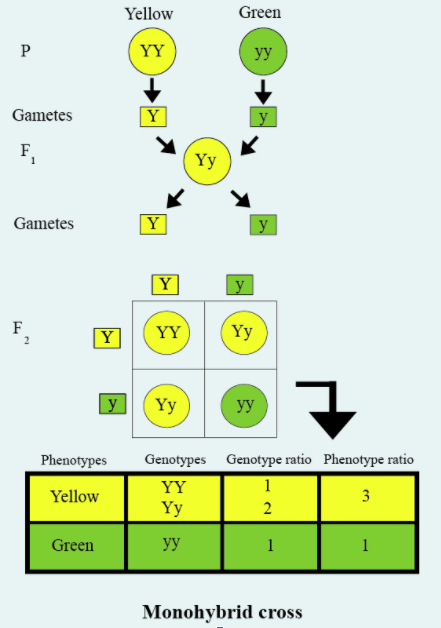
Mendel's experiments show that the Traits may be dominant or recessive by performing a monohybrid cross. Monohybrid cross between two pure breeding varieties always obtained hybrid progeny exhibiting one parental trait while the opposite trait was never expressed in the $F_1$ generation. It suggested that two alleles of a gene are often either dominant or recessive and the presence of the dominant allele in $F_1$ hybrids masks the expression of the recessive one.
Additional Information: Alleles are often either dominant or recessive. Dominant alleles show their effect even though the individual only has one copy of the allele (also referred to as being heterozygous). As an example, the allele for yellow seed is dominant, therefore you simply need one copy of the 'yellow seed' allele to possess yellow seed (although, with two copies you'll still have yellow seed). When the individuals have two copies of alleles then only the effects of recessive alleles are shown. As an example, the allele for green seed is recessive, therefore to possess green seed you would like to possess two copies of the ‘green seed' allele.
Note: If both alleles are dominant, it's called codominance. The resulting characteristic is because of both alleles being expressed equally. An example of this is the blood type AB which is the results of codominance of the A and B dominant alleles.
Complete answer:
Mendel's experiments show that the Traits may be dominant or recessive by performing a monohybrid cross. Monohybrid cross between two pure breeding varieties always obtained hybrid progeny exhibiting one parental trait while the opposite trait was never expressed in the $F_1$ generation. It suggested that two alleles of a gene are often either dominant or recessive and the presence of the dominant allele in $F_1$ hybrids masks the expression of the recessive one.
Additional Information: Alleles are often either dominant or recessive. Dominant alleles show their effect even though the individual only has one copy of the allele (also referred to as being heterozygous). As an example, the allele for yellow seed is dominant, therefore you simply need one copy of the 'yellow seed' allele to possess yellow seed (although, with two copies you'll still have yellow seed). When the individuals have two copies of alleles then only the effects of recessive alleles are shown. As an example, the allele for green seed is recessive, therefore to possess green seed you would like to possess two copies of the ‘green seed' allele.
Note: If both alleles are dominant, it's called codominance. The resulting characteristic is because of both alleles being expressed equally. An example of this is the blood type AB which is the results of codominance of the A and B dominant alleles.
Recently Updated Pages
Which of the following graphs shows the variation of class 12 physics CBSE

Draw a labelled diagram of the human male reproductive class 12 biology CBSE
Describe the experiment to compare the emf of two cells class 12 physics CBSE
What is standard hydrogen electrode
What is conventional current and electric current class 12 physics CBSE
2Bromopentane is treated with an alcoholic KOH solution class 12 chemistry CBSE
Trending doubts
Draw a labelled sketch of the human eye class 12 physics CBSE
Which are the Top 10 Largest Countries of the World?
Draw ray diagrams each showing i myopic eye and ii class 12 physics CBSE
Which is the correct genotypic ratio of mendel dihybrid class 12 biology CBSE
Which is the strongest oxidising agent out of the following class 12 chemistry CBSE
Differentiate between homogeneous and heterogeneous class 12 chemistry CBSE