




What is meant by refining of metals? Describe the electrolytic refining of copper with a neat labelled diagram.
Answer
 Verified
572.4k+ views
Hint: As we know that in chemistry, periodic tables play a vital role. Now we are using a modern periodic table. This modern periodic table consists of totally \[118\] elements. In the periodic table there are totally \[18\] columns and \[7\] rows. The columns are called groups. Hence, \[18\] groups in the periodic table. The rows are called periods. Hence, totally \[7\] period in the table. The atomic number of the element is nothing but the number of electrons or number of protons. The mass number of the atom is nothing but the sum of the number of protons and number of neutrons. In general we move left to right metallic property of the atom decreases. We move right to left and non-metallic property decreases.
Complete answer:
The refining of metal is given below,
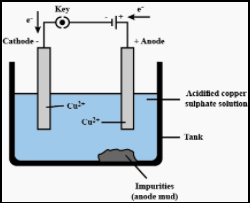
In electrolysis, the anode is made up of the impure metal and the cathode is made up of pure metal. The electrolytic solution is nothing but the solution of metal salt. When electric current is passing in an electrolytic solution, pure metal dissolves and settles at the cathode. The impurities settle down at anode and that is called anode mud.
The refining of copper is given below,
At anode: \[Cu \to C{u^{2 + }} + 2{e^ - }\]
At cathode: \[C{u^{2 + }} + 2{e^ - } \to Cu\]
The diagrammatic representation of electrolytic refining of copper is given below,
Note:
As we know, in the world there are a lot of elements in various forms. For study and developing purposes, classification happens. Periodic table used to study the elements in easy form. If one new element is discovered, it means, based on the physical and chemical property we placed in the periodic table. In the modern periodic table metallic atoms are placed in the left side of the table and non-metallic atoms are placed in the right side of the table. Metalloids and transition elements are placed in between metal and non-metal elements. Below the two rows are there. There are nothing but lanthanides and actinides. These are f-block elements.
Complete answer:
The refining of metal is given below,
In electrolysis, the anode is made up of the impure metal and the cathode is made up of pure metal. The electrolytic solution is nothing but the solution of metal salt. When electric current is passing in an electrolytic solution, pure metal dissolves and settles at the cathode. The impurities settle down at anode and that is called anode mud.
The refining of copper is given below,
At anode: \[Cu \to C{u^{2 + }} + 2{e^ - }\]
At cathode: \[C{u^{2 + }} + 2{e^ - } \to Cu\]
The diagrammatic representation of electrolytic refining of copper is given below,
Note:
As we know, in the world there are a lot of elements in various forms. For study and developing purposes, classification happens. Periodic table used to study the elements in easy form. If one new element is discovered, it means, based on the physical and chemical property we placed in the periodic table. In the modern periodic table metallic atoms are placed in the left side of the table and non-metallic atoms are placed in the right side of the table. Metalloids and transition elements are placed in between metal and non-metal elements. Below the two rows are there. There are nothing but lanthanides and actinides. These are f-block elements.
Recently Updated Pages
If x a + bt + ct2 where x is in meters and t is in class 11 physics CBSE

A car covers the first half distance between two places class 11 physics CBSE
The resultant of two vectors overrightarrow P and overrightarrow class 11 physics CBSE
Find the value of cos 135 class 11 maths CBSE
A mass M is held in place by an applied force F and class 11 physics CBSE
A solution of glucose in water is labelled as 10 dfracwv class 11 chemistry CBSE
Trending doubts
One Metric ton is equal to kg A 10000 B 1000 C 100 class 11 physics CBSE
Find the value of the expression given below sin 30circ class 11 maths CBSE
What do you mean by retardation What is its SI uni class 11 physics CBSE
Draw a diagram of nephron and explain its structur class 11 biology CBSE
10 examples of friction in our daily life
Difference between physical and chemical change class 11 chemistry CBSE