




What is meant by limiting friction?
Answer
 Verified
564.6k+ views
Hint: In Physics, we define force as a push or pull. When two objects interact with each other they apply force on each other. When they get separated from each other, no longer they experience this force but the impact of force lasts for some time. This means either the object comes to rest or starts moving and the reason for this we will discuss here.
Complete answer:
We know when objects interact with each other they apply force on each other.
Similarly, when two surfaces slide against each other they produce a force called frictional force which opposes their relative motion.
We categorize frictions mainly in two categories, static friction, and kinetic friction. As the name suggests, in static friction the object does not move and in kinetic friction, the object starts moving.
Limiting friction comes under static friction. So, we will discuss static friction now. Static friction keeps an object at rest. When we try to move a stationary object on a surface, before it starts moving, it experiences static friction. We can say that static friction balances the applied force.
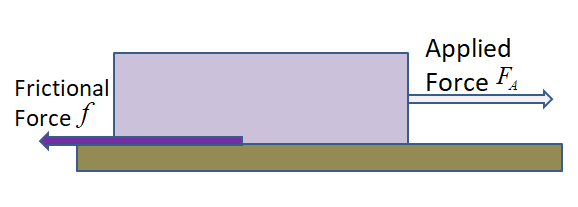
But we also know after applying a certain amount of force the object starts moving. So, the highest value of static friction which opposes the applied force when the object is just about to move is called limiting friction. For example, suppose limiting friction is \[2N\] , this means if we apply the force of \[1N\] or \[2N\] it will be balanced by the static friction. But if the applied force is \[3N\] , greater than the limiting friction object will start moving.
So, limiting friction is the maximum value of static friction which comes to play when the object is just about to move on the surface.
Note:
The frictional force depends on the texture of surfaces, i.e., rough surfaces produce more friction. Limiting friction does not depend on the area of contact and always acts tangentially.
Complete answer:
We know when objects interact with each other they apply force on each other.
Similarly, when two surfaces slide against each other they produce a force called frictional force which opposes their relative motion.
We categorize frictions mainly in two categories, static friction, and kinetic friction. As the name suggests, in static friction the object does not move and in kinetic friction, the object starts moving.
Limiting friction comes under static friction. So, we will discuss static friction now. Static friction keeps an object at rest. When we try to move a stationary object on a surface, before it starts moving, it experiences static friction. We can say that static friction balances the applied force.
But we also know after applying a certain amount of force the object starts moving. So, the highest value of static friction which opposes the applied force when the object is just about to move is called limiting friction. For example, suppose limiting friction is \[2N\] , this means if we apply the force of \[1N\] or \[2N\] it will be balanced by the static friction. But if the applied force is \[3N\] , greater than the limiting friction object will start moving.
So, limiting friction is the maximum value of static friction which comes to play when the object is just about to move on the surface.
Note:
The frictional force depends on the texture of surfaces, i.e., rough surfaces produce more friction. Limiting friction does not depend on the area of contact and always acts tangentially.
Recently Updated Pages
Which will be the least stable resonating structure class 11 chemistry CBSE

How many 5 digit telephone numbers can be construc-class-11-maths-CBSE
How do you find the angle of the resultant vector class 11 physics CBSE
Draw labelled diagram of the following i Gram seed class 11 biology CBSE
1 Quintal is equal to a 110 kg b 10 kg c 100kg d 1000 class 11 physics CBSE
What is the need and importance of classification class 11 biology CBSE
Trending doubts
Find the value of the expression given below sin 30circ class 11 maths CBSE
One Metric ton is equal to kg A 10000 B 1000 C 100 class 11 physics CBSE
10 examples of friction in our daily life
Draw a diagram of a plant cell and label at least eight class 11 biology CBSE
Difference between physical and chemical change class 11 chemistry CBSE
Proton was discovered by A Thomson B Rutherford C Chadwick class 11 chemistry CBSE