




What is meant by hybridization of atomic orbitals? Describe $ sp,s{p^2}\,and\,s{p^3} $ hybridization with examples.
Answer
 Verified
520.8k+ views
Hint :Hybridization is defined as the mixing of a group of slightly different atomic orbitals, resulting in a new set of orbitals with equivalent energies and forms. One $ 2s $ orbital, for example, can combine with two $ \;2p $ orbitals of carbon to generate three new $ s{p^2} $ hybrid orbitals. Because there is less repulsion between the electron pairs in these hybrid orbitals, they are more stable. Hybridization aids in determining the molecule's geometry.
Complete Step By Step Answer:
$ sp $ Hybridization:
When one s and one p orbital in the same main shell of an atom combine to generate two new equivalent orbitals, this is known as $ sp $ hybridization. $ sp $ hybridised orbitals are the new orbitals that develop. It produces $ 180 $ -degree linear molecules.
This sort of hybridization entails combining one s and one p orbital of equal energy to create a new hybrid orbital known as a sp hybridised orbital.
Diagonal hybridization is another name for $ sp $ hybridization.
Each $ sp $ hybridised orbital has $ 50 $ percent $ s $ and $ p $ character.
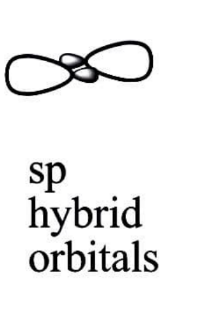
All beryllium compounds such as $ Be{F_2},{\text{ }}Be{H_2},{\text{ }}BeC{l_2} $ and all carbon-containing triple bond compounds such as $ {C_2}{H_2} $ are examples of $ sp $ Hybridization.
$ s{p^2} $ Hybridization:
When one $ s $ and two $ p $ orbitals of the same shell of an atom combine to generate three equivalent orbitals, this is known as $ s{p^2} $ hybridization. $ s{p^2} $ hybrid orbitals are the new orbitals that have been created.
Trigonal hybridization is another name for $ s{p^2} $ hybridization.
It entails combining one s orbital with two p orbitals of equal energy to create the $ s{p^2} $ hybrid orbital.
A trigonal symmetry blend of $ s $ and $ p $ orbitals is maintained at $ 1200 $ degrees.
All three hybrid orbitals remain in the same plane and form a $ 120^\circ $ angle with one another. Each of the resulting hybrid orbitals has $ 33.33 $ percent s and $ 66.66 $ percent character.
A triangle planar form is found in molecules in which the central atom is connected to three other atoms and is $ s{p^2} $ hybridised.
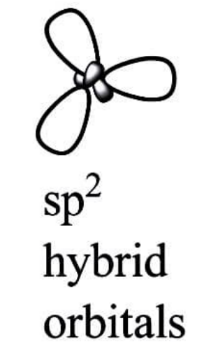
Examples:
$ B{F_3},{\text{ }}B{H_3}, $ and all other Boron compounds
Ethylene is a group of carbon molecules that have a carbon-carbon double bond $ \left( {{C_2}{H_4}} \right) $
$ s{p^3} $ Hybridization:
A tetrahedral hybridization, or $ s{p^3}, $ occurs when one orbital and three orbitals belonging to the same shell of an atom combine to generate four new equivalent orbitals. $ s{p^3} $ hybrid orbitals are the new orbitals that have been generated.
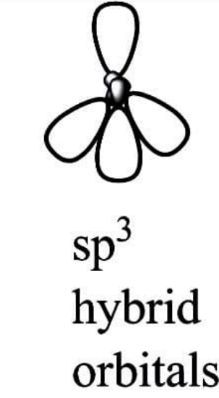
These are aimed at the four corners of a conventional tetrahedron and form a $ 109^\circ 28' $ angle with each other.
The $ s{p^3} $ hybrid orbitals have a $ 109.280 $ degree angle between them.
Each $ s{p^3} $ hybrid orbital contains $ 25\% $ s character and $ 75\% $ p character.
Ethane $ \left( {{C_2}{H_6}} \right) $ and methane are two examples of $ s{p^3} $ hybridization.
Note :
The hybrid orbitals have a different geometry of orbital arrangement and energy than the conventional atomic orbitals after hybridization. In addition, the orbital overlap reduces the molecule's energy. Degenerate hybrid orbitals are generated by combining conventional atomic orbitals with degenerate hybrid orbitals.
Complete Step By Step Answer:
$ sp $ Hybridization:
When one s and one p orbital in the same main shell of an atom combine to generate two new equivalent orbitals, this is known as $ sp $ hybridization. $ sp $ hybridised orbitals are the new orbitals that develop. It produces $ 180 $ -degree linear molecules.
This sort of hybridization entails combining one s and one p orbital of equal energy to create a new hybrid orbital known as a sp hybridised orbital.
Diagonal hybridization is another name for $ sp $ hybridization.
Each $ sp $ hybridised orbital has $ 50 $ percent $ s $ and $ p $ character.
All beryllium compounds such as $ Be{F_2},{\text{ }}Be{H_2},{\text{ }}BeC{l_2} $ and all carbon-containing triple bond compounds such as $ {C_2}{H_2} $ are examples of $ sp $ Hybridization.
$ s{p^2} $ Hybridization:
When one $ s $ and two $ p $ orbitals of the same shell of an atom combine to generate three equivalent orbitals, this is known as $ s{p^2} $ hybridization. $ s{p^2} $ hybrid orbitals are the new orbitals that have been created.
Trigonal hybridization is another name for $ s{p^2} $ hybridization.
It entails combining one s orbital with two p orbitals of equal energy to create the $ s{p^2} $ hybrid orbital.
A trigonal symmetry blend of $ s $ and $ p $ orbitals is maintained at $ 1200 $ degrees.
All three hybrid orbitals remain in the same plane and form a $ 120^\circ $ angle with one another. Each of the resulting hybrid orbitals has $ 33.33 $ percent s and $ 66.66 $ percent character.
A triangle planar form is found in molecules in which the central atom is connected to three other atoms and is $ s{p^2} $ hybridised.
Examples:
$ B{F_3},{\text{ }}B{H_3}, $ and all other Boron compounds
Ethylene is a group of carbon molecules that have a carbon-carbon double bond $ \left( {{C_2}{H_4}} \right) $
$ s{p^3} $ Hybridization:
A tetrahedral hybridization, or $ s{p^3}, $ occurs when one orbital and three orbitals belonging to the same shell of an atom combine to generate four new equivalent orbitals. $ s{p^3} $ hybrid orbitals are the new orbitals that have been generated.
These are aimed at the four corners of a conventional tetrahedron and form a $ 109^\circ 28' $ angle with each other.
The $ s{p^3} $ hybrid orbitals have a $ 109.280 $ degree angle between them.
Each $ s{p^3} $ hybrid orbital contains $ 25\% $ s character and $ 75\% $ p character.
Ethane $ \left( {{C_2}{H_6}} \right) $ and methane are two examples of $ s{p^3} $ hybridization.
Note :
The hybrid orbitals have a different geometry of orbital arrangement and energy than the conventional atomic orbitals after hybridization. In addition, the orbital overlap reduces the molecule's energy. Degenerate hybrid orbitals are generated by combining conventional atomic orbitals with degenerate hybrid orbitals.
Recently Updated Pages
Master Class 11 Social Science: Engaging Questions & Answers for Success

Master Class 11 Physics: Engaging Questions & Answers for Success
Master Class 11 Maths: Engaging Questions & Answers for Success
Master Class 11 Economics: Engaging Questions & Answers for Success
Master Class 11 Computer Science: Engaging Questions & Answers for Success
Master Class 11 Chemistry: Engaging Questions & Answers for Success
Trending doubts
One Metric ton is equal to kg A 10000 B 1000 C 100 class 11 physics CBSE
There are 720 permutations of the digits 1 2 3 4 5 class 11 maths CBSE
1 Quintal is equal to a 110 kg b 10 kg c 100kg d 1000 class 11 physics CBSE
State and prove Bernoullis theorem class 11 physics CBSE
Difference Between Prokaryotic Cells and Eukaryotic Cells
Which among the following are examples of coming together class 11 social science CBSE