




What do you mean by rectangular components of a vector? Explain how a vector can be resolved into two rectangular components in a plane.
Answer
 Verified
569.9k+ views
Hint: There are majorly two types of quantities, scalar and vector quantities. All the quantities are divided into these two categories. Scalar quantities are those quantities, which have only magnitude eg – mass, speed, pressure, etc. Vector quantities are those which have both magnitude and directions eg – weight, velocity and thrust. The special fact about vectors is that we can resolve it into components.
Complete step by step answer:
Rectangular components means the components or parts of a vector in any two mutually perpendicular axes. This could be understood by an example as illustrated below.
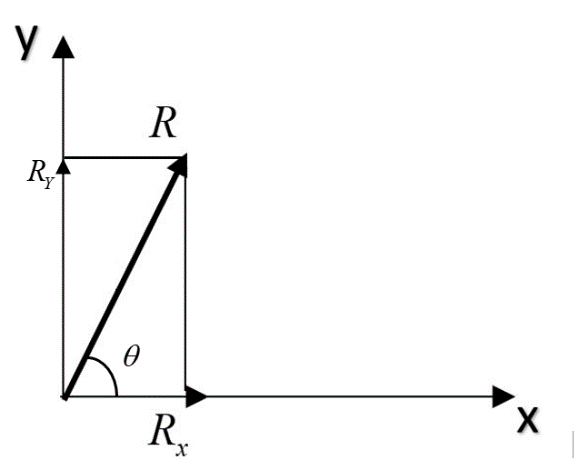
Let a vector quantity ‘R’ inclined at an angle $\theta$ from the x-axis. By convention, we can split the vector ‘R’ in two rectangular components. As shown in the figure, the vector ‘R’ is split into two components;
$R_x$along x-axis and $R_y$ along y-axis. This is an extremely important and useful property of vectors. Using it, we can solve complex problems very easily. Also, we can write the values of these components as;
$R_x = Rcos\theta$
$R_y=Rsin\theta$
Additional Information: For any two general vectors, we have the magnitude of their resultant $R = \sqrt{A^2+B^2+2ABcos\theta}$. Since we have split the given vector ‘R’ into two independent vectors, we can see that doing this won't change the magnitude of the original vector.
Here A = $R_x = Rcos\theta$ and B = $R_y=Rsin\theta$
Hence, putting in the formula:
$R = \sqrt{A^2+B^2+2ABcos\theta}$
$\Rightarrow R = \sqrt{(Rcos\theta)^2+(Rsin\theta)^2+2(Rcos\theta)(Rsin\theta)cos90^{\circ}}$
As $cos\ 90^{\circ} = 0$
$R = \sqrt{R^2[(cos\theta)^2+(sin\theta)^2]+0}$
Also, $sin^2\theta+cos^2\theta = 1$
So, $R = \sqrt{R^2} = R$
Hence proved.
Note: One must not confuse that we can take the vector components only along axes that are mutually perpendicular. One can also find the component of a vector about any axis which inclination with the vector is given, provided the magnitude of the vector must not change.
Complete step by step answer:
Rectangular components means the components or parts of a vector in any two mutually perpendicular axes. This could be understood by an example as illustrated below.
Let a vector quantity ‘R’ inclined at an angle $\theta$ from the x-axis. By convention, we can split the vector ‘R’ in two rectangular components. As shown in the figure, the vector ‘R’ is split into two components;
$R_x$along x-axis and $R_y$ along y-axis. This is an extremely important and useful property of vectors. Using it, we can solve complex problems very easily. Also, we can write the values of these components as;
$R_x = Rcos\theta$
$R_y=Rsin\theta$
Additional Information: For any two general vectors, we have the magnitude of their resultant $R = \sqrt{A^2+B^2+2ABcos\theta}$. Since we have split the given vector ‘R’ into two independent vectors, we can see that doing this won't change the magnitude of the original vector.
Here A = $R_x = Rcos\theta$ and B = $R_y=Rsin\theta$
Hence, putting in the formula:
$R = \sqrt{A^2+B^2+2ABcos\theta}$
$\Rightarrow R = \sqrt{(Rcos\theta)^2+(Rsin\theta)^2+2(Rcos\theta)(Rsin\theta)cos90^{\circ}}$
As $cos\ 90^{\circ} = 0$
$R = \sqrt{R^2[(cos\theta)^2+(sin\theta)^2]+0}$
Also, $sin^2\theta+cos^2\theta = 1$
So, $R = \sqrt{R^2} = R$
Hence proved.
Note: One must not confuse that we can take the vector components only along axes that are mutually perpendicular. One can also find the component of a vector about any axis which inclination with the vector is given, provided the magnitude of the vector must not change.
Recently Updated Pages
The given figure shows two endocrine glands marked class 11 biology NEET_UG

Match columnI with columnII and select the correct class 11 biology NEET
Match column I with column II and select the correct class 11 biology NEET_UG
Which floral family has left 9 right + 1 arrangement class 11 biology NEET_UG
Which is not a variety of sheep A Lohi B Beetal C Nellore class 11 biology NEET_UG
Match column I with column II and select the correct class 11 biology NEET_UG
Trending doubts
One Metric ton is equal to kg A 10000 B 1000 C 100 class 11 physics CBSE
Draw a diagram of a plant cell and label at least eight class 11 biology CBSE
Difference Between Prokaryotic Cells and Eukaryotic Cells
Draw a well labelled diagram of reflex arc and explain class 11 biology CBSE
Two of the body parts which do not appear in MRI are class 11 biology CBSE
1 ton equals to A 100 kg B 1000 kg C 10 kg D 10000 class 11 physics CBSE