




What is the maximum volume of an open box with a square base whose surface area (not including the top) is 27 $\text{i}{{\text{n}}^{2}}$?
Answer
 Verified
560.1k+ views
Hint: Let us assume an open box, with a square base with each edge of length a inch, and height of the box h inch.
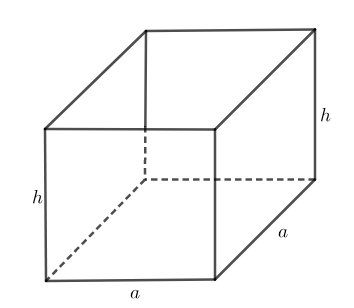
Let the surface area of the box (not including the top the top) be s, then we have
$s=\left( a\times a \right)+4\left( a\times h \right)$
Thus, the surface area of the open box is $s={{a}^{2}}+4ah$.
We can also write the above equation as
$4ah=s-{{a}^{2}}$
And thus, we have the height of the open box as
$h=\dfrac{s-{{a}^{2}}}{4a}...\left( i \right)$
Complete step-by-step solution:
From the figure, we can clearly say that the volume of this open box is
$V=a\times a\times h$
Using the value of height from equation (i), we get
$V={{a}^{2}}\left( \dfrac{s-{{a}^{2}}}{4a} \right)$
We can simplify this equation by cancelling terms to get,
$V=\left( \dfrac{as-{{a}^{3}}}{4} \right)...\left( ii \right)$
Here, we know that the value of s is constant, and we need to find the value of a for which the volume is maximum.
So, we know that we need to differentiate the volume with respect to a. Thus, we have
$\dfrac{dV}{da}=\dfrac{d}{da}\left( \dfrac{as-{{a}^{3}}}{4} \right)$
So, on differentiation, we get
$\dfrac{dV}{da}=\dfrac{d}{da}\left( \dfrac{as}{4} \right)-\dfrac{d}{da}\left( \dfrac{{{a}^{3}}}{4} \right)$
Hence, we now have the following equation
$\dfrac{dV}{da}=\dfrac{s}{4}-\dfrac{3{{a}^{2}}}{4}$
We now need to equate this differentiation with zero. So, we get
$\dfrac{s}{4}-\dfrac{3{{a}^{2}}}{4}=0$
Solving for a, we get
$3{{a}^{2}}=s$
Or, we can write
$a=\sqrt{\dfrac{s}{3}}$
We still need to see whether this is a maxima point or minima point.
So, ${{\left. \dfrac{{{d}^{2}}V}{d{{a}^{2}}} \right|}_{a=\sqrt{\dfrac{s}{3}}}}=\dfrac{d}{da}{{\left[ \dfrac{s}{4}-\dfrac{3{{a}^{2}}}{4} \right]}_{a=\sqrt{\dfrac{s}{3}}}}$
On solving this equation, we get
${{\left. \dfrac{{{d}^{2}}V}{d{{a}^{2}}} \right|}_{a=\sqrt{\dfrac{s}{3}}}}={{\left[ 0-\dfrac{3a}{2} \right]}_{a=\sqrt{\dfrac{s}{3}}}}$
On putting the value of a, we get
${{\left. \dfrac{{{d}^{2}}V}{d{{a}^{2}}} \right|}_{a=\sqrt{\dfrac{s}{3}}}}=\left[ -\dfrac{3\sqrt{\dfrac{s}{3}}}{2} \right]$
Or, we can write
${{\left. \dfrac{{{d}^{2}}V}{d{{a}^{2}}} \right|}_{a=\sqrt{\dfrac{s}{3}}}}=\left[ -\dfrac{\sqrt{3s}}{2} \right]$
We can clearly see that ${{\left. \dfrac{{{d}^{2}}V}{d{{a}^{2}}} \right|}_{a=\sqrt{\dfrac{s}{3}}}}<0$ .
Thus, the volume is maximum at $a=\sqrt{\dfrac{s}{3}}$ .
We know that the surface area is 27 $\text{i}{{\text{n}}^{2}}$ as is given in the question. So, we now get the value
$a=\sqrt{\dfrac{27}{3}}$
And since the value of a can never be negative, the value of a will be
$a=3$ .
Putting the values of a and s in equation (ii), we get
$V=\left( \dfrac{\left( 3\times 27 \right)-{{\left( 3 \right)}^{3}}}{4} \right)$
Thus, we get
$V=\left( \dfrac{\left( 3\times 27 \right)-27}{4} \right)$
On solving the above equation, we get
$V=\left( \dfrac{27}{2} \right)\text{i}{{\text{n}}^{3}}$
Hence, $V=13.5\text{ i}{{\text{n}}^{3}}$
Thus, the maximum volume of the open box is $13.5\text{ i}{{\text{n}}^{3}}$.
Note: We must remember that the surface area of open box with a square base is $s={{a}^{2}}+4ah$ and the surface area of a closed box with a square base is $s=2{{a}^{2}}+4ah$. Here, $a=\sqrt{\dfrac{s}{3}}$ , and since a can not be a negative value, we can say that $\sqrt{s}$ is also positive and thus, $\left[ -\dfrac{\sqrt{3s}}{2} \right]$ will be negative.
Let the surface area of the box (not including the top the top) be s, then we have
$s=\left( a\times a \right)+4\left( a\times h \right)$
Thus, the surface area of the open box is $s={{a}^{2}}+4ah$.
We can also write the above equation as
$4ah=s-{{a}^{2}}$
And thus, we have the height of the open box as
$h=\dfrac{s-{{a}^{2}}}{4a}...\left( i \right)$
Complete step-by-step solution:
From the figure, we can clearly say that the volume of this open box is
$V=a\times a\times h$
Using the value of height from equation (i), we get
$V={{a}^{2}}\left( \dfrac{s-{{a}^{2}}}{4a} \right)$
We can simplify this equation by cancelling terms to get,
$V=\left( \dfrac{as-{{a}^{3}}}{4} \right)...\left( ii \right)$
Here, we know that the value of s is constant, and we need to find the value of a for which the volume is maximum.
So, we know that we need to differentiate the volume with respect to a. Thus, we have
$\dfrac{dV}{da}=\dfrac{d}{da}\left( \dfrac{as-{{a}^{3}}}{4} \right)$
So, on differentiation, we get
$\dfrac{dV}{da}=\dfrac{d}{da}\left( \dfrac{as}{4} \right)-\dfrac{d}{da}\left( \dfrac{{{a}^{3}}}{4} \right)$
Hence, we now have the following equation
$\dfrac{dV}{da}=\dfrac{s}{4}-\dfrac{3{{a}^{2}}}{4}$
We now need to equate this differentiation with zero. So, we get
$\dfrac{s}{4}-\dfrac{3{{a}^{2}}}{4}=0$
Solving for a, we get
$3{{a}^{2}}=s$
Or, we can write
$a=\sqrt{\dfrac{s}{3}}$
We still need to see whether this is a maxima point or minima point.
So, ${{\left. \dfrac{{{d}^{2}}V}{d{{a}^{2}}} \right|}_{a=\sqrt{\dfrac{s}{3}}}}=\dfrac{d}{da}{{\left[ \dfrac{s}{4}-\dfrac{3{{a}^{2}}}{4} \right]}_{a=\sqrt{\dfrac{s}{3}}}}$
On solving this equation, we get
${{\left. \dfrac{{{d}^{2}}V}{d{{a}^{2}}} \right|}_{a=\sqrt{\dfrac{s}{3}}}}={{\left[ 0-\dfrac{3a}{2} \right]}_{a=\sqrt{\dfrac{s}{3}}}}$
On putting the value of a, we get
${{\left. \dfrac{{{d}^{2}}V}{d{{a}^{2}}} \right|}_{a=\sqrt{\dfrac{s}{3}}}}=\left[ -\dfrac{3\sqrt{\dfrac{s}{3}}}{2} \right]$
Or, we can write
${{\left. \dfrac{{{d}^{2}}V}{d{{a}^{2}}} \right|}_{a=\sqrt{\dfrac{s}{3}}}}=\left[ -\dfrac{\sqrt{3s}}{2} \right]$
We can clearly see that ${{\left. \dfrac{{{d}^{2}}V}{d{{a}^{2}}} \right|}_{a=\sqrt{\dfrac{s}{3}}}}<0$ .
Thus, the volume is maximum at $a=\sqrt{\dfrac{s}{3}}$ .
We know that the surface area is 27 $\text{i}{{\text{n}}^{2}}$ as is given in the question. So, we now get the value
$a=\sqrt{\dfrac{27}{3}}$
And since the value of a can never be negative, the value of a will be
$a=3$ .
Putting the values of a and s in equation (ii), we get
$V=\left( \dfrac{\left( 3\times 27 \right)-{{\left( 3 \right)}^{3}}}{4} \right)$
Thus, we get
$V=\left( \dfrac{\left( 3\times 27 \right)-27}{4} \right)$
On solving the above equation, we get
$V=\left( \dfrac{27}{2} \right)\text{i}{{\text{n}}^{3}}$
Hence, $V=13.5\text{ i}{{\text{n}}^{3}}$
Thus, the maximum volume of the open box is $13.5\text{ i}{{\text{n}}^{3}}$.
Note: We must remember that the surface area of open box with a square base is $s={{a}^{2}}+4ah$ and the surface area of a closed box with a square base is $s=2{{a}^{2}}+4ah$. Here, $a=\sqrt{\dfrac{s}{3}}$ , and since a can not be a negative value, we can say that $\sqrt{s}$ is also positive and thus, $\left[ -\dfrac{\sqrt{3s}}{2} \right]$ will be negative.
Recently Updated Pages
Master Class 10 English: Engaging Questions & Answers for Success

Master Class 10 Social Science: Engaging Questions & Answers for Success
Master Class 10 Computer Science: Engaging Questions & Answers for Success
Class 10 Question and Answer - Your Ultimate Solutions Guide
Master Class 10 General Knowledge: Engaging Questions & Answers for Success
Master Class 10 Maths: Engaging Questions & Answers for Success
Trending doubts
What is the full form of NDA a National Democratic class 10 social science CBSE
Explain the Treaty of Vienna of 1815 class 10 social science CBSE
Who Won 36 Oscar Awards? Record Holder Revealed
Bharatiya Janata Party was founded in the year A 1979 class 10 social science CBSE
What is the median of the first 10 natural numbers class 10 maths CBSE
Why is it 530 pm in india when it is 1200 afternoon class 10 social science CBSE