




How many maximum electrons can be filled in p-orbital?
Answer
 Verified
579k+ views
Hint: Every orbital has a shape in which the probability of finding the electron is the most. We know that for p-orbital, the azimuthal quantum number is 1, so the magnetic quantum number will be 3 (-1, 0, +1). And each magnetic quantum number can accommodate two electrons that have opposite spin.
Complete step-by-step answer:There are four quantum numbers that can help to find the number of electrons in a shell or any orbital. First, the principle quantum number tells the number of shells and is shown by n. Second, the azimuthal quantum number tells the number of sub-shell and the magnetic quantum number tells the number of orbitals and each orbital can have two electrons having an opposite spin. No orbital can have two electrons having the same spin.
Till now we now 6 shells having the p-orbital, i.e., 2 – 7. These are written as $2p,3p,4p,5p,6p,\text{ and 7}p$. We know that for p-orbital, the azimuthal quantum number is 1, so the magnetic quantum number will be 3 (-1, 0, +1). So, there are three orbitals of the p-subshell. These are represented as:
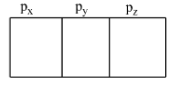
So, each of the orbitals can accommodate a maximum of two electrons and these must have opposite spin. Therefore, there are three orbitals, hence there can be a total of six electrons and this is shown below:
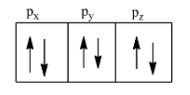
Note:By studying these quantum numbers we came to know that the s-orbital can have two electrons, the d-orbital can have 10 electrons, and the f-orbital can have 14 electrons.
Complete step-by-step answer:There are four quantum numbers that can help to find the number of electrons in a shell or any orbital. First, the principle quantum number tells the number of shells and is shown by n. Second, the azimuthal quantum number tells the number of sub-shell and the magnetic quantum number tells the number of orbitals and each orbital can have two electrons having an opposite spin. No orbital can have two electrons having the same spin.
Till now we now 6 shells having the p-orbital, i.e., 2 – 7. These are written as $2p,3p,4p,5p,6p,\text{ and 7}p$. We know that for p-orbital, the azimuthal quantum number is 1, so the magnetic quantum number will be 3 (-1, 0, +1). So, there are three orbitals of the p-subshell. These are represented as:
So, each of the orbitals can accommodate a maximum of two electrons and these must have opposite spin. Therefore, there are three orbitals, hence there can be a total of six electrons and this is shown below:
Note:By studying these quantum numbers we came to know that the s-orbital can have two electrons, the d-orbital can have 10 electrons, and the f-orbital can have 14 electrons.
Recently Updated Pages
Master Class 11 English: Engaging Questions & Answers for Success

Master Class 11 Social Science: Engaging Questions & Answers for Success
Master Class 11 Maths: Engaging Questions & Answers for Success
Master Class 11 Biology: Engaging Questions & Answers for Success
Master Class 11 Physics: Engaging Questions & Answers for Success
Master Class 11 Chemistry: Engaging Questions & Answers for Success
Trending doubts
Find the value of the expression given below sin 30circ class 11 maths CBSE
Difference between physical and chemical change class 11 chemistry CBSE
Draw a diagram of a plant cell and label at least eight class 11 biology CBSE
Draw a diagram showing the external features of fish class 11 biology CBSE
10 examples of law on inertia in our daily life
Draw a diagram of nephron and explain its structur class 11 biology CBSE