




How can matter be classified at a macroscopic level?
Answer
 Verified
546k+ views
Hint: The matter is any substance that consists of mass and has volume. Macroscopic level means which is visible to your naked eye. Matter can be classified based on the chemical composition of different substances.
Complete answer:
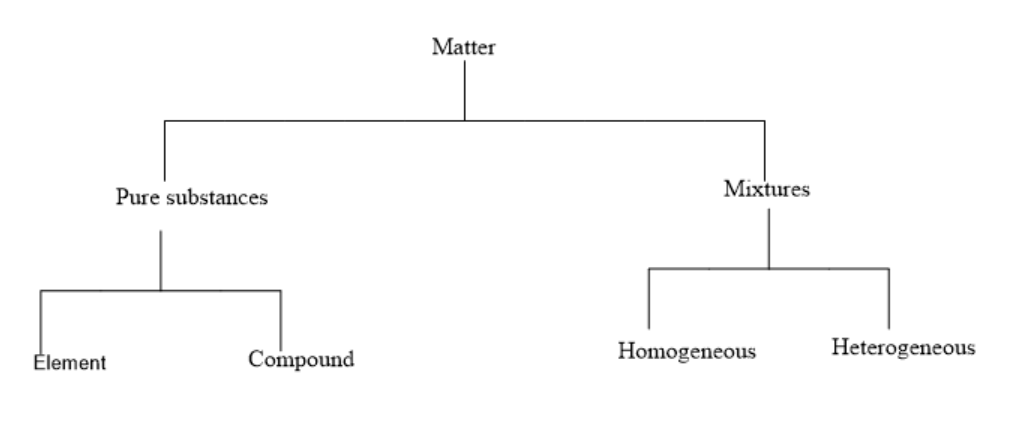
As shown in the diagram above, we can see that macroscopic matter is broadly classified into two main categories: Pure substances and mixtures. The pure substances are sub-categorized into Element and compound and mixtures are sub-categorized into Homogeneous and Heterogeneous.
Note:
When asked to classify matter, pay attention to what type of classification is asked. Is it macroscopic or microscopic? Because matter is classified based on its phases into solid, liquid, and gas. Matter can be classified also based on its chemical and physical properties.
Complete answer:
As shown in the diagram above, we can see that macroscopic matter is broadly classified into two main categories: Pure substances and mixtures. The pure substances are sub-categorized into Element and compound and mixtures are sub-categorized into Homogeneous and Heterogeneous.
| MATTER | |
| Pure substances | Mixtures |
| These substances are made up of only one type of molecule or atom. | These substances are made up of more than one atom or molecule that are not chemically bonded. |
Note:
When asked to classify matter, pay attention to what type of classification is asked. Is it macroscopic or microscopic? Because matter is classified based on its phases into solid, liquid, and gas. Matter can be classified also based on its chemical and physical properties.
Recently Updated Pages
Master Class 11 English: Engaging Questions & Answers for Success

Master Class 11 Social Science: Engaging Questions & Answers for Success
Master Class 11 Maths: Engaging Questions & Answers for Success
Master Class 11 Biology: Engaging Questions & Answers for Success
Master Class 11 Physics: Engaging Questions & Answers for Success
Master Class 11 Chemistry: Engaging Questions & Answers for Success
Trending doubts
Explain the Treaty of Vienna of 1815 class 10 social science CBSE
First Cotton Mill of India
In which year voting age was reduced from 21 to 18?
What planets have no moons Which one has only one moon class 10 physics CBSE
What is the full form of POSCO class 10 social science CBSE
10 examples of evaporation in daily life with explanations