




Match the label of the diagrams with the correct cellular structure given above.
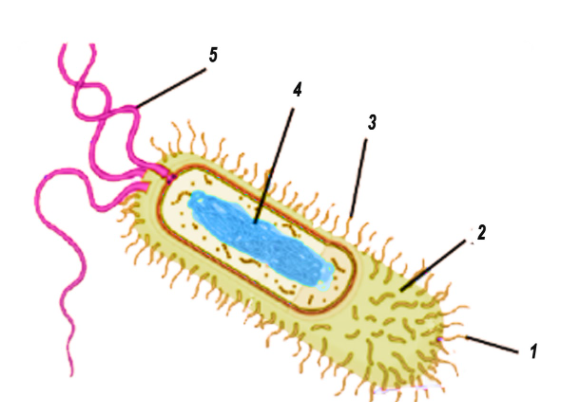
(A)Flagellum-V, Pilus-I, Cytoplasm-II, Nucleoid-III
(B)Flagellum-III, Pilus-V, Cytoplasm-IV, Nucleoid-I
(C)Flagellum-V, Pilus-III, Cytoplasm-IV, Nucleoid-II
(D)Flagellum-IV, Pilus-II, Cytoplasm-V, Nucleoid-III
(E)Flagellum-V, Pilus-III, Cytoplasm-II, Nucleoid-IV
Answer
 Verified
592.2k+ views
Hint: It's an easy, single-celled organism that lacks a nucleus and membrane-bound organelles. It's found during a focal area of the cell called the nucleoid, and it regularly comprises one huge circle called a circular chromosome.
Complete answer:
The diagram is of a prokaryotic bacterial cell. The microorganisms have various limbs or pili (Label III) on its surface for connection to the substrate. It also features a single polar flagellum (Label V) attached to at least one end. As only one flagellum is present, it's a monotrichous bacteria. The bacterium is motile and rod-shaped. The prokaryotic cells possess cytoplasm (Label II). They lack a well-developed nucleus. The central part of a prokaryotic cell that contains a bacterial chromosome and isn't limited by a nuclear layer is called a Nucleoid (Label IV).
Additional Information: Most bacteria are, however, surrounded by a rigid cell membrane made out of peptidoglycan, a polymer composed of linked carbohydrates and little proteins. The cell film gives an extra layer of security, enables the cell to keep up its shape, and forestalls parchedness. Numerous microorganisms even have the farthest layer of starches called the capsule. The capsule is clingy and encourages the cell to append to surfaces in its current circumstance.
So the correct answer is ‘Flagellum-V, Pilus-III, Cytoplasm-II, Nucleoid-IV’.
Note: Fimbriae are various, hair-like structures that are utilized for connection to have cells and different surfaces. Microbes can likewise have bar-like structures alluded to as pili, which are accessible to various assortments.
Regular prokaryotic cells range from 0.1 to 5.0 micrometers (μm) in measurement and are essentially more modest than eukaryotic cells, which typically have widths beginning from 10 to 100 μm.
Complete answer:
The diagram is of a prokaryotic bacterial cell. The microorganisms have various limbs or pili (Label III) on its surface for connection to the substrate. It also features a single polar flagellum (Label V) attached to at least one end. As only one flagellum is present, it's a monotrichous bacteria. The bacterium is motile and rod-shaped. The prokaryotic cells possess cytoplasm (Label II). They lack a well-developed nucleus. The central part of a prokaryotic cell that contains a bacterial chromosome and isn't limited by a nuclear layer is called a Nucleoid (Label IV).
Additional Information: Most bacteria are, however, surrounded by a rigid cell membrane made out of peptidoglycan, a polymer composed of linked carbohydrates and little proteins. The cell film gives an extra layer of security, enables the cell to keep up its shape, and forestalls parchedness. Numerous microorganisms even have the farthest layer of starches called the capsule. The capsule is clingy and encourages the cell to append to surfaces in its current circumstance.
So the correct answer is ‘Flagellum-V, Pilus-III, Cytoplasm-II, Nucleoid-IV’.
Note: Fimbriae are various, hair-like structures that are utilized for connection to have cells and different surfaces. Microbes can likewise have bar-like structures alluded to as pili, which are accessible to various assortments.
Regular prokaryotic cells range from 0.1 to 5.0 micrometers (μm) in measurement and are essentially more modest than eukaryotic cells, which typically have widths beginning from 10 to 100 μm.
Recently Updated Pages
Master Class 11 English: Engaging Questions & Answers for Success

Master Class 11 Maths: Engaging Questions & Answers for Success
Class 11 Question and Answer - Your Ultimate Solutions Guide
Master Class 11 Biology: Engaging Questions & Answers for Success
Master Class 11 Physics: Engaging Questions & Answers for Success
Master Class 11 Accountancy: Engaging Questions & Answers for Success
Trending doubts
Differentiate between an exothermic and an endothermic class 11 chemistry CBSE
One Metric ton is equal to kg A 10000 B 1000 C 100 class 11 physics CBSE
There are 720 permutations of the digits 1 2 3 4 5 class 11 maths CBSE
In what year Guru Nanak Dev ji was born A15 April 1469 class 11 social science CBSE
Difference Between Prokaryotic Cells and Eukaryotic Cells
Draw a diagram of a plant cell and label at least eight class 11 biology CBSE