




Match the following genes of the Lac-operon with their respective products:
(a) i gene (i) 𝞫- galactosidase (b) z gene (ii) Permease (c) a gene (iii) Repressor (d) y gene (iv) Transacetylase
Select the correct option
A. (a)-(i), (b)-(iii), (c)-(ii), (d)-(iv)
B. (a)-(iii), (b)-(i), (c)-(ii), (d)-(iv)
C. (a)-(iii), (b)-(i), (c)-(iv), (d)-(ii)
D. (a)-(iii), (b)-(iv), (c)-(i), (d)-(ii)
| (a) i gene | (i) 𝞫- galactosidase |
| (b) z gene | (ii) Permease |
| (c) a gene | (iii) Repressor |
| (d) y gene | (iv) Transacetylase |
Answer
 Verified
618.3k+ views
Hint: The lac-operon is a group of genes. The group of genes are responsible for the metabolism and transport of Lactose in many enteric bacteria and E.coli. The process happens when glucose is not available as the energy source.
Complete step by step answer: The Lac-operon consists of three structural genes that code for different enzymes. The i gene is the one coding for the Repressor protein. The i in the name stands for Inducer, it has the ability to turn off the expression of the gene, and it prevents the formation of messenger RNA. This inhibits the process of transcription in the Lac operon. The z gene codes for beta-galactosidase, the gene responsible for the catalysis of the hydrolysis of lactose into glucose and galactose. The y gene is which codes for permease enzyme and facilitates and regulates the permeability of lactose into the cells. The gene codes for transacetylase enzyme, whose function is to facilitate the functioning of- galactosidase by transferring an acetyl group from Acetyl-CoA to galactosidase necessary for lactose catabolism.
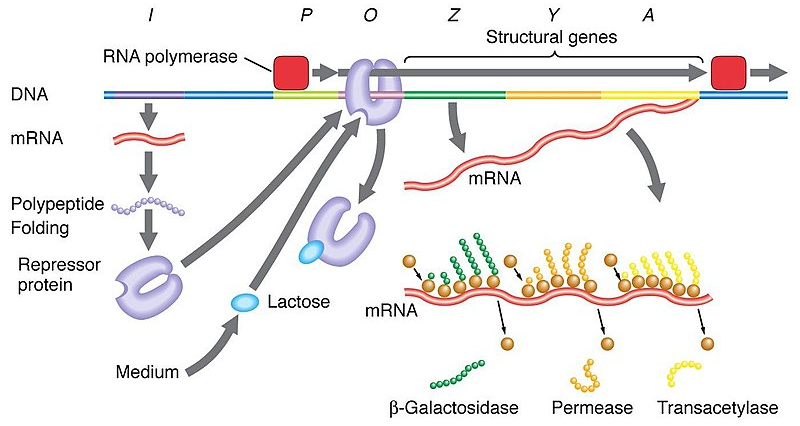
In the process, lactose acts as an inducer. The presence of lactose in the medium, it can activate the
regulatory gene. The inducer binds to the repressor gene and makes it inactive. Thus it is a negatively regulated process.
Thus, the correct answer is option C.
Note: Operons are present only in prokaryotes and are absent in eukaryotic organisms. The various types of operons are Lac operon involved in lactose degradation, Trp operon involved in tryptophan biosynthesis, and His operon involved in Histidine biosynthesis.
Complete step by step answer: The Lac-operon consists of three structural genes that code for different enzymes. The i gene is the one coding for the Repressor protein. The i in the name stands for Inducer, it has the ability to turn off the expression of the gene, and it prevents the formation of messenger RNA. This inhibits the process of transcription in the Lac operon. The z gene codes for beta-galactosidase, the gene responsible for the catalysis of the hydrolysis of lactose into glucose and galactose. The y gene is which codes for permease enzyme and facilitates and regulates the permeability of lactose into the cells. The gene codes for transacetylase enzyme, whose function is to facilitate the functioning of- galactosidase by transferring an acetyl group from Acetyl-CoA to galactosidase necessary for lactose catabolism.
In the process, lactose acts as an inducer. The presence of lactose in the medium, it can activate the
regulatory gene. The inducer binds to the repressor gene and makes it inactive. Thus it is a negatively regulated process.
Thus, the correct answer is option C.
Note: Operons are present only in prokaryotes and are absent in eukaryotic organisms. The various types of operons are Lac operon involved in lactose degradation, Trp operon involved in tryptophan biosynthesis, and His operon involved in Histidine biosynthesis.
Recently Updated Pages
Master Class 12 Business Studies: Engaging Questions & Answers for Success

Master Class 12 Chemistry: Engaging Questions & Answers for Success
Master Class 12 Biology: Engaging Questions & Answers for Success
Class 12 Question and Answer - Your Ultimate Solutions Guide
Master Class 11 English: Engaging Questions & Answers for Success
Master Class 11 Social Science: Engaging Questions & Answers for Success
Trending doubts
Which are the Top 10 Largest Countries of the World?
Draw a labelled sketch of the human eye class 12 physics CBSE
Differentiate between homogeneous and heterogeneous class 12 chemistry CBSE
Differentiate between Pyramid of energy and pyramid class 12 biology CBSE
Why is the cell called the structural and functional class 12 biology CBSE
Draw the diagram of the pyramid of energy Explain In class 12 biology CBSE