




Match the following columns: The point, at which chord \[x-y-1=0\] of the parabola, \[{{y}^{2}}=4x\], is bisected, is
(P) (-1, 2)
(Q) (3, 2)
(R) (-1, -5)
(S) (5, -2)
Answer
 Verified
574.5k+ views
Hint: Find the two quadratic equations in x and y separately with the help of the given equations of parabola and the line. Suppose A and B as \[\left( {{x}_{1}},{{y}_{1}} \right)\]and\[\left( {{x}_{2}},{{y}_{2}} \right)\]. So, \[\left( {{x}_{1}},{{x}_{2}} \right)\] will be roots of the quadratic formed in ‘x’ and \[\left( {{y}_{1}},{{y}_{2}} \right)\] will be roots of the quadratic formed in ‘y’. And the mid – point of any line – segment with \[\left( {{x}_{1}},{{y}_{1}} \right)\] and \[\left( {{x}_{2}},{{y}_{2}} \right)\] as extremes, is given as,
\[\left( \dfrac{{{x}_{1}}+{{x}_{2}}}{2},\dfrac{{{y}_{1}}+{{y}_{2}}}{2} \right)\]
Complete step by step answer:
Here, we are given a chord \[x-y-1=0\] of the parabola \[{{y}^{2}}=4x\] and we need to find the point on the chord, which bisects it. i.e., the mid – point of chord AB.
We can draw diagram with the help of all the information provided in the problem as,
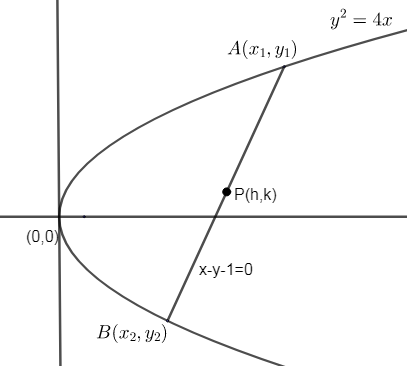
Let us suppose the mid – point of chord AB is P (h, k) and points A and B as \[\left( {{x}_{1}},{{y}_{1}} \right)\] and \[\left( {{x}_{2}},{{y}_{2}} \right)\] respectively,
We can find the points A and B by solving the equations of parabola and the line because they are the intersecting points of parabola and the given line.
So, given equations of line and parabola are,
\[\begin{align}
& x-y-1=0-(i) \\
& {{y}^{2}}=4x-(ii) \\
\end{align}\]
We can find value of x from the equation (i) as,
\[\begin{align}
& x-y-1=0 \\
&\Rightarrow x=y+1-(iii) \\
\end{align}\]
Now, we can put \[x=y+1\] to the equation (ii) and hence, we get,
\[\begin{align}
& {{y}^{2}}=4\left( y+1 \right) \\
& \Rightarrow {{y}^{2}}=4y+4 \\
&\Rightarrow {{y}^{2}}-4y-4=0-(iv) \\
\end{align}\]
As, the above equation in quadratic will give two values of y on solving it and that would be the ordinates of point A and B. i.e. \[{{y}_{1}}\] and \[{{y}_{2}}\] because we are finding intersection points of line and parabola, given in the problem.
So, \[{{y}_{1}}\] and \[{{y}_{2}}\] are two roots of equation (iv).
We know if any quadratic \[a{{x}^{2}}+bx+c=0\] has roots \[\alpha \]and \[\beta \], then relation between roots and coefficients of quadratic is given as,
\[\left. \begin{align}
& \alpha +\beta =\dfrac{-b}{a} \\
& \alpha \beta =\dfrac{c}{a} \\
\end{align} \right\}-(v)\]
So, form the equation (iv) and (v), we get,
\[\begin{align}
& {{y}_{1}}+{{y}_{2}}=\dfrac{4}{1}=4-(vi) \\
& {{y}_{1}}{{y}_{2}}=\dfrac{-4}{1}=-4-(vii) \\
\end{align}\]
Similarly, we can get value of ‘y’ from the equation (i) as,
\[\begin{align}
& x-y-1=0 \\
&\Rightarrow y=x-1-(viii) \\
\end{align}\]
Put the value of y in equation (ii). So, we get,
\[\begin{align}
& {{\left( x-1 \right)}^{2}}=4x \\
& \Rightarrow {{x}^{2}}+1-2x=4x \\
&\Rightarrow {{x}^{2}}-6x+1=0-(ix) \\
\end{align}\]
Similarly, \[\left( {{x}_{1}},{{x}_{2}} \right)\] should be the roots of the above equation.
Hence, from equation (v) and (ix), we get,
\[\left. \begin{align}
& {{x}_{1}}+{{x}_{2}}=6 \\
& {{x}_{1}}{{x}_{2}}=1 \\
\end{align} \right\}-(x)\]
Now, we know mid – point of a line segment with extremes at \[\left( {{m}_{1}},{{n}_{1}} \right)\] and \[\left( {{m}_{2}},{{n}_{2}} \right)\] is given by relation,
\[\left( \dfrac{{{m}_{1}}+{{n}_{1}}}{2},\dfrac{{{m}_{2}}+{{n}_{2}}}{2} \right)-(xi)\]
Hence, mid – point of A and B is given as,
\[\left( \dfrac{{{x}_{1}}+{{x}_{2}}}{2},\dfrac{{{y}_{1}}+{{y}_{2}}}{2} \right)\]
Put, \[{{x}_{1}}+{{x}_{2}}=6\] and \[{{y}_{1}}+{{y}_{2}}=4\] from the equations (vi) and (x). We get mid – point P as,
\[P\left( h,k \right)=\left( \dfrac{6}{2},\dfrac{4}{2} \right)\]
\[P\left( h,k \right)=\left( 3,2 \right)\]
Hence, we need to match the problem in the left column to Q (3, 2) from the second column.
Note: One may use parametric coordinates for points A and B as well. Parametric coordinates for parabola \[{{y}^{2}}=4ax\] can be given as supposed as \[\left( a{{t}^{2}},2at \right)\]. So, A and B can be supposed as \[\left( at_{1}^{2},2a{{t}_{1}} \right)\] and \[\left( at_{2}^{2},2a{{t}_{2}} \right)\]and hence put \[\left( a{{t}^{2}},2at \right)\] to the given line, \[x-y-1=0\] to get a quadratic in ‘t’ and hence get the middle points (where, put a = 1 in parametric coordinates) using the relation of roots of a quadratic and coefficients.
So, we get,
Mid – point \[=\left( \dfrac{a\left( t_{1}^{2}+t_{2}^{2} \right)}{2},\dfrac{2a\left( {{t}_{1}}+{{t}_{2}} \right)}{2} \right)\]
\[a{{t}^{2}}-2at-1=0\]
Put a = 1,
\[{{t}^{2}}-2t-1=0\]
Hence, \[{{t}_{1}}+{{t}_{2}}=2\]and \[{{t}_{1}}{{t}_{2}}=-1\].
Now, find the middle point of AB with this approach as well.
One may solve the quadratic \[{{y}^{2}}-4y-4=0\] and \[{{x}^{2}}-6x+1=0\] as well to get the exact intersection points to get the middle point of \[\left( h,k \right)\]. So, do not waste your time calculating intersecting points with the given quadratic equations.
\[\left( \dfrac{{{x}_{1}}+{{x}_{2}}}{2},\dfrac{{{y}_{1}}+{{y}_{2}}}{2} \right)\]
Complete step by step answer:
Here, we are given a chord \[x-y-1=0\] of the parabola \[{{y}^{2}}=4x\] and we need to find the point on the chord, which bisects it. i.e., the mid – point of chord AB.
We can draw diagram with the help of all the information provided in the problem as,
Let us suppose the mid – point of chord AB is P (h, k) and points A and B as \[\left( {{x}_{1}},{{y}_{1}} \right)\] and \[\left( {{x}_{2}},{{y}_{2}} \right)\] respectively,
We can find the points A and B by solving the equations of parabola and the line because they are the intersecting points of parabola and the given line.
So, given equations of line and parabola are,
\[\begin{align}
& x-y-1=0-(i) \\
& {{y}^{2}}=4x-(ii) \\
\end{align}\]
We can find value of x from the equation (i) as,
\[\begin{align}
& x-y-1=0 \\
&\Rightarrow x=y+1-(iii) \\
\end{align}\]
Now, we can put \[x=y+1\] to the equation (ii) and hence, we get,
\[\begin{align}
& {{y}^{2}}=4\left( y+1 \right) \\
& \Rightarrow {{y}^{2}}=4y+4 \\
&\Rightarrow {{y}^{2}}-4y-4=0-(iv) \\
\end{align}\]
As, the above equation in quadratic will give two values of y on solving it and that would be the ordinates of point A and B. i.e. \[{{y}_{1}}\] and \[{{y}_{2}}\] because we are finding intersection points of line and parabola, given in the problem.
So, \[{{y}_{1}}\] and \[{{y}_{2}}\] are two roots of equation (iv).
We know if any quadratic \[a{{x}^{2}}+bx+c=0\] has roots \[\alpha \]and \[\beta \], then relation between roots and coefficients of quadratic is given as,
\[\left. \begin{align}
& \alpha +\beta =\dfrac{-b}{a} \\
& \alpha \beta =\dfrac{c}{a} \\
\end{align} \right\}-(v)\]
So, form the equation (iv) and (v), we get,
\[\begin{align}
& {{y}_{1}}+{{y}_{2}}=\dfrac{4}{1}=4-(vi) \\
& {{y}_{1}}{{y}_{2}}=\dfrac{-4}{1}=-4-(vii) \\
\end{align}\]
Similarly, we can get value of ‘y’ from the equation (i) as,
\[\begin{align}
& x-y-1=0 \\
&\Rightarrow y=x-1-(viii) \\
\end{align}\]
Put the value of y in equation (ii). So, we get,
\[\begin{align}
& {{\left( x-1 \right)}^{2}}=4x \\
& \Rightarrow {{x}^{2}}+1-2x=4x \\
&\Rightarrow {{x}^{2}}-6x+1=0-(ix) \\
\end{align}\]
Similarly, \[\left( {{x}_{1}},{{x}_{2}} \right)\] should be the roots of the above equation.
Hence, from equation (v) and (ix), we get,
\[\left. \begin{align}
& {{x}_{1}}+{{x}_{2}}=6 \\
& {{x}_{1}}{{x}_{2}}=1 \\
\end{align} \right\}-(x)\]
Now, we know mid – point of a line segment with extremes at \[\left( {{m}_{1}},{{n}_{1}} \right)\] and \[\left( {{m}_{2}},{{n}_{2}} \right)\] is given by relation,
\[\left( \dfrac{{{m}_{1}}+{{n}_{1}}}{2},\dfrac{{{m}_{2}}+{{n}_{2}}}{2} \right)-(xi)\]
Hence, mid – point of A and B is given as,
\[\left( \dfrac{{{x}_{1}}+{{x}_{2}}}{2},\dfrac{{{y}_{1}}+{{y}_{2}}}{2} \right)\]
Put, \[{{x}_{1}}+{{x}_{2}}=6\] and \[{{y}_{1}}+{{y}_{2}}=4\] from the equations (vi) and (x). We get mid – point P as,
\[P\left( h,k \right)=\left( \dfrac{6}{2},\dfrac{4}{2} \right)\]
\[P\left( h,k \right)=\left( 3,2 \right)\]
Hence, we need to match the problem in the left column to Q (3, 2) from the second column.
Note: One may use parametric coordinates for points A and B as well. Parametric coordinates for parabola \[{{y}^{2}}=4ax\] can be given as supposed as \[\left( a{{t}^{2}},2at \right)\]. So, A and B can be supposed as \[\left( at_{1}^{2},2a{{t}_{1}} \right)\] and \[\left( at_{2}^{2},2a{{t}_{2}} \right)\]and hence put \[\left( a{{t}^{2}},2at \right)\] to the given line, \[x-y-1=0\] to get a quadratic in ‘t’ and hence get the middle points (where, put a = 1 in parametric coordinates) using the relation of roots of a quadratic and coefficients.
So, we get,
Mid – point \[=\left( \dfrac{a\left( t_{1}^{2}+t_{2}^{2} \right)}{2},\dfrac{2a\left( {{t}_{1}}+{{t}_{2}} \right)}{2} \right)\]
\[a{{t}^{2}}-2at-1=0\]
Put a = 1,
\[{{t}^{2}}-2t-1=0\]
Hence, \[{{t}_{1}}+{{t}_{2}}=2\]and \[{{t}_{1}}{{t}_{2}}=-1\].
Now, find the middle point of AB with this approach as well.
One may solve the quadratic \[{{y}^{2}}-4y-4=0\] and \[{{x}^{2}}-6x+1=0\] as well to get the exact intersection points to get the middle point of \[\left( h,k \right)\]. So, do not waste your time calculating intersecting points with the given quadratic equations.
Recently Updated Pages
Master Class 11 Computer Science: Engaging Questions & Answers for Success

Master Class 11 Business Studies: Engaging Questions & Answers for Success
Master Class 11 Economics: Engaging Questions & Answers for Success
Master Class 11 English: Engaging Questions & Answers for Success
Master Class 11 Maths: Engaging Questions & Answers for Success
Master Class 11 Biology: Engaging Questions & Answers for Success
Trending doubts
One Metric ton is equal to kg A 10000 B 1000 C 100 class 11 physics CBSE
There are 720 permutations of the digits 1 2 3 4 5 class 11 maths CBSE
Discuss the various forms of bacteria class 11 biology CBSE
Draw a diagram of a plant cell and label at least eight class 11 biology CBSE
State the laws of reflection of light
Explain zero factorial class 11 maths CBSE