




Match the columns and find correct options
Column I Column II a Basal p Dianthus b Free central q pea C Parietal r Lemon D Axile s Marigold E Marginal t Argemone
(a) a-p, b-q, c-r, d-s, e-t
(b) a-s, b-p, c-t, d-r, e-q
(c) a-q, b-r, c-s, d-t, e-p
(d) a-t, b-s, c-r, d-q, e-p
(e) a-s, b-r, c-t, d-p, e-q
| Column I Column II | |||
| a | Basal | p | Dianthus |
| b | Free central | q | pea |
| C | Parietal | r | Lemon |
| D | Axile | s | Marigold |
| E | Marginal | t | Argemone |
Answer
 Verified
639.3k+ views
Hint: The placenta is a special type of tissue in flowering plants that connects the ovules to the ovary.
Complete answer:
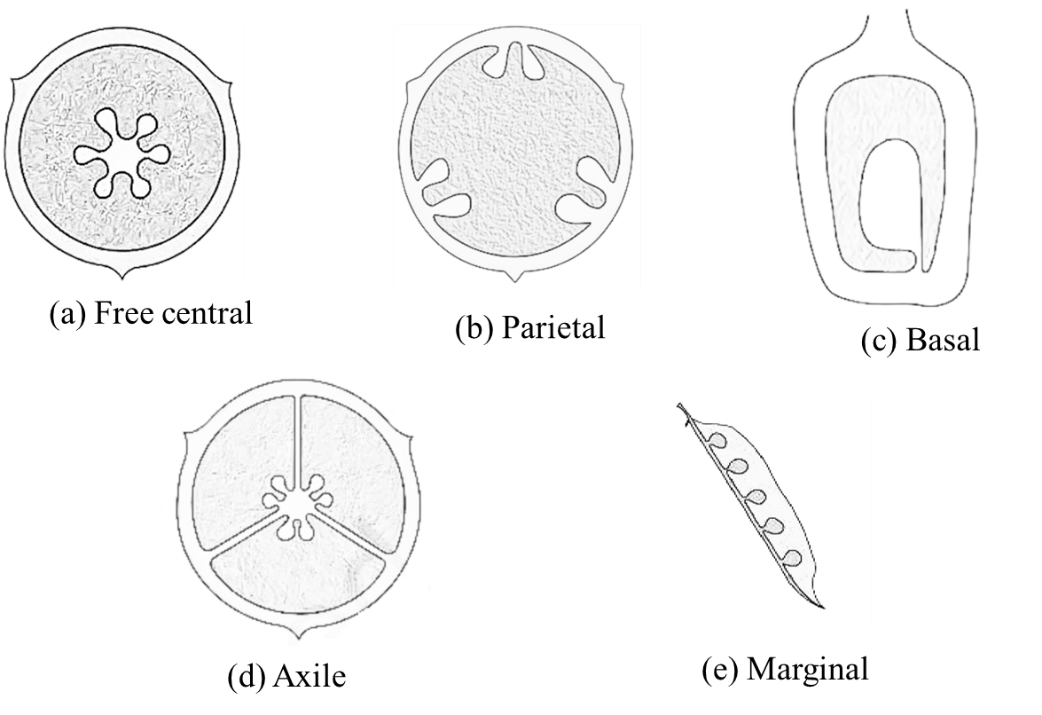
Placentation can be described as the mode of arrangement of ovules on the placenta inside the ovary. There are different types of placentation in plants that include basal, parietal, axile, free central, and marginal.
Types of placentation:
- Axile: This type of placentation is found in bicarpellary to multicarpellary syncarpous ovary. The carpel fuse forms a central axis and ovules are arranged on this axis. Examples of axile placentation include Hibiscus, lemon, tomato, lilly.
- Basal: This type of placenta is found in mono to multicarpellary, syncarpous ovary. The placenta develops at the base of the ovary and generally, a single ovule is attached to it. Examples are sunflower, daisy, marigold.
- Marginal: It is found in the mainly monocarpellary unilocular ovary. In this type, the placenta forms a ridge along the ventral side of the ovary and the ovules are arranged on this ridge forming two rows. An example includes pea.
- Parietal: This type of placenta is found in bicarpellary to multicarpellary syncarpous ovary. A false septum divided the ovary into two chambers. Example: mustard.
- Free central: In this type of placenta, ovules are arranged on the central axis due to the degradation of the false septum. Example: dianthus.
So, the correct answer is ‘a-s, b-p, c-t, d-r, e-q’
Note:
- In the apocarpous ovary, there is typically a single line of placentation in each ovary and more than one free carpel is present.
- In the syncarpous ovary, the lines of placentation can be regularly spaced along the wall of the ovary or near the center of the ovary. In this ovary, more than one carpel is found which are fused.
Complete answer:
Placentation can be described as the mode of arrangement of ovules on the placenta inside the ovary. There are different types of placentation in plants that include basal, parietal, axile, free central, and marginal.
Types of placentation:
- Axile: This type of placentation is found in bicarpellary to multicarpellary syncarpous ovary. The carpel fuse forms a central axis and ovules are arranged on this axis. Examples of axile placentation include Hibiscus, lemon, tomato, lilly.
- Basal: This type of placenta is found in mono to multicarpellary, syncarpous ovary. The placenta develops at the base of the ovary and generally, a single ovule is attached to it. Examples are sunflower, daisy, marigold.
- Marginal: It is found in the mainly monocarpellary unilocular ovary. In this type, the placenta forms a ridge along the ventral side of the ovary and the ovules are arranged on this ridge forming two rows. An example includes pea.
- Parietal: This type of placenta is found in bicarpellary to multicarpellary syncarpous ovary. A false septum divided the ovary into two chambers. Example: mustard.
- Free central: In this type of placenta, ovules are arranged on the central axis due to the degradation of the false septum. Example: dianthus.
So, the correct answer is ‘a-s, b-p, c-t, d-r, e-q’
Note:
- In the apocarpous ovary, there is typically a single line of placentation in each ovary and more than one free carpel is present.
- In the syncarpous ovary, the lines of placentation can be regularly spaced along the wall of the ovary or near the center of the ovary. In this ovary, more than one carpel is found which are fused.
Recently Updated Pages
Master Class 12 Economics: Engaging Questions & Answers for Success

Master Class 12 English: Engaging Questions & Answers for Success
Master Class 12 Social Science: Engaging Questions & Answers for Success
Master Class 12 Maths: Engaging Questions & Answers for Success
Master Class 12 Physics: Engaging Questions & Answers for Success
Master Class 11 Social Science: Engaging Questions & Answers for Success
Trending doubts
One Metric ton is equal to kg A 10000 B 1000 C 100 class 11 physics CBSE
Difference Between Prokaryotic Cells and Eukaryotic Cells
Find the value of the expression given below sin 30circ class 11 maths CBSE
Two of the body parts which do not appear in MRI are class 11 biology CBSE
Draw a diagram of nephron and explain its structur class 11 biology CBSE
10 examples of friction in our daily life