




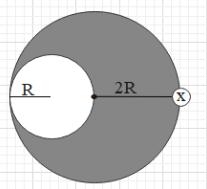
Mass of bigger disc having radius $2R$ is $M$. A disc of radius $R$ is cut from a bigger disc as shown in figure. Moment of inertia of disc about an axis passing through periphery and perpendicular to plane (shown in figure) is :-
Answer
 Verified
587.7k+ views
Hint:First find the moment of inertia of the whole disc (without the cavity) about the given axis by using the parallel axes theorem. Then find the mass of the smaller disc that is being cut out and calculate its moment of inertia about the same axes. Later, subtract the two to find the required quantity.
Formula used:
$I=\dfrac{m{{r}^{2}}}{2}$
where I is the moment of inertia of a disc of mass m and radius r, about the axis of the disc.
$\sigma =\dfrac{m}{A}$
where $\sigma $ is areal mass density of a planar body of mass m and area A.
Complete step by step answer:
Here, to find the moment of inertia of the given system (disc) about the axis passing through periphery and perpendicular to plane we shall subtract the moment of inertia of the smaller disc (${{I}_{2}}$) (the cavity) from the moment of inertia of the whole disc (${{I}_{1}}$) (i.e. without including the cavity).
i.e. $I={{I}_{1}}-{{I}_{2}}$ …. (i)
The moment of inertia of the bigger disc about its own axis is equal to ${{I}_{B}}=\dfrac{M{{(2R)}^{2}}}{2}=2M{{R}^{2}}$.
Then by applying parallel axes theorem we get that moment of inertia of the bigger disc about an axis passing through periphery and perpendicular to plane is equal to ${{I}_{1}}={{I}_{B}}+M{{(2R)}^{2}}$
(here $d=2R$)
Then,
${{I}_{1}}=2M{{R}^{2}}+4M{{R}^{2}}
\Rightarrow{{I}_{1}}=6M{{R}^{2}}$
Let us now find the mass of the smaller disc (m). For this let us assume that the disc has uniform mass distribution and the mass density of both the discs is the same.Therefore,
$\dfrac{M}{\pi {{(2R)}^{2}}}=\dfrac{m}{\pi {{R}^{2}}}$
$\Rightarrow m=\dfrac{M}{4}$
Therefore, the moment of inertia of the smaller disc about its own axis is equal to ${{I}_{s}}=\dfrac{\left( \dfrac{M}{4} \right){{R}^{2}}}{2}=\dfrac{M{{R}^{2}}}{8}$
Then by applying parallel axes theorem we get that moment of inertia of the smaller disc about an axis passing through periphery and perpendicular to plane is equal to ${{I}_{2}}={{I}_{s}}+\left( \dfrac{M}{4} \right){{(3R)}^{2}}$
(here, $d=3R$)
Then,
$\Rightarrow {{I}_{2}}=\dfrac{M{{R}^{2}}}{8}+\left( \dfrac{M}{4} \right){{(3R)}^{2}}$
$\Rightarrow {{I}_{2}}=\dfrac{19M{{R}^{2}}}{8}$
Now, substitute the values in (i).
$\Rightarrow I=6M{{R}^{2}}-\dfrac{19M{{R}^{2}}}{8}\\
\therefore I=\dfrac{29M{{R}^{2}}}{8}$
Therefore, the moment of inertia of the given system about the given axis is equal to $\dfrac{29M{{R}^{2}}}{8}$.
Note:Some students may think how did we subtract the moment of inertia of a smaller disc from the moment of inertia of the whole disc.Note that moment of inertia is scalar quantity. Moment of inertia of the body is contributed by all small elements of the body. Therefore, if there is a cavity in the body we first find the moment of inertia of the whole body and then subtract the contributions by the small elements that were present in that cavity.
Formula used:
$I=\dfrac{m{{r}^{2}}}{2}$
where I is the moment of inertia of a disc of mass m and radius r, about the axis of the disc.
$\sigma =\dfrac{m}{A}$
where $\sigma $ is areal mass density of a planar body of mass m and area A.
Complete step by step answer:
Here, to find the moment of inertia of the given system (disc) about the axis passing through periphery and perpendicular to plane we shall subtract the moment of inertia of the smaller disc (${{I}_{2}}$) (the cavity) from the moment of inertia of the whole disc (${{I}_{1}}$) (i.e. without including the cavity).
i.e. $I={{I}_{1}}-{{I}_{2}}$ …. (i)
The moment of inertia of the bigger disc about its own axis is equal to ${{I}_{B}}=\dfrac{M{{(2R)}^{2}}}{2}=2M{{R}^{2}}$.
Then by applying parallel axes theorem we get that moment of inertia of the bigger disc about an axis passing through periphery and perpendicular to plane is equal to ${{I}_{1}}={{I}_{B}}+M{{(2R)}^{2}}$
(here $d=2R$)
Then,
${{I}_{1}}=2M{{R}^{2}}+4M{{R}^{2}}
\Rightarrow{{I}_{1}}=6M{{R}^{2}}$
Let us now find the mass of the smaller disc (m). For this let us assume that the disc has uniform mass distribution and the mass density of both the discs is the same.Therefore,
$\dfrac{M}{\pi {{(2R)}^{2}}}=\dfrac{m}{\pi {{R}^{2}}}$
$\Rightarrow m=\dfrac{M}{4}$
Therefore, the moment of inertia of the smaller disc about its own axis is equal to ${{I}_{s}}=\dfrac{\left( \dfrac{M}{4} \right){{R}^{2}}}{2}=\dfrac{M{{R}^{2}}}{8}$
Then by applying parallel axes theorem we get that moment of inertia of the smaller disc about an axis passing through periphery and perpendicular to plane is equal to ${{I}_{2}}={{I}_{s}}+\left( \dfrac{M}{4} \right){{(3R)}^{2}}$
(here, $d=3R$)
Then,
$\Rightarrow {{I}_{2}}=\dfrac{M{{R}^{2}}}{8}+\left( \dfrac{M}{4} \right){{(3R)}^{2}}$
$\Rightarrow {{I}_{2}}=\dfrac{19M{{R}^{2}}}{8}$
Now, substitute the values in (i).
$\Rightarrow I=6M{{R}^{2}}-\dfrac{19M{{R}^{2}}}{8}\\
\therefore I=\dfrac{29M{{R}^{2}}}{8}$
Therefore, the moment of inertia of the given system about the given axis is equal to $\dfrac{29M{{R}^{2}}}{8}$.
Note:Some students may think how did we subtract the moment of inertia of a smaller disc from the moment of inertia of the whole disc.Note that moment of inertia is scalar quantity. Moment of inertia of the body is contributed by all small elements of the body. Therefore, if there is a cavity in the body we first find the moment of inertia of the whole body and then subtract the contributions by the small elements that were present in that cavity.
Recently Updated Pages
Master Class 11 English: Engaging Questions & Answers for Success

Master Class 11 Social Science: Engaging Questions & Answers for Success
Master Class 11 Maths: Engaging Questions & Answers for Success
Master Class 11 Biology: Engaging Questions & Answers for Success
Master Class 11 Physics: Engaging Questions & Answers for Success
Master Class 11 Chemistry: Engaging Questions & Answers for Success
Trending doubts
One Metric ton is equal to kg A 10000 B 1000 C 100 class 11 physics CBSE
Difference Between Prokaryotic Cells and Eukaryotic Cells
Find the value of the expression given below sin 30circ class 11 maths CBSE
Two of the body parts which do not appear in MRI are class 11 biology CBSE
Draw a diagram of a plant cell and label at least eight class 11 biology CBSE
10 examples of friction in our daily life