




Marshall’s acid is:
(A) ${{\text{H}}_{\text{2}}}{\text{S}}{{\text{O}}_{\text{4}}}$
(B) ${{\text{H}}_{\text{2}}}{{\text{S}}_2}{{\text{O}}_{\text{7}}}$
(C) ${{\text{H}}_{\text{2}}}{{\text{S}}_2}{{\text{O}}_{\text{3}}}$
(D) ${{\text{H}}_{\text{2}}}{{\text{S}}_2}{{\text{O}}_8}$
Answer
 Verified
609.9k+ views
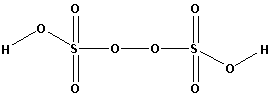
Hint: Marshall’s acid is also known as peroxydisulfuric acid. Peroxy indicates that the ${\text{O}} - {\text{O}}$ linkage is present.
Step by step answer: ${{\text{H}}_{\text{2}}}{\text{S}}{{\text{O}}_{\text{4}}}$ is known as sulphuric acid. Sulphuric acid is also known as hydrogen sulphate or oil of vitriol.
Thus, ${{\text{H}}_{\text{2}}}{\text{S}}{{\text{O}}_{\text{4}}}$ is not Marshall’s acid.
Thus, option (A) is not correct.
${{\text{H}}_{\text{2}}}{{\text{S}}_2}{{\text{O}}_{\text{7}}}$ is known as disulphuric acid. Disulphuric acid is also known as pyrosulphuric acid.
Thus, ${{\text{H}}_{\text{2}}}{{\text{S}}_2}{{\text{O}}_{\text{7}}}$ is not Marshall’s acid.
Thus, option (B) is not correct.
${{\text{H}}_{\text{2}}}{{\text{S}}_2}{{\text{O}}_{\text{3}}}$ is known as thiosulphuric acid. Thiosulphuric acid is also known as hydroxidioxidosulfido sulphate.
Thus, ${{\text{H}}_{\text{2}}}{{\text{S}}_2}{{\text{O}}_{\text{3}}}$ is not Marshall’s acid.
Thus, option (C) is not correct.
${{\text{H}}_{\text{2}}}{{\text{S}}_2}{{\text{O}}_8}$ is known as peroxydisulfuric acid. Peroxydisulfuric acid is also known as Marshall’s acid.
Thus, ${{\text{H}}_{\text{2}}}{{\text{S}}_2}{{\text{O}}_8}$ is Marshall’s acid.
Thus, the correct option is (D) ${{\text{H}}_{\text{2}}}{{\text{S}}_2}{{\text{O}}_8}$.
Additional Information:
-Marshall’s acid is an inorganic compound. It is solid and colourless in appearance. It is a powerful oxidising agent. The salts of Marshall’s acid are industrially important.
-Marshall’s acid is named after Professor Hugh Marshall who invented it.
-Ways of production of Marshall’s acid are as follows:
-From potassium sulphate or ammonium sulphate in acidic solution.
-Oxidation of oleum with hydrogen peroxide or ozone.
-Electrolysing aqueous solution of sulphate ions.
-Reaction of chlorosulfonic acid with hydrogen peroxide.
-Electrolysis of sulphuric acid with platinum electrodes at high voltage.
Note: Marshall’s acid in structural terms is written as ${\text{H}}{{\text{O}}_{\text{3}}}{\text{SOOS}}{{\text{O}}_{\text{3}}}{\text{H}}$. The oxidation state of sulphur is ${\text{ + 6}}$.
The structure of Marshall’s acid is as follows:
Peroxy indicates that the ${\text{O}} - {\text{O}}$ linkage is present.
Step by step answer: ${{\text{H}}_{\text{2}}}{\text{S}}{{\text{O}}_{\text{4}}}$ is known as sulphuric acid. Sulphuric acid is also known as hydrogen sulphate or oil of vitriol.
Thus, ${{\text{H}}_{\text{2}}}{\text{S}}{{\text{O}}_{\text{4}}}$ is not Marshall’s acid.
Thus, option (A) is not correct.
${{\text{H}}_{\text{2}}}{{\text{S}}_2}{{\text{O}}_{\text{7}}}$ is known as disulphuric acid. Disulphuric acid is also known as pyrosulphuric acid.
Thus, ${{\text{H}}_{\text{2}}}{{\text{S}}_2}{{\text{O}}_{\text{7}}}$ is not Marshall’s acid.
Thus, option (B) is not correct.
${{\text{H}}_{\text{2}}}{{\text{S}}_2}{{\text{O}}_{\text{3}}}$ is known as thiosulphuric acid. Thiosulphuric acid is also known as hydroxidioxidosulfido sulphate.
Thus, ${{\text{H}}_{\text{2}}}{{\text{S}}_2}{{\text{O}}_{\text{3}}}$ is not Marshall’s acid.
Thus, option (C) is not correct.
${{\text{H}}_{\text{2}}}{{\text{S}}_2}{{\text{O}}_8}$ is known as peroxydisulfuric acid. Peroxydisulfuric acid is also known as Marshall’s acid.
Thus, ${{\text{H}}_{\text{2}}}{{\text{S}}_2}{{\text{O}}_8}$ is Marshall’s acid.
Thus, the correct option is (D) ${{\text{H}}_{\text{2}}}{{\text{S}}_2}{{\text{O}}_8}$.
Additional Information:
-Marshall’s acid is an inorganic compound. It is solid and colourless in appearance. It is a powerful oxidising agent. The salts of Marshall’s acid are industrially important.
-Marshall’s acid is named after Professor Hugh Marshall who invented it.
-Ways of production of Marshall’s acid are as follows:
-From potassium sulphate or ammonium sulphate in acidic solution.
-Oxidation of oleum with hydrogen peroxide or ozone.
-Electrolysing aqueous solution of sulphate ions.
-Reaction of chlorosulfonic acid with hydrogen peroxide.
-Electrolysis of sulphuric acid with platinum electrodes at high voltage.
Note: Marshall’s acid in structural terms is written as ${\text{H}}{{\text{O}}_{\text{3}}}{\text{SOOS}}{{\text{O}}_{\text{3}}}{\text{H}}$. The oxidation state of sulphur is ${\text{ + 6}}$.
The structure of Marshall’s acid is as follows:
Peroxy indicates that the ${\text{O}} - {\text{O}}$ linkage is present.
Recently Updated Pages
Master Class 12 Economics: Engaging Questions & Answers for Success

Master Class 12 English: Engaging Questions & Answers for Success
Master Class 12 Social Science: Engaging Questions & Answers for Success
Master Class 12 Maths: Engaging Questions & Answers for Success
Master Class 12 Physics: Engaging Questions & Answers for Success
Master Class 9 General Knowledge: Engaging Questions & Answers for Success
Trending doubts
Explain the Treaty of Vienna of 1815 class 10 social science CBSE
Why is it 530 pm in india when it is 1200 afternoon class 10 social science CBSE
What is the full form of POSCO class 10 social science CBSE
Define Potential, Developed, Stock and Reserved resources
The speaker of the Lok Sabha is elected by the APresident class 10 social science CBSE
Complete the sentence with the most appropriate word class 10 english CBSE